Friday, August 4, 2023

Kenilworth Aquatic Gardens

Along the banks of the Anacostia River in the District of Columbia is the Kenilworth Aquatic Gardens. It's operated by the the National Park Service.  In mid-July, it's predictably hot and humid, so I arrived when the gates opened at 8:00 a.m.  As you can see at the right,  it does get crowded around 10:30 am, when I'm leaving for the day. 

The main attraction for me is the large number of water lotus in bloom.  The huge flower is matched by the disc-like seed pods that appears later.

Photographing the water lotus has its difficulties.  They grow in large, shallow water pools that are easy to admire, but much more difficult to photograph from dry land.


Luckily, on this visit there were no mosquitos at add to the challenge.  I find the new flower buds very appealing, if I can find an uncluttered setting with a bit of early morning light.

Another favorite setting is the combination of a new bud plus a fully open flower.

Mixed in with the lotus are pools with water lilies.


Water lilies are more challenging because they are not standing on a tall stalk at my eye level, and frankly, getting down to their level muddied my knees, and attracted bemused looks from non-photographers.  (I'm used to it.)


There was another unexpected flowering plant in the shallow water, identified by my friend Rosemarie Parker as spider lily.  It's appearance suggested tome "orchid", so I had to once again get down low to capture its beauty.

I was rather pleased with the resulting image.

An added bonus to my early bird arrival was capturing one of only three parking spaces under some shade trees.  

Paul Schmitt


Wednesday, June 28, 2023

Snapshots of Prince Edward Island

The eight mile long Confederation Bridge was opened in 1997.  The idea of a bridge was heatedly debated before a referendum passed by 59.4%.  It transformed life on the island and eventually gained widespread approval.  We arrived at the bridge on a windy, rainy morning.  New visitors frequently stop at the viewpoint on Cape Jourimain as these young people did.  The ride across the bridge is smooth, but we'd have liked to have had a clearer view.


Once on the island, one soon sees hallmarks of this small province with only about 150,000 residents.  The sea is always nearby, so a great variety of lighthouses are seen.   This is Cape Bear Lighthouse where the first radio message was received from the stricken Titanic.

Largely, the lighthouses are wooden.  The island lacks hard stone that is so often used elsewhere.

Two more constants are flowering lupines and small fishing harbors.  The lupines are widespread.


There is abundant seafood to feast upon.  This lunch featured a fresh haddock sandwich and bay scallop tacos, both with PEI potato salad and cabbage slaw.  You can't drive more than 5 kilometers without passing a field of potatoes. 

Another certainty is friendly people.  Pam and I agree that the residents are another hallmark.

Our first three days were marked by cloudy and breezy days - not ideal for photography but fine to explore.  On several occasions, we visited locations marked by seaside tragedies.  This is Covehead Lighthouse.

 
The Yankee Gale of  October 3, 1851 claimed 74 ships and 150 lives.  The fishing fleet was calmed in the evening and unable to return to harbor.  In the night, the gale drove the fleet onshore with no mercy.
 
For most of our days on PEI, I searched for that perfect display of lupines.  There was this small bouquet framing a grave marker next to a rural church.  Not many are colored pink so I liked these.

My luck changed when we visited an abandoned shipyard at Murray Head across the bay from Georgetown.  Wow, three lupine colors in one place.
 
While researching places to visit, I discovered a number of "Pioneer Cemetery" listings.   There was one near Cavendish called "Yankee Hill Pioneer Cemetery".  It also had a lighthouse nearby.  Walking in on the private road, we were greeted by the owner who was in the process of clearing the trail to the side.   Bruce highlighted the history and paused mowing while we explored.


These are the stones for Mary Pickering (1792-1878) and Thomas Pickering (1790-1878).  They had eleven children.  He was a farmer, mariner and shipbuilder. 

Another was a marker for George McKay, a native of Durness, Scotland.  (1763-1816)

Bruce is building a home on Yankee Hill with a ocean view that includes a view of this lighthouse on London Bay.

It may seem unusual to include cemeteries in an itinerary, but in Atlantic Canada, they are  a continuing link to people's pasts. We stopped at the Brackley Beach Cemetery on the north shore where two ladies were unloading trays of flowers for placing on markers of family members.   In Cavendish Cemetery, this marker honoring mariners lost in earlier mentioned Yankee Gail of 1851.  At a cemetery in Georgetown, this marker remembers a boy lost at age four.  Note the childhood ornaments for those who died young.  I've seen this elsewhere.

At our last hotel in Montague, I woke for the very early sunrise.  The highway bridge was lined with planters full of petunias.

The sunrise was framed with three large cast sculptures of cormorants.


It was now time to head home.  Again, we stopped at the Confederation Bridge for one last look.


We paid our $50.25 toll and returned home..

One last comment is for golfers.  The island has many lush courses that could be imagined to be in Scotland- rolling hills, sandy bunkers and picture perfect greens.  We met several people touring across the island for a new course each day. Sadly, I was terrible at golf.

Paul Schmitt

Monday, June 12, 2023

Sauntering in the Shenandoahs

Now these mountains are our Holy Land, and we ought to saunter through them reverently, not 'hike' through them.       

                                                John Muir

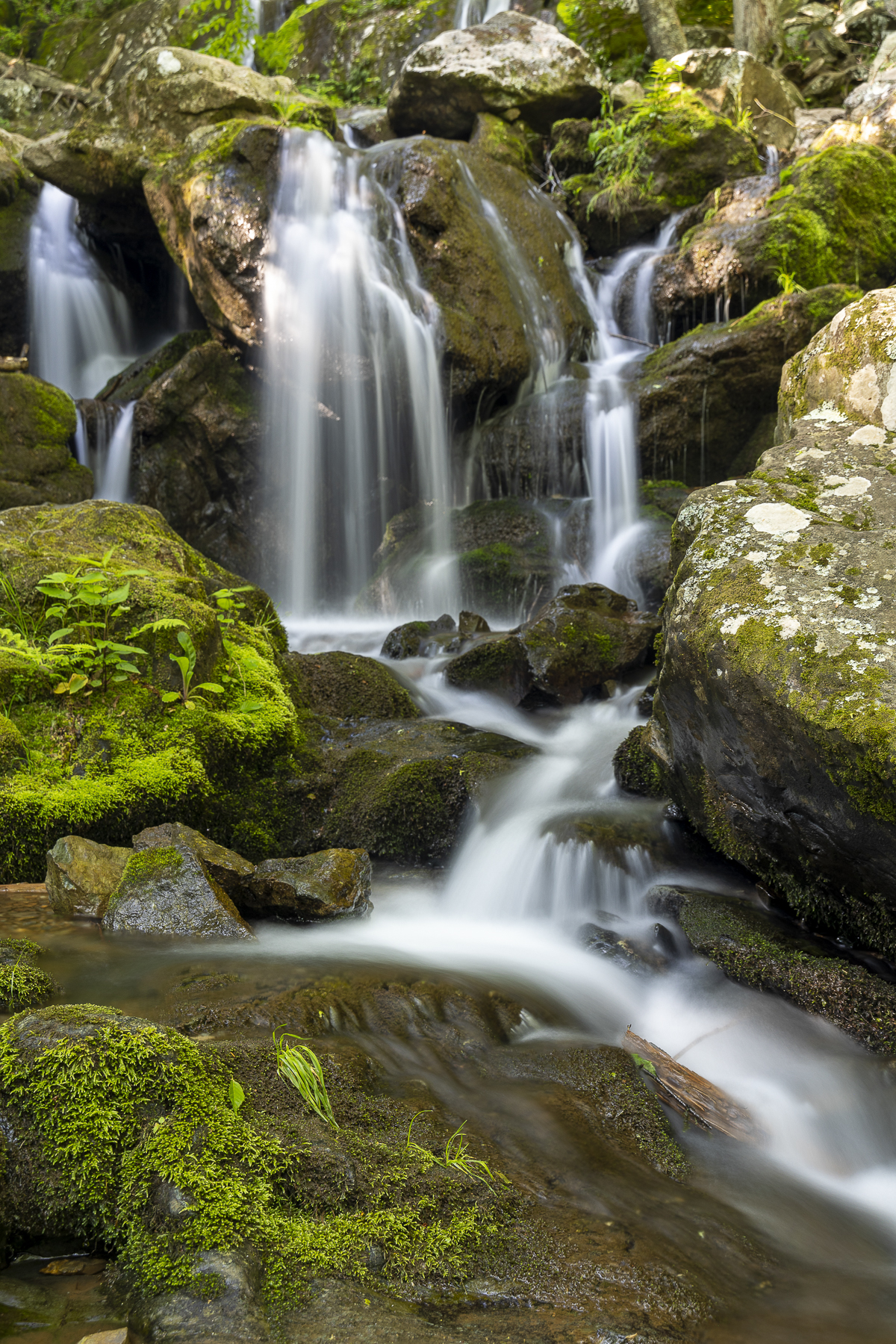
Here are a few photographs which appealed to my eye at various places along the Skyline Drive, Virginia.  True to Muir's idea, I tried to keep my pace slower.  First are two falls found in Dark Hollow near Big Meadows.   The upper falls has several drops on it's way to the viewer:

I chose to include the lower three.  What most appealed to me was the mossy covered rocks framing the milky white water.   Just below this was another smaller scene that I labored to frame while simultaneously keeping my boots dry.

Why use such a slow exposure?   The slow, steady movement down Dark Hollow stream was peaceful. So, the silky water matched my feelings.  There is no one right shutter speed, but there can be one that conveys how I perceive the motion.

On Limberlost trail, I hoped for some wildflowers.   This fascinating flower seems related to Columbine, but the color seems unusual.  The small spider makes it special.   It appears in only one of the seven images in the stack necessary to capture sharp focus on the entire flower.


Also on the Limberlost trail there was a Pink Lady's Slipper, Cypripedium acaule.  These are truly a wild orchid since there has never been a success raising them from seed.  So, every one I see is exciting.


This was a big surprise given the large population of whitetail deer in the national park.  There was sign of some browsing on some plants.  There has been no deer hunting in the national park since it inception in the 1930s, and in my personal opinion the forest under story is greatly diminished in its diversity.

There were also some "critters" in the park that were of interest.  I value a singing Indigo Bunting as always a treat.  There were dozens at several overlooks, and a few that perched in an uncluttered place  to perform.


As I drove the Skyline Drive,  giant yellow swallowtail butterflies soared past, and sometimes found suitable blooming flowers to feed upon.  On one occasion, one of them found a spot at an overlook where one could safely park.  Hesitate, and they are soaring off to a distant place.


At another stop, an Eastern Towhee jumped into song (as the males are so oft to do.)  They really throw everything into the song.  Again, the trick is to wait for an uncluttered perch.

There was a heavy fog one morning, or perhaps the mountain ridges were just in the clouds?  There is a softness to the light and a quietness that mutes any traffic.   Only a little yellow color was revealed.  This took me back to foggy morning scenes around 1953 at my uncle's farm in southern Indiana.  These were the same -Moth mullein- yellow flowers. 


Finally, the distant hilltops and ridges in the Shenandoah are best seen in monochrome. 


Life is old there, or so the saying suggests. Ninety years with no logging produces some massive trees.  But I saw few sapling trees to replace them.  I wonder what the future will bring?

Paul Schmitt
Saturday, May 27, 2023

Three Favorites from May 2023

It's time to wrap up May with three bird images that have some meaning to me.  First, is an elegant Cedar Waxwing that was part of a group of about five that were gleaning caterpillars incredibly close to my parked car.

Waxwings are a huge treat when they appear.  Their contact singing is so extremely high pitched that any background noise will surely leave it disguised.  They move through the cover like ghosts.  

On the same morning, a pair of Brown Thrashers appeared.  Not shy like waxwings: rather bold in human terms.  More often they are in grass fields, so finding this one perched was unusual. It appeared to be surveying the grasses for insects.

The thrashers generally nest in a series of dense thorn bushes.

Bobolinks are always a subject for my May outings. It seemed to be an off year for them and most outings were failures, especially in the quest for flight images.  This boy did stop to sing in the hope that the females had arrived from South America.  The rich yellow cap on the head plus the bold black and white patterns on the back (not visible) are supplemented by their bubbling song. Look at the scalloped ends on the tail feathers. 


Two weeks later, all of the singing was over and the ladies were in their ground nests. 

I noted the black and white patterns on the back.  Well, the otherwise inadequate flight image on the left does illustrate one more reason I track these boys in May.  This was at 1/2000 second, and I still couldn't precisely track his flight.  Next year!


Next for me is June in Shenandoah National Park.

Paul


Thursday, May 18, 2023

Mundy Wildflower Garden- Slowing Down to See

It's been twenty years since I discovered the Mundy Wildflower Garden on the Cornell campus. The rich array of spring blooms captured my imagination. Soon I was working on a project to upgrade the  images posted at the welcoming "Bloom Board."  A sense of urgency drove me as I worked to find artful compositions that spoke of the beauty.  No mug shots! I said.  Over five hundred quality images were put on file; but in retrospect, I needed to slow down in order to realize the emotions that I was feeling. 

The urgency is now controlled.  Honestly, every time I get low on the ground for an intimate view, well, my cranky knees also work to slow my pace.  There are only three subjects for this message.  In addition to appreciating their beauty, I hope there is some useful insight for even simple phone captures.

The first subject is a small pod of Wild Geraniums. This image is different from what I made twenty years ago in two respects.   First, I paid more attention to the colors in the scene and to the location of the supporting yellows especially.  Twenty years ago, the distant colors were not carefully placed above and below the blue-violet blooms. I could have done better years before.  Notice how the leaf at the bottom shows  the form clearly.

The second difference is in the camera technology now available. I was so close to these flowers that only a short distance is actually in sharp focus. The image is a stack of six images that walk from the nearest part of the Wild Geranium leaf to the last part that I wanted in focus. The camera is on a tripod and does not move for all six images.  For each shot, the scene displays red dots on all edges that are sharp. I merely walk the red dots from near to far on the flower, and stop. The software selects all sharp areas and fills in the rest with those blurry remaining pixels.  Amazing, and not even a dream in 2003.  

The next image is also a second group of Wild Geraniums but with a different intent.  There is a subtle hint that the plants thrive in the mixed light of woodlands.  That was my intent. The blooms are also more directly facing the viewer. 


This is actually a better offering for identification purposes.  It called for greater depth in sharp focus; there were 9 images in the stack.  Impossible twenty years ago.  Easy today.

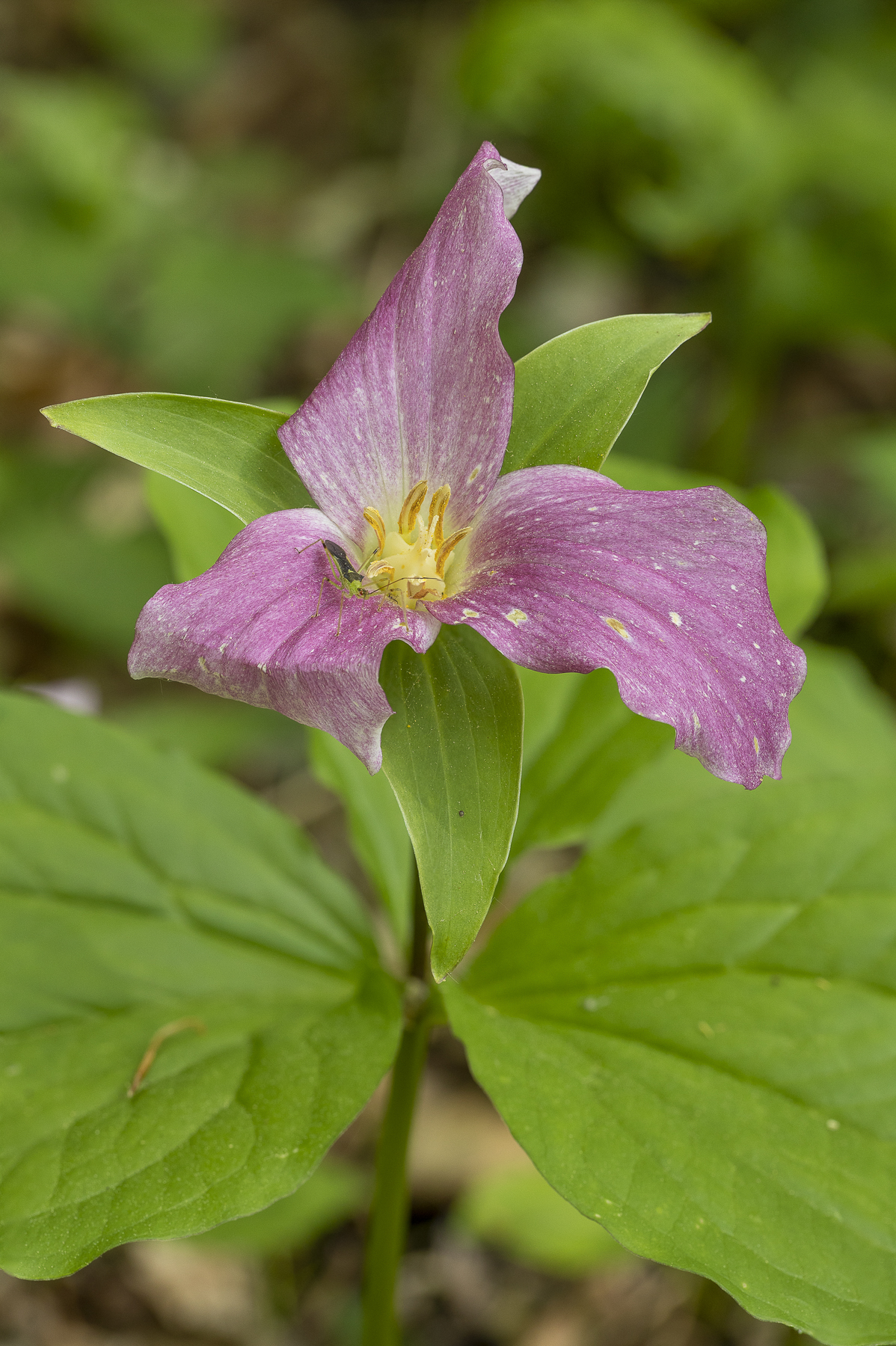
These big white Trillium grandiflorum are my final subject.  Wait, did I say white?

Yeah, this healthy trillium started out that way, and in its old age it is blushing pink. Still beautiful.  That's why I concentrated on it.  Richly green leaves, too.  It gets love from me because it is still vibrant.  Do you see anything unusual on the flower?  There's a critter sitting motionless even as I poked the one-eyed lens close to it. Let's get a closer view.


I wonder if it is waiting to snap up some visitor feeding on the rich amber pollen? 

I am not sure if I would have noticed this little bug in my earlier rush to photograph everything.

So, there you have it.  Three images in 2-1/2 hours with pauses to enjoy the orioles passing through Mundy.  

Going up to Ithaca, I also am slowing down with the idea to see any of the deer waiting to run across the Route 13 morning rush of commuters. That's another story that also teaches that the slower you go, the more you see.

It's spring.  Enjoy!

Paul


Sunday, April 30, 2023

Ask Five Times- Can I do that?

Over the last two years, I have been moving past  objectively showing the things I love in nature towards a more subjective result based on why they engage me.  The aim is to build a style that has more meaning.  Sakichi Toyoda of Toyota Motor Company fame introduced the approach of asking why five times.  For art, this hopefully will lead to images having stronger meaning.  

At left begins an example from a series of three images that I captured one year ago.  It is a beautiful objective image that defines the subject. Let's ask about the meaning:

  1. See the rich colors in the bird.
  2. It's a beautiful blue sky day.
  3. The apple blossoms look nice.
  4. The focus is sharp.  Ho hum.
  5. ....sort of running out of meaning.


 Move to the second image and try for five better whys:

  1. The Oriole is after something in the flowers.
  2. Does it mean there is nectar in the blossoms?
  3. There is something to be learned here.
  4. If there isn't nectar, are there insects maybe?
  5. What is to be learned next?


On to a third image seeking greater meaning for the five whys:

  1. Wow, there are little yellow caterpillars inside the apple blossoms.  Look in his beak.
  2. It's not nectar.
  3. Orioles are visiting the apple trees for protein.
  4. This is unexpected!
  5. Next year I should check the trees for this.


The third images shifts my style from a mug shot to showing a relationship between bird, tree and insect.  It has more meaning. 

Note:  In April 27, 2023,  the same tree is in blossom and there are no caterpillars, and hence no Orioles.

If at this point you are lacking interest in the five why's exercise, it is fine to just enjoy the pics absent the text. 

That is the background to what I pursued in April while I was in the Washington area on family business.  It's a far different locale than my strongly rural Finger Lakes home.  Could I create meaningful images in this new neighborhood with limited natural scenes?  Can I answer the why question five times?  Here goes my test.

Rock Creek on an April Morning
  1. There is a surprising wildness so close to the sounds of DC morning traffic.
  2. The foreground pulls me into layers in middle and far that feel rural.
  3. The spring greens are the same as I'd see at home in the Finger Lakes. 
  4. A city can be inviting. No trash to see seen.  Bravo.
  5. Rock Creek has a restorative power for residents, and me.

Another good place is Brookside Gardens in Wheaton, Maryland.  It's a Montgomery County Park.  Early mornings are quiet and beautiful.  Here is why I always enjoy my visits.

Pavilion at Brookside Gardens- Wheaton

  1. The hallmark of Brookside garden designs are rich foregrounds that welcome the eyes to explore.
  2. Exploring, I find layers to search in near, mid and far layers.  It's far from stale.
  3. The visitor immediately wants to find the path to the pagoda overlooking the lake.
  4. The reflections on the lake double upon the distant background.  
  5. The park is a refuge from the hectic crowded city.
There is another magical place in Brookside Gardens in April when the Wisteria is in bloom.
 

The Wisteria Bench
  1. Who could pass up a chance to sit on this bench? 
  2. The flowers have a delicious perfume.  The photo helps to remember it.
  3. The color of  wisteria blooms and the surrounding greenery are ephemeral. 
  4. Knowing the flowers will soon be gone keeps you lingering a bit longer.
  5. This is a calming.  I dream of sitting here next year with my 1/1/2 year old granddaughter.


The Purity of a Dogwood Flower 


  1. Here I see the purity of the beautiful Dogwood without distractions.
  2. My eyes always start at the white, which is as I intended.  
  3. The branches support my eyes exploration of white petals, lively green leaves and some reds too.  
  4. There is a purity that welcomes returning to view this image repeatedly.  Background is blurry complementary without distracting.
  5. It seems like a visual solo performance.

There are some wildflowers that I would never expect to find near DC. One is Virginia Bluebells; but to my surprise I found them on the perimeter of Brookside.  They were in a lovely setting too.  What can I do with the five questions?

Virginian Bluebells Found  at the Creek


  1.  I find two very similar Bluebell stalks that create a visual echo between near and mid distances.
  2. The light is nice and warm in the morning light.
  3. The distant ground is just enough to suggest a wooded forest.
  4. Technically, I have a green, blue and red split complementary color design that is very pleasing, with no deviations from those three.Very harmonious.
  5. I believe the viewer can return to look at this often.
  6. Adding another answer, the image tells the story of what they are, where to see them and why it is worth looking for them.

Asking the five why's does slow me down to the speed of seeing and understanding in a more subjective mode.  It would seem to apply widely in the pursuit of creative results.

I have come to realize that in my much earlier photography,  I would often come home with photos wherein the aim was just getting the right exposure, focus and maybe composition without pausing to ask why.  Part of that was the more difficult steps required using film.  The process was exposing a roll of slide film, waiting two weeks to receive the processed slides and then finally seeing how many were as expected.  With current digital tools, the feedback is nearly instantaneous.  Never going back.


Saturday, March 25, 2023

Sakura- Cherry Blossoms in DC

It was good fortune to be in DC this year as the cherry blossoms came into bloom.  In Japan, the ornamental Prunus subg. Cerasus are symbolic of the ephemeral nature of life,  and also tied to national spirit.  -They are called Sakura in Japan.- These abundant flowering trees are native to Asia, and contrast with our native cherries that have modest blooms but yield abundant fruits.

While most attention is given to the cherry blossoms around the National Mall, there are many displays throughout Washington such as this towering cherry tree just off Rock Creek Park.

One early morning, I walked over to photograph the scene.  When I complimented the owner on the tree's beauty, he remarked that a professional arborist cares for the tree.

There are over twelve hundred cherries near the Tidal Basin.  They don't all bloom at the same time nor display identical coloration.  These pinks are just a little short of full bloom.


 Along the promenade one sees some very old cherry trees.  I was told there are twelve trees that date back to the original gift from Japan in 1912.  Perhaps this is one of those.


Walking farther along the path, the visitor comes to another striking monument, the Martin Luther King, Jr. Memorial.  There was a decision to make with this scene.  Where to put the focus?  My decision was that you immediately know it is MLK Jr., even if soft. The tree is less obvious out of focus.


And, sometimes the best scenes are found when looking away from the Tidal Basin. Here is a first surprise.  This is a rare location to capture the reflection of the Washington Monument.  All other places had tree branches over the monument.


It was time to return to our apartment, and the sun was so intense.  On the way to the bus stop near  the Mall, there was another cherry framing the Washington Monument.

I learned two things while doing these photos.  First, be there early if possible. By late morning, it gets very crowded.  Finally, use transit - whether the Metro to the Smithsonian station or a bus. I used the number 52 bus that delivered me even closer that the Metro.  Senior fare was only $1.   I walked one block to number 52 route begins, and arriving at 14th and Constitution it was only about four to the tidal basin.  Beats driving.

Paul