Showing posts with label spring. Show all posts

Sunday, April 6, 2025

When does spring arrive?

Good question about when spring really starts.  Looking at my past years photos, the variability of dates is large. Below is a notable memory from February 2011.  Skunk Cabbage arguably is the first native flower.  But its first emergence is not  February, more likely in early March. It is a bit unusual to see it emerging through a crust of snow.  The plant senses increasing daylight and begins a catalytic reaction to melt the ground.  The hood,  Spathe, shelters the pollen-rich Spadix.  The flower smells like carrion so flies are attracted.  The flies gather the pollen, but there is no actual food reward to the fly.

My interest in this plant is in part promoted by my desperation to find something to photograph.  Guess one can suggest that I,too, am fooled just like the fly.  However, I protest.  It is a serious challenge to find just one suitable example with the Spadix visible.  After all, the flies are attracted by smell, and it need not be visible to succeed.  My first trip to photograph in March found many, but none with a visible Spadix.  Finally a good example was found on April 4.

Actually, these were three were all growing in close arrangement with only  two Spadix visible (and, only if I reflected extra sunlight into the spathe.)  The colors were a spectacular purple, warm green and amber yellow.  (I've tried  three times to capture the hues using watercolor with little success.)

One shot was not enough.  Had to get closer.


Looking at my garden, I see many native plants sending up new growth including bloodroot, trillium, lung wort and wild leeks. Perhaps the other benefit of pursuing these first blooms is preparing cameras, lenses and achy knees for the spring photo bonanza.  

Paul Schmitt


Saturday, April 27, 2024

Five Beautiful Spring Wildflowers

It's time to share a small set of wildflower images for 2024. My aim is to always strive for some new images that offer a fresh view. 

The spring weather here in New York has been challenging for wildflower photography.  Sure, it's been warm and has offered reasonable rain.  There have been some really windy stretches that limit image sharpness. So, I am limited to only five fresh images.

My first offering is of the "lowly" Skunk Cabbage,  Symplocarpus foetidus.  The plant has a clever approach.  First, in early spring there are few insects to pollinate other than flies.  So, it smells like carrion (but it's not.)   So the flies get nothing in return.  Also, it creates a hood over the pollen to shield it from any rain washing the pollen off.  This hood usually keeps the pollen out of sight.  


I searched a large area in the wet woodland before I finally found this beautiful cluster of three plants.

Next is a plant that is now thriving in my house garden,  Lungwort aka Pulmonaria officinalis.  Common in Europe, it seems to have adapted well here.  Mine have been in colorful bloom for seven weeks.

Medieval herbalist attributed the leave's similarity to lung tissue as indicating usefulness in treating lung disease.  (note" Phone image using  iPhone 14 with ProCamera app.)

Next is Sharp-lobed Hepatica,  Hepatica acutiloba. Beautiful blues just like the previous subject. 

Hepatica blooms before its leaves emerge.  At the base of the stalks is the emerging crop of 2024 leaves.

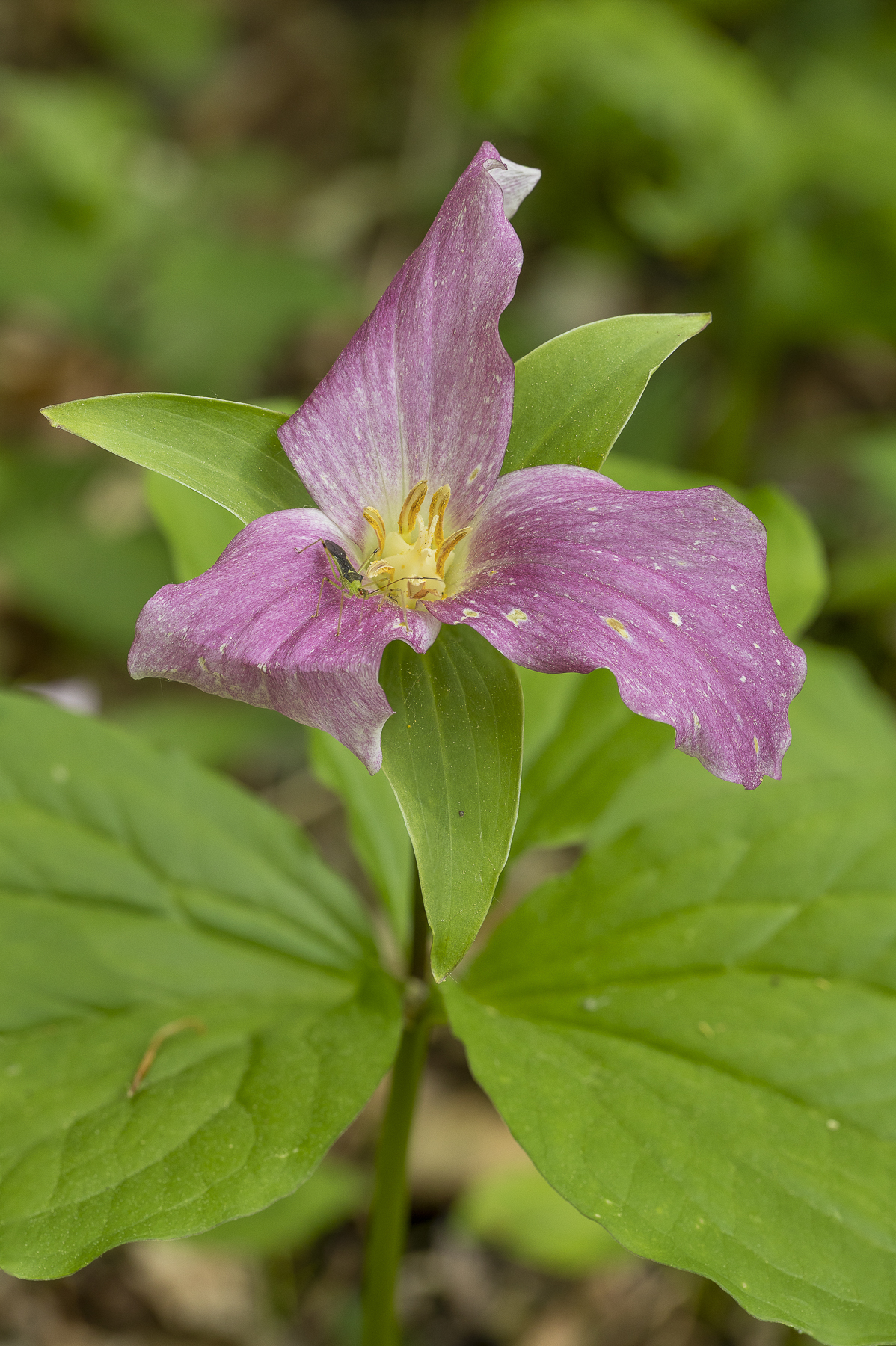
Now,  for the most exciting wildflower I have found this spring. I cannot recall ever seeing such brilliant colors in a Purple Trillium, Trillium erectum.  Furthermore, it is very large and true to its name - the plant is very erect.  The specimen in the distant left is nodding, as is more common.

In addition, the warm green under leaf is notable. Everything was perfect including the rise in the land that isolated the plant from the very distant trees.  The photo is also from my iPhone. I could not get my Canon lens adequately low to the ground.  

My final image drifts into photo geek territory, so please humor me.  Blue Cohosh, Caulophyllum thalictroides is easily overlooked.  The leaves are bluish green and the small flowers are a subdued yellow-green to brown.  The plant is relatively tall, so slight wind causes problems obtaining sharp results.  I love the challenge.

Returning home with this image yesterday, I decided that I would create an ink drawing from this photo to really "see" the structure of Blue Cohosh. When finished, I realized that the textures, forms and colors of the plant are not really understood when making the photo.  Now, I see it, and have abandoned any thought of adding watercolor.  It is beyond my skill.

Thank you for your interest.

 Paul Schmitt 


Wednesday, April 10, 2024

Something Special in April

No complaining today about clouds hiding the eclipse.  After several years of struggle, our Lenten Roses have produced a vigorous display.  The proper name is Heliborus orientalis.  We have fenced it each winter to thwart the hungry deer, and I'd say it was worth the effort.  

The first plant is pink tending to a sort of a mauve shade. Looking closely one sees the petals have speckles of darker values.  The right bloom is finished and should soon show a seed pod. 

The second plant is tending towards a warm yellow with some clearly greenish shades.  It, too, has the speckles. 

There is a steady stream of small bees and perhaps even small wasps.  After all, there aren't a lot of competitors on April 9 and 10.  

I'm seeing a lot of other plants emerging, so expect some images of spring in the gardens and the woodlands.

 Paul Schmitt


Thursday, May 18, 2023

Mundy Wildflower Garden- Slowing Down to See

It's been twenty years since I discovered the Mundy Wildflower Garden on the Cornell campus. The rich array of spring blooms captured my imagination. Soon I was working on a project to upgrade the  images posted at the welcoming "Bloom Board."  A sense of urgency drove me as I worked to find artful compositions that spoke of the beauty.  No mug shots! I said.  Over five hundred quality images were put on file; but in retrospect, I needed to slow down in order to realize the emotions that I was feeling. 

The urgency is now controlled.  Honestly, every time I get low on the ground for an intimate view, well, my cranky knees also work to slow my pace.  There are only three subjects for this message.  In addition to appreciating their beauty, I hope there is some useful insight for even simple phone captures.

The first subject is a small pod of Wild Geraniums. This image is different from what I made twenty years ago in two respects.   First, I paid more attention to the colors in the scene and to the location of the supporting yellows especially.  Twenty years ago, the distant colors were not carefully placed above and below the blue-violet blooms. I could have done better years before.  Notice how the leaf at the bottom shows  the form clearly.

The second difference is in the camera technology now available. I was so close to these flowers that only a short distance is actually in sharp focus. The image is a stack of six images that walk from the nearest part of the Wild Geranium leaf to the last part that I wanted in focus. The camera is on a tripod and does not move for all six images.  For each shot, the scene displays red dots on all edges that are sharp. I merely walk the red dots from near to far on the flower, and stop. The software selects all sharp areas and fills in the rest with those blurry remaining pixels.  Amazing, and not even a dream in 2003.  

The next image is also a second group of Wild Geraniums but with a different intent.  There is a subtle hint that the plants thrive in the mixed light of woodlands.  That was my intent. The blooms are also more directly facing the viewer. 


This is actually a better offering for identification purposes.  It called for greater depth in sharp focus; there were 9 images in the stack.  Impossible twenty years ago.  Easy today.

These big white Trillium grandiflorum are my final subject.  Wait, did I say white?

Yeah, this healthy trillium started out that way, and in its old age it is blushing pink. Still beautiful.  That's why I concentrated on it.  Richly green leaves, too.  It gets love from me because it is still vibrant.  Do you see anything unusual on the flower?  There's a critter sitting motionless even as I poked the one-eyed lens close to it. Let's get a closer view.


I wonder if it is waiting to snap up some visitor feeding on the rich amber pollen? 

I am not sure if I would have noticed this little bug in my earlier rush to photograph everything.

So, there you have it.  Three images in 2-1/2 hours with pauses to enjoy the orioles passing through Mundy.  

Going up to Ithaca, I also am slowing down with the idea to see any of the deer waiting to run across the Route 13 morning rush of commuters. That's another story that also teaches that the slower you go, the more you see.

It's spring.  Enjoy!

Paul


Tuesday, April 6, 2021

Signs of Spring

 Here in New York State a late spring followed a hard winter.  The signs of a warmer season have been late and mixed.  The Canada Geese are back.

And they are starting to nest.


But appropriately, on April 1 some wintery weather dropped in to play a joke on us.

There is one spring flowering plant that cares not if it is snowy or cold.  The Skunk Cabbage creates a catalytic warming that melts the ground so it can bloom.  

First, it does not smell like a skunk. but the spathe does seem to have an odor that attracts flies and gnats.  I rather welcome its hardiness along with the daffodils.

Waterfowl also make an early spring arrival.  One favorite bird that always excites me is the Wood Duck.  Here are two gorgeous males that I found on a small pond lined with woodlands.

 It seems like there is always a greater number of males and on this morning there were six males vying for two females.  This female has made her choice and a rejected male is facing a determined stare from the female.


Another set of visitors to the pond on this chilly morning was a gang of Common Mergansers. They often sweep across a pond or river in a line suggesting a coordinated fishing strategy.


These early spring days are often a frustrating time where we are ready before the seasons are willing to make a clean switch to warmth. I am surely not alone in being ready for better days.

Paul Schmitt


Monday, May 18, 2020

Baltimore Oriole Feeding

It's been a slow spring.  By my records, wildflower blooms and migrating birds are at least three weeks late arriving.   So, I have been busy with a massive revision to my photo file, but it was not my first choice.  Yesterday I saw a good clear and calm morning that was perfect.  And, nearby apple trees were finally coming into bloom. I've always seen good numbers of birds in the flowering trees, but I have never been able to determine what they were feeding on.  Were the Baltimore Orioles somehow getting nutrition from the flowers themselves?  After all, it is common for people to put out orange halves and dishes of grape jelly for orioles.  Is there also nectar in the apple blossoms for them?  Well, I came home with a series of four colorful images that answered my question.

This colorful male came into my view at the top of a large apple tree that had just come into bloom.


 He began probing in the open blossoms.


 Soon his beak emerged with a caterpillar.


He shook it a bit and then it was up and in with a little flip of his head.  Down it went.


So, the answer is that the Baltimore Oriole was there for the high protein caterpillar.

The tree was alive with other birds including Redwing Blackbirds, Gold Finches and warblers.   The larger birds tended to be in the outer parts of the tree and also towards the top. The smaller birds were mostly in the denser parts.   They were more difficult to track.  There was one Tennessee Warbler that sometimes ventured to the edges.  Take a look at him.


There is a small caterpillar in the the tip of his beak.  He was there for the same thing.

Now, it is dark and misting.  Back to the computer.

Best,

Paul Schmitt


Wednesday, June 1, 2016

The Joys of Spring

Yesterday was the end of May.  The month's been busy.  It is time for a recap of some highlights.

First was the joy of finding some favorites seen in a new way.  Always love the Trillium grandiflorum.  I came away with muddy knees.  It was worthwhile.


Another striking wildflower that I seem to have difficulty finding in full bloom is the Virginia Bluebells, also called Virginia Cowslip.  (Mertensia virginica)


Spring is a conflicted time with the natural world so active.  Emerging flowers and returning birds compete for my attention with spring green landscapes.  The Common Yellowthroat is a familiar friend that I found singing strongly his familiar song.


 Another friend is the Tree Swallow.  They compete with Eastern Bluebirds for nest boxes.  Not quite as musical, they are a bit more approachable and are brilliant  when the sun plays on their feathers.


The Eastern Bluebirds will take up a defensive position on a favored nest box and scan the sky for their adversary, the Tree Swallow.


The flora keeps calling with some subjects beyond the common. The most notable are the Pink Lady's Slippers that are found infrequently.  They are simply glorious.


With luck or patience, one can see what pollinates them.  It is a race to get to a bloom before the Bumblebee races off to another distant target.  In the mix of sun and shadow, getting the bee on a sunny bloom is near to impossible.


But sometimes the sun does align with some flowers for a spectacular display.


The result justifies the pain of awaking at 5 am to arrive when the light is perfect.

It's been a good spring.

Paul Schmitt

Wednesday, May 21, 2014

Orioles in Spring


Sometimes the mowing and such keeps me close to home, but that's okay.  On a recent day I went over to the small (and I mean really small) town park in my neighborhood.  It's so small they don't even have a set of swings, but I digress. That little park can have some nice birds in the spring.

While I was talking with a passing neighbor, I noticed movement in the adjacent power line.  Swinging the camera over to the action, I found a very colorful male Baltimore Oriole. There are a lot of dead weed stalks  on the power line. They are left over from last year.  These stalks are attractive to these Orioles because they  weave a hanging pouch for a nest. The dead stalks  have the long fibers that are ideal for their needs.


So it was that this bird disappeared into the tangle and reappeared with some fibers.  Almost simultaneously, a female appeared nearby.  She must have been on the same mission for good materials.

What happened next was the sort of behavior that draws me to watching and photographing birds.  The male laid the fibers on her back and proceeded to mate with her, while she still held her own set of fibers in her beak.  This all happened very quickly.


The male Oriole retired to a nearby bush and I could still see his set of nest fibers on her back.


She collected the fibers from her back. A moment later both Orioles were winging up the hillside towards some treetop to add to their nest. I've seen Oriole nests, and it strikes me that they must repeat this trip to find nest fibers a hundred times over each day for days to take the next step and deposit eggs into the nest. Such persistence!

Paul           


Monday, April 29, 2013

Spring Birds

Photographing birds is nearly always unpredictable. So, this year I have had to work hard to convert observed birds into photographs. I've had Ruby-crowned Kinglets very close- once when I was walking the neighborhood with no camera - but never where I could get a good image. But, it is still a delight to see the male Kinglet flare his ruby colored crown into view.  So, enough with excuses and on with some new photos.

First up is a Yellow-rumped Warbler that was foraging in the bushes below a huge willow.


I am always amazed when I see how slender a warbler's legs are. 

Carolina Wrens used to be an unusual sight here in the Finger Lakes, but they have become more common. (Global warming, anyone?) They are great singers and very approachable.  So, I spent a good part of Sunday morning listening to this chap. How can such a small package make so loud a song?


But, sometimes he had to pause from the song to do a little feather upkeep.


Sometimes I discover a bird that I have not been paying much attention to, but find deserving more interest. Usually this happens when I see some interesting behavior  as in the next subject. I had this little House Sparrow foraging in front of me, and I saw something new to me. He was feeding on the small buds of bushes and vines. Never really paid much attention to that.


I find the grey cap with the rich red sides attractive along with the mottled bib.  Sometimes, a bird exhibits what I can only call "character". This Eastern Towhee was a persistent "loudmouth", mostly voicing the phrase "drink your  tea" over and over. Like the Wood Thrush, he understood that he had to broadcast  his message in all possible directions.


So, that is all I can show for my efforts in the bird area. The wildflowers are abundant right now, so I'll be reporting on them soon.

Paul Schmitt

Friday, May 25, 2012

Birds and Blooms

True to my blog's name, today was birds and blooms, just in reverse order. Began the day at Cornell Plantation's Mundy Wildflower garden with another skilled photographer.  It's always enlightening to see how two photographers can stand next to one another and end up with widely different and equally interesting photos. It is an excellent way to increase your creativity.

The Wild Geraniums instantly got my interest.  Just love their color and simple form.


While the garden is devoted to native plants, it is virtually impossible to keep non-native plants out.  Think of how impossible it is to banish dandelions for your garden or lawn. 

So, the garden also has masses of lovely pink and purple Dame's Rocket. Now, this plant is widely called Phlox, but it is not.  Phlox has the same colors, but it has five petals.  This has four. I am sure the small bee on the flower doesn't care what the name is. End of botany lesson.

I have Dame's Rocket around my yard, and while I do pull it, I've accepted that it will not be defeated.  I accept it in small numbers because the colors are appreciated and it would be too much work to do otherwise. It is a truce.

And, as I continued in the garden, the Dame's Rocket provided a nice framing to some Cow Parsnip that just began to bloom. Cow Parsnip is a sort of coarse and ungainly plant. The bees love it.


Usually, Cow Parsnip grows in large, ungainly masses that make it difficult to photograph in such a way that a single plant's form is clearly seen. So, I liked this combination of Cow Parsnip and Dame's Rocket.

As I continued, I found another plant just beginning to bloom, and it is one of my favorites, Blue Flag.


By this time, I was growing hungry, my companion had to go, and the wind was making it nearly impossible to photograph flowers and get sharp images. Time to grab a Subway and eat while I observed a nearby  Redtail Hawk nest.  Arrived to find one adult perched nearby.  At first, it flew from a perch behind where I stand on the bridge and went to a perch directly above the nest, and then into the nest. The two chicks were dozing. It soon left the nest.


It returned to the perch behind me where I could see it was watching something in the wooded area.  It flew into the woods, but returned to the perch with no prey. It was likely a squirrel or chipmunk.


What happened next was pretty exciting as the bird launched from the tree and flew nearly directly overhead on its way to the nest.


After some time, one chick must have rung the dinner bell and the adult hawk responded.  She pulled a grey squirrel up from inside the nest and began to deliver bits of food.  The other chick in the back watched but did not join in, eventually going off to sleep.

I figured the action was over for awhile since sleep usually follows food. Time to head home and start the long process of downloading and editing. 

All in all, a pretty good day of birds and blooms.

Paul