Showing posts with label trillium grandiflorum. Show all posts

Thursday, May 18, 2023

Mundy Wildflower Garden- Slowing Down to See

It's been twenty years since I discovered the Mundy Wildflower Garden on the Cornell campus. The rich array of spring blooms captured my imagination. Soon I was working on a project to upgrade the  images posted at the welcoming "Bloom Board."  A sense of urgency drove me as I worked to find artful compositions that spoke of the beauty.  No mug shots! I said.  Over five hundred quality images were put on file; but in retrospect, I needed to slow down in order to realize the emotions that I was feeling. 

The urgency is now controlled.  Honestly, every time I get low on the ground for an intimate view, well, my cranky knees also work to slow my pace.  There are only three subjects for this message.  In addition to appreciating their beauty, I hope there is some useful insight for even simple phone captures.

The first subject is a small pod of Wild Geraniums. This image is different from what I made twenty years ago in two respects.   First, I paid more attention to the colors in the scene and to the location of the supporting yellows especially.  Twenty years ago, the distant colors were not carefully placed above and below the blue-violet blooms. I could have done better years before.  Notice how the leaf at the bottom shows  the form clearly.

The second difference is in the camera technology now available. I was so close to these flowers that only a short distance is actually in sharp focus. The image is a stack of six images that walk from the nearest part of the Wild Geranium leaf to the last part that I wanted in focus. The camera is on a tripod and does not move for all six images.  For each shot, the scene displays red dots on all edges that are sharp. I merely walk the red dots from near to far on the flower, and stop. The software selects all sharp areas and fills in the rest with those blurry remaining pixels.  Amazing, and not even a dream in 2003.  

The next image is also a second group of Wild Geraniums but with a different intent.  There is a subtle hint that the plants thrive in the mixed light of woodlands.  That was my intent. The blooms are also more directly facing the viewer. 


This is actually a better offering for identification purposes.  It called for greater depth in sharp focus; there were 9 images in the stack.  Impossible twenty years ago.  Easy today.

These big white Trillium grandiflorum are my final subject.  Wait, did I say white?
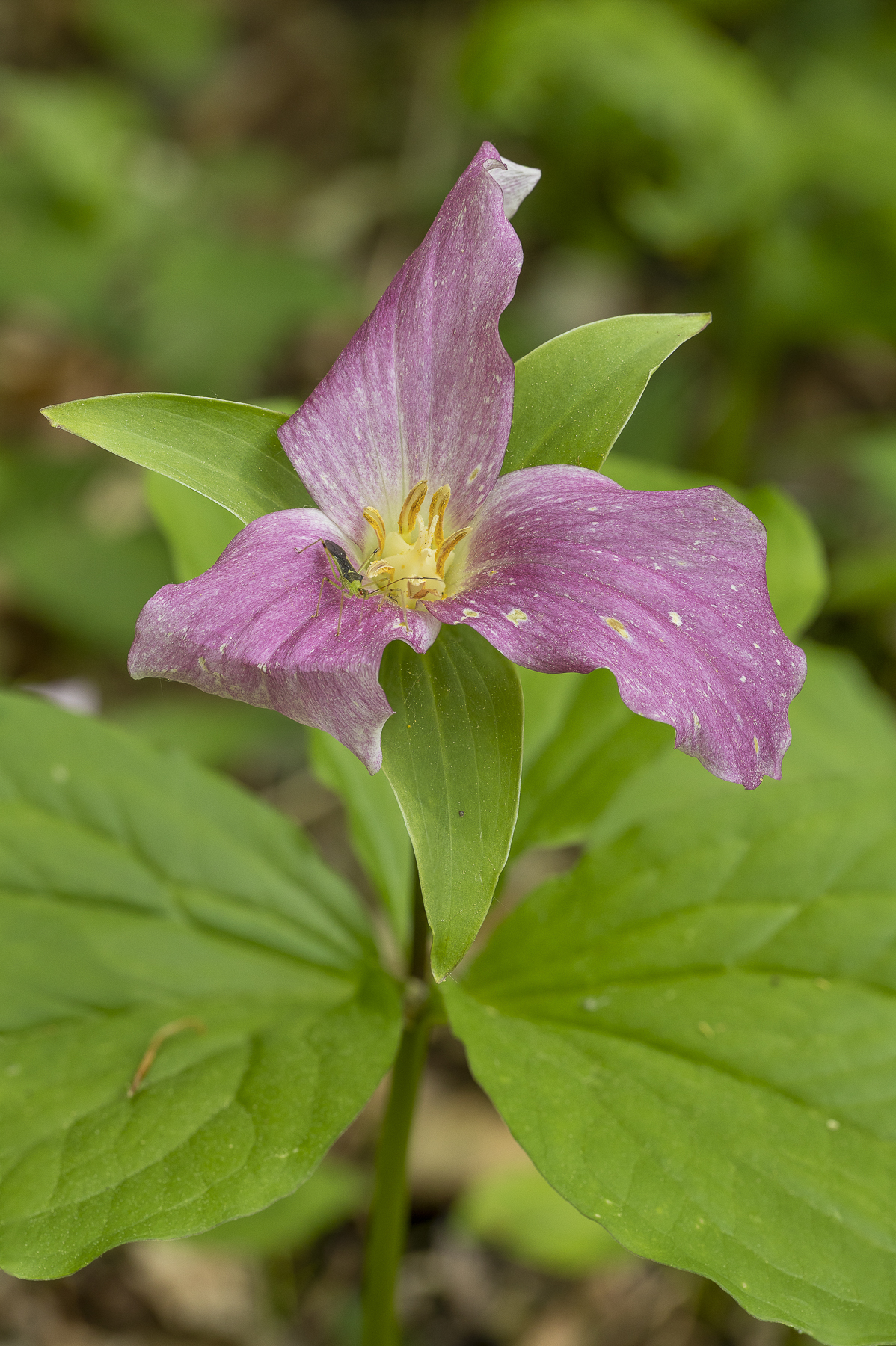
Yeah, this healthy trillium started out that way, and in its old age it is blushing pink. Still beautiful.  That's why I concentrated on it.  Richly green leaves, too.  It gets love from me because it is still vibrant.  Do you see anything unusual on the flower?  There's a critter sitting motionless even as I poked the one-eyed lens close to it. Let's get a closer view.


I wonder if it is waiting to snap up some visitor feeding on the rich amber pollen? 

I am not sure if I would have noticed this little bug in my earlier rush to photograph everything.

So, there you have it.  Three images in 2-1/2 hours with pauses to enjoy the orioles passing through Mundy.  

Going up to Ithaca, I also am slowing down with the idea to see any of the deer waiting to run across the Route 13 morning rush of commuters. That's another story that also teaches that the slower you go, the more you see.

It's spring.  Enjoy!

Paul


Thursday, April 29, 2021

A Burst of Spring Flowers

The woodland bloom is getting exciting.  I went out yesterday to search for a warbler at Cornell's Arnot Forest and did not get 200 yards into the woods before the wildflowers changed the plan.  Right along the main forest road was this stately Purple Trillium- Trillium erectum- in perfect condition.


While the species name would imply the flower is erect, it is always nodding down.  The trick to a good image of it is to get very low - that is best done by finding plants on a steep hillside.  Seen at right is the usual approach.  In this case, I had to straddle a fallen log on a somewhat slippery slope.  It is a slow process with much care to avoid damaging other blooming plants.

At such a close distance, the lens has a shallow of depth of focus. So, I made six images stepped from closest leaf tip the to the most distant leaf. This, of course, included the purple flower's detail.  The resulting "portrait" came from aligning all six images and selecting the sharper parts of each image.  This is a revolutionary change in how to overcome the inherent limits of optics. See the result below.


I became rather driven to find Purple Trillium clinging to increasingly steep slopes.

 
Inevitably, I found the most marginal of all possibilities.


This was about 50 feet above the valley floor.  It convinced me to find other subjects.  

The beautiful Trout Lily - Erythronium americanum - were also in bloom.  They are only open when the sky is clear so, this was the opportunity I wanted.


Like the Purple Trillium, they are looking downward.  I put my camera down in the leaves and propped it up to get the image.  They are a true ephemera and will totally disappear by mid-summer.

There are other blooms to find that were easier to photograph.  Consider the Virginia Bluebells- Mertensia virginica.  It is a plant of the river woods.  Here's one of my favorite images.

It had been a full morning. As I exited the forest road, I saw an exceptional cluster of White Trillium - Trillium grandiflorum - and had to stop.  Too lazy to unload my camera again, I depended upon my iPhone. 


Ten blooms!   The steep bank must be rich and well watered.  

No wonder that spring is my favorite season.

Paul

Monday, May 20, 2019

Signs of Spring

After being away for most of May in 2018, I vowed to stay close to home for the spring of 2019.  It's been a good month in terms of birds, and of blooms. Here a few of the birds that offered good views.

Orchard Oriole singing.  Male first spring


I've learned that a large number of birds feed on the blooming Crab Apple trees. Black-capped Chickadees hang upside down when feeding on the lower flowers.

Black-capped Chickadee.
Another participant in the feast is the Yellow Warbler.

Yellow Warbler, male


Away from the apple trees, another striking bird that arrives in May is the Scarlet Tanager.  They are a bit more difficult to locate since they prefer the extreme treetops.

Scarlet Tanager,  male
Enough of the birds, the blog is also about "blooms".  Besides, wildflowers are much easier to photograph - only if the flowers happen to be in good bloom (and the winds are calm and the light is good).  I have a list of wildflowers for which I  need a better example.  Highest on the list was Blue Cohosh.

Blue Cohosh in bloom


The colors are really challenging to get correct, and the Cohosh has a tall, spindly stalk that moves in the slightest breeze. 

For the next bloom, breeze is again a challenge; however, just getting extremely low and finding a clear, uncluttered view is added. So, I checked bellwort off my list.

Large-flowered Bellwort


And, there are some whose beauty just drives me to get a new result.  Once again, my knees got dirty getting low for the trillium.

Trillium grandiflorum


I never tire of photographing trillium. 

So, May has been a good month for photos, and there is still time to add some more.  There's a small warbler that I am researching now for a good setting.

Thanks for your interest.

Paul Schmitt


Wednesday, May 27, 2015

Blooming Wonderful

The Finger Lakes of New York are a bonanza for the nature lover. One of my favorite nature spots in spring is the Mundy Wildflower Garden along Fall Creek on the Cornell University campus. It is a rich, intensely managed natural area with an amazing array of native plants, and it is alive with birds, too.  I have been going there for twelve years and always come away richly rewarded.  To learn more, go to:   http://www.cornellplantations.org/our-gardens/botanical/mundy-wildflower

Today, I began there shortly after sunrise. I concentrated on the flowers though the birds were very active.  Later, I would join a work party removing invasives and planting more native plants. But first, I would have some play time. Entering the garden,  large beds of yellow surrounded the white flowers of the Great Solomon's Seal hanging gracefully beneath rich green leaves.  I've seen Ruby-thoated Hummingbirds hovering under these to gather nectar.

Near the entrance was White Baneberry, Actaea pachypoda, called Doll's Eyes because the china white berries have a purplish "pupil". The plant in Mundy was in such a charming alignment that a photo was mandatory. The leaves and flower head were in ideal arrangement.

Other delights awaited me in the garden.  Down the trail were the Great Solomon's Seal mixed in with Wild Geranium. Also called Spotted Cranesbill, Geranium maculatum is an easy plant to introduce into the home garden.  Both of these are hardy, though I've learned to keep the Solomon's Seal behind a fence to thwart the deer's hunger. Unlike so many of our introduced garden plants, they are ideally matched to our climate and low maintenance.

Next I came upon some False Solomon's Seal growing among the ferns. These sway in the slightest breeze, so I had to work fast before the sun stirred up the air.  However, unlike a bird, they cannot fly away just as I get ready to fire the shutter.


Not all plants are in peak bloom; the large White Trillium, Trillium grandiflorum, can also be attractive when the white flowers fade to red.  See below.


 Another deer resistance plant that is ideal for the home garden is the Wild Columbine. Watching a hummingbird feed on it is not to be missed.  In many cases, it has been shown that these native varieties have richer nectar than the exotic varieties that may be somewhat showier.  For me, a native plant that is better adapted to our locale means less care in the garden and a great ability to sustain itself over the years.

My saunter through Mundy Wildflower Garden led me to another late spring favorite, May Apple.  I have it in my home garden where its toxicity has proven its worth. Deer have never touched it.  It is not invasive and requires zero care.  Today I headed for a favorite place in Mundy where I discovered a harvestman spider in residence.


I made a final stop on my way to join the work party. I had found another Wild Geranium next to a contrasting tree.  The difference in the textures and colors attracted me.


 There was just so much eye candy to be found, that I found it hard to quit. The ephemeral nature of native plants means that a return next week will present a new set of blooms to enjoy. That is part of what keeps me coming back each year. Throughout the spring, there are both wildflower and bird walks in the Plantations that are expert-led.  They are listed in this link:
 http://www.ssreg.com/cornellplantations/classes/classes.asp?catID=4421

So, whether it is birds or flowers, the Mundy Wildflower Garden is a treasure for all nature lovers.  Discover it if you can.

Paul


Thursday, June 5, 2014

Blooming Highlights

The rush of migrating birds has ended, and it's time to catch up with the highlights of the spring wildflower blooms. I find myself pulled between the elusive birds and ephemeral blooms.  Here is the best of the spring blooms.

At the entrance to Cornell Plantation's Mundy Wildflower Garden, I found Celandine Poppies and Virginia Bluebells in wonderful colors.  I had to get very low on the ground to get this view.


Nearby was one of my favorites each year, May Apple. Another chance to lie on the ground.


The Trillium grandiflorum were a bit higher and less difficult to photograph.  They are always grand.


An easily overlooked wildflower is the Wild Geranium (Geranium maculatum).  Oddly, the garden geraniums we plant in our gardens are not members of the Geranium genum.   The Wild Geraniums are so prolific that the deer must not be eating them.  Hope it stays that way!


Now, all of these are fairly common, and while beautiful, they do not excite the passions like a wild orchid. These Pink Lady's Slippers were in a cluster of 185 plants that I visited for the first time this spring.


That is an extraordinary cluster of blooms.  I also like to portray the charming arrangements that the blooms sometime present.  This one is, for me, a portrait, .....perhaps of two sisters?


So, those are my highlights of spring.  In only a week or maybe two, the later blooming orchids will appear, and I'll get excited once again.  The one difference is that I will have to endure the mosquitoes that frequent the bogs and fens in June.

You can understand how I am torn between choosing blooms or birds on any given day.

Kind regards,

Paul