Showing posts with label Bobolinks. Show all posts

Monday, May 20, 2024

The Bobolinks are here!

Few birds are as exuberant as a male Bobolink in May as it anticipates the arrival of the females.  Its song is a bubbling cascade that is picked up by competing males.  If unfamiliar, it is best to just search for it on the internet.  It's lovely.  The singing is temporary.  Once the pairs begin nesting, the bubbling chorus is replaced by whines and chips.

Bobolinks are a grassland bird that find minor stalks or bushes to perch on for their singing.

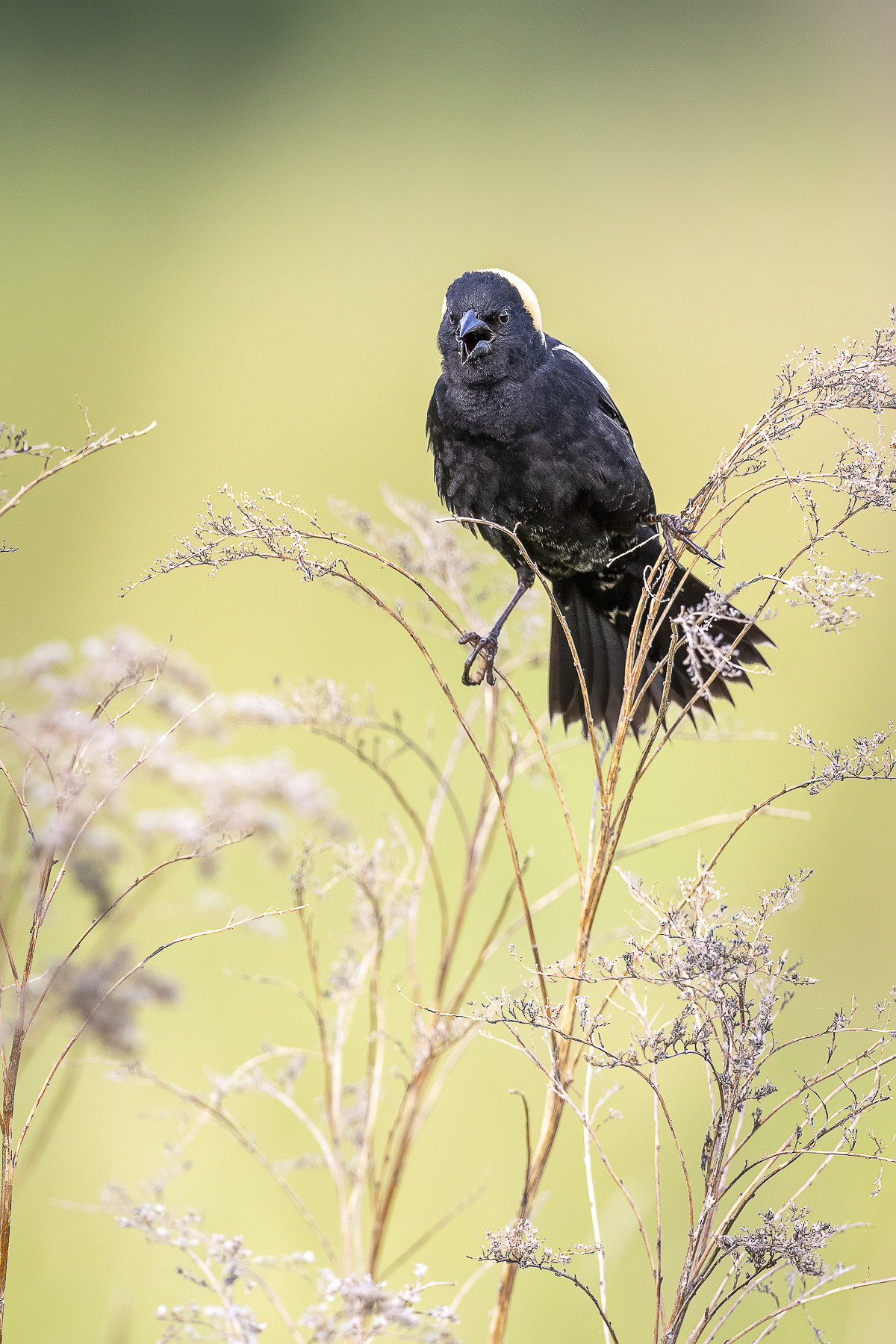
The yellow cap on the head and the white on black back of the body earn it the name "Tuxedo Bird".

They are an inquisitive bird that balances the singing with searching for catapillars.  (Saw it but wasn't fast enough to capture on camera.) On the plus side, they are not shy around people.  Was often within twenty feet, standing still naturally.

The bird can perch on very thin grass stalks suggesting how little they actually weigh.


The biggest challenge is being quick enough to actually capture a sharp image of one in flight.  


This was a 1/2000 second shutter on burst mode with eye tracking autofocus. Expect one good image in a hundred whenever I add some anticipation of flight. 

Another trait that I find interesting is their ability to find makeshift perches, sometimes bridging between two stalks.

Bobolinks also display a fluttering flight similar to how various raptors hover when looking for prey.  Seems this is more part of display for these birds.
My most loved behavior is still the full throated song offered with shaking throat feathers from a perch on what ever is available.

This is all so temporary.  In about two months, the grassland will have large flock of adults and juveniles coursing over the meadow before quickly departing southward.

Happy to share where to find these with my neighbors.

Paul Schmitt

Saturday, May 27, 2023

Three Favorites from May 2023

It's time to wrap up May with three bird images that have some meaning to me.  First, is an elegant Cedar Waxwing that was part of a group of about five that were gleaning caterpillars incredibly close to my parked car.

Waxwings are a huge treat when they appear.  Their contact singing is so extremely high pitched that any background noise will surely leave it disguised.  They move through the cover like ghosts.  

On the same morning, a pair of Brown Thrashers appeared.  Not shy like waxwings: rather bold in human terms.  More often they are in grass fields, so finding this one perched was unusual. It appeared to be surveying the grasses for insects.

The thrashers generally nest in a series of dense thorn bushes.

Bobolinks are always a subject for my May outings. It seemed to be an off year for them and most outings were failures, especially in the quest for flight images.  This boy did stop to sing in the hope that the females had arrived from South America.  The rich yellow cap on the head plus the bold black and white patterns on the back (not visible) are supplemented by their bubbling song. Look at the scalloped ends on the tail feathers. 


Two weeks later, all of the singing was over and the ladies were in their ground nests. 

I noted the black and white patterns on the back.  Well, the otherwise inadequate flight image on the left does illustrate one more reason I track these boys in May.  This was at 1/2000 second, and I still couldn't precisely track his flight.  Next year!


Next for me is June in Shenandoah National Park.

Paul


Thursday, June 23, 2022

The Tuxedo Bird

Rising early on a June day, I recalled when I did this daily in the glass plant.  No more. Now, I shared the road with unfortunates who have to do this daily.  Instead,  I had a rendezvous with the Tuxedo Bird, aka the Bobolink.

Note: Best viewed on tablet or larger screen.

Once plentiful, habitat loss and changes in grassland farming practices have reduced them.  On this morning, I am at Greenspring Natural Cemetery near Ithaca.  Their grasslands are not mowed until late fall.  The birds benefit. Listen to his song:

 https://www.youtube.com/watch?app=desktop&v=LOlO_kN0KiA

Bobolinks are not particularly shy, so I can just stand quietly in plain sight.  Last year's weed stalks are among the few perches for the  male to use while broadcasting his bubbling song.

He puts his full energy into the song.  I love how his tail feathers splay out, revealing the scalloped tips on each feather.  It's quite a display.

Unlike last year, the female Bobolinks are still visible suggesting they are not yet preparing their ground nest.  One researcher told me it is all but impossible to find her nest in the tall grasses.   I'd never try. 

This is truly the best scene I have ever captured of a Bobolink. 

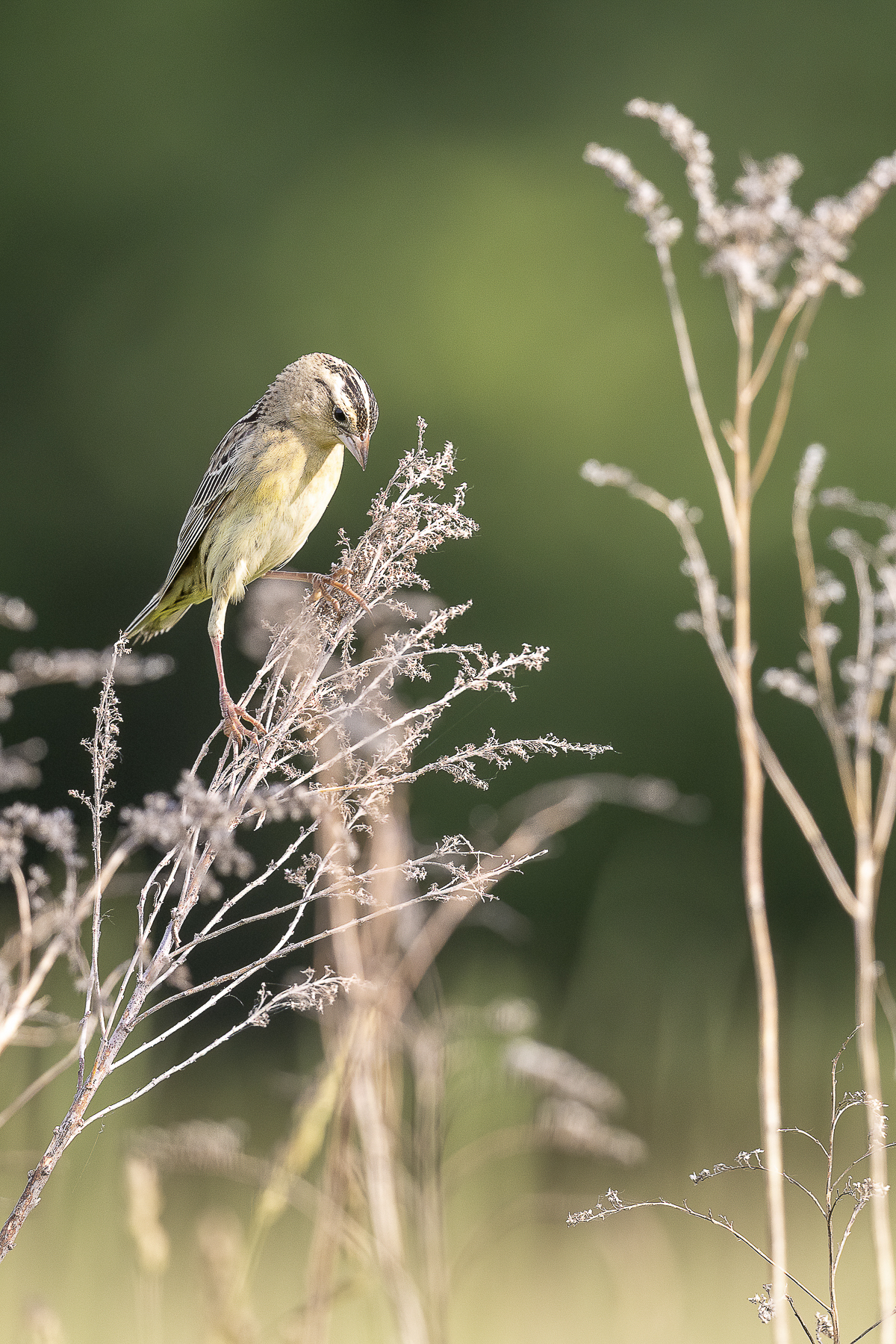
While the male's energy was mostly split between attracting the female and repelling a neighboring male, the female was also probing for insects hidden in the dry stalks.

I did have one image showing an inchworm she had pulled out. Her rapid movement left it a bit blurred.  (Oh well, another time maybe.)

I did also see evidence that the male spares a little time to look for insects.

I also suggested that the Bobolinks were tolerant of me, but there were a few times when the male seemed to be giving me a hard look.

Maybe it was just happenstance that chose to direct his song directly towards me. Still, I love the look.

As a side note, this is about a 25 acre field and I did not follow the bird's movements.  After some observation a previous day, I picked a spot and avoided unnecessary movements. The males seem to have favored perches. The best strategy seems to be pick a spot and be patient.

After breeding season, the males molt and acquire plumage like the female for their trip to South America.  I'd bet the males never sing once south.

Hope you enjoy my ramblings.

Paul Schmitt


Monday, May 18, 2015

Bobolinks!

It is late spring now, and the birds are in various stages of the nesting season.  Great Horned Owls have already fledged, Eastern Bluebirds are feeding young and Yellow Warblers are building nests.  The Bobolinks have finally arrived and are filling the air with a wonderful, bubbly song in the meadows.

Today, I went to the Greensprings Natural Cemetery near Ithaca to see the Bobolinks. The meadows are not mowed during nesting season, and an abundance of ground nesting birds can be found. While there was an oversupply of male Bobolinks, I saw two pairs that were defending territory, and perhaps, starting a nest beneath the widely scattered honeysuckle bushes.

The male has this fluttery flight over the meadow accompanying his bubble and tinkle song. It seemed to me that it principally attracts rival males, not females.


The male also take a perch to broadcast his message.  This seemed to be announcing a territory.


This fellow's lady seemed to keep pretty close to him, and foraged among the grasses with a few excursions to the weed stalks for a look around.  I find her quite attractive too.


Greenspring practices responsible management of the meadows with regards to mowing. I recall that they only mow every other year in the late summer when nesting is complete.  The result is an abundant, prairie-like habitat full of the cycle of life.


Paul