Showing posts with label waterfalls. Show all posts

Monday, June 12, 2023

Sauntering in the Shenandoahs

Now these mountains are our Holy Land, and we ought to saunter through them reverently, not 'hike' through them.       

                                                John Muir

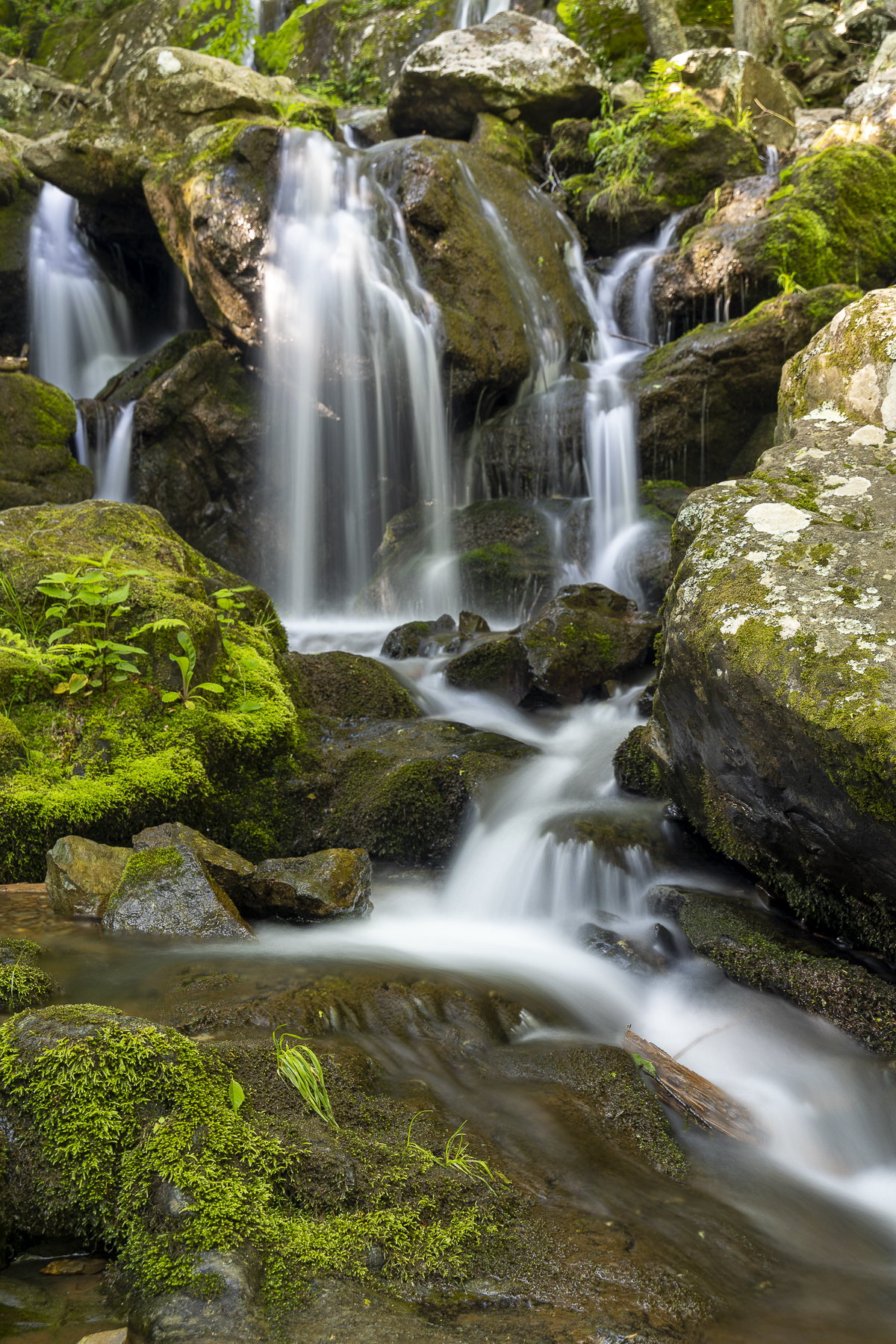
Here are a few photographs which appealed to my eye at various places along the Skyline Drive, Virginia.  True to Muir's idea, I tried to keep my pace slower.  First are two falls found in Dark Hollow near Big Meadows.   The upper falls has several drops on it's way to the viewer:

I chose to include the lower three.  What most appealed to me was the mossy covered rocks framing the milky white water.   Just below this was another smaller scene that I labored to frame while simultaneously keeping my boots dry.

Why use such a slow exposure?   The slow, steady movement down Dark Hollow stream was peaceful. So, the silky water matched my feelings.  There is no one right shutter speed, but there can be one that conveys how I perceive the motion.

On Limberlost trail, I hoped for some wildflowers.   This fascinating flower seems related to Columbine, but the color seems unusual.  The small spider makes it special.   It appears in only one of the seven images in the stack necessary to capture sharp focus on the entire flower.


Also on the Limberlost trail there was a Pink Lady's Slipper, Cypripedium acaule.  These are truly a wild orchid since there has never been a success raising them from seed.  So, every one I see is exciting.


This was a big surprise given the large population of whitetail deer in the national park.  There was sign of some browsing on some plants.  There has been no deer hunting in the national park since it inception in the 1930s, and in my personal opinion the forest under story is greatly diminished in its diversity.

There were also some "critters" in the park that were of interest.  I value a singing Indigo Bunting as always a treat.  There were dozens at several overlooks, and a few that perched in an uncluttered place  to perform.


As I drove the Skyline Drive,  giant yellow swallowtail butterflies soared past, and sometimes found suitable blooming flowers to feed upon.  On one occasion, one of them found a spot at an overlook where one could safely park.  Hesitate, and they are soaring off to a distant place.


At another stop, an Eastern Towhee jumped into song (as the males are so oft to do.)  They really throw everything into the song.  Again, the trick is to wait for an uncluttered perch.

There was a heavy fog one morning, or perhaps the mountain ridges were just in the clouds?  There is a softness to the light and a quietness that mutes any traffic.   Only a little yellow color was revealed.  This took me back to foggy morning scenes around 1953 at my uncle's farm in southern Indiana.  These were the same -Moth mullein- yellow flowers. 


Finally, the distant hilltops and ridges in the Shenandoah are best seen in monochrome. 


Life is old there, or so the saying suggests. Ninety years with no logging produces some massive trees.  But I saw few sapling trees to replace them.  I wonder what the future will bring?

Paul Schmitt

Thursday, February 9, 2023

Frozen in Time

 Winter strips the landscape of a lot of noise.  The inner form of trees is simplified absent the leaves.  Waterfalls become clearer with the trees bare.  The precipices are covered with ice, and sometimes the flow of water is nearly stopped.  Early in my discovery of waterfall photography, I was directed to this hidden falls in Lansing (New York).  It was part of a family's backyard.

I even returned at night to make extremely long exposures and painted the ice with colored lights. 

The little falls had no name and likely was never seen in a postcard. Big falls are often seen on postcards and imitated by newbies.  I did that at Niagara Falls in 2013.  The falls are illuminated every evening.  Many capture just what was seen on the postcard.  There is also much more to see when exploring more closely.  

Seen below is a small portion of the American Falls that was created in the late morning when the sun created a rainbow.  Now, the sun moves pretty quickly across the sky so the rainbow is not static either.  Keeping the rainbow on that ice-capped rock keeps the photographer shooting, and quickly moving the tripod while not bumping into other people next to the railing.

This image of the American Falls was much more memorable in part, because it is not found on a postcard and will not be repeated exactly like this. 

Here in the Finger Lakes, the iconic falls is arguably Taughannock.  At 215 feet of straight drop, it is higher than Niagara and easily approached to the lower level, even more so in winter.  It's my favorite, especially when ice covered.  On this morning, there was a strong flow contributing to widespread ice well away from the drop.  It was also extremely cold; my fingers were nearly numb even with glove liners plus mittens.  (It was worth the walk up the gorge to hear and feel the giant in winter.)

There is, however, much more to portraying the mix of solid and liquid found in such a scene.  This is an ever-changing sculpture of  hard ice and liquid water.  This is an instant in time that will never be recreated. 


The photographer has the choice of shutter speed that creates an interpretation that can be faster or slower than how our brain processes time.  Seems fascinating to consider.

There are other winter scenes to explore. At the base of Ithaca Falls, there are ice formations found away from the falls.  They are the result of wind blowing the water spray, and also the rise and fall of the flows.  As the day warms, the flow increases and the ice creeps higher.   This image presents two levels - Ithaca Falls and the crooked willow on the edge.   That seems more interesting.

I think it wise to begin with a local favorite and conclude with an exotic favorite - Gibbon Falls in Yellowstone in early February 2020.  The river is not frozen because of thermal springs feeding the river.   One of the attractions for this location is the beautiful circular path presented to the viewer's eyes. 

A week later after making this image, we were all learning about a global pandemic and foregoing travel. So, that makes it a little more memorable.

I hope you find this enjoyable.

Paul Schmitt


Saturday, December 31, 2022

It's About Time

This discussion all began with a critique by a fellow photographer stating that his preference for showing moving water was with the camera "freezing" movement. He preferred that and suggested  long exposures were artificial.  So, he viewed the creamy texture seen below as not natural.


The exposure for the above image was slow, 0.8 seconds.  I liked this because it gives a feeling of gentle flowing water. It occurs to me that before the invention of the camera shutter, we had no idea of what any moving subject looked like.  Before that, we could not see crashing drops of water spilling over a water fall, or the wings of  the Goldfinch launching into flight seen below.  It was a blur.

Time itself is a human invention.  It was developed for navigators to determine longitude.  Then it was extended in the industrial revolution to economically quantify labor delivered, and later refined to coordinate railroad schedules across wide distances.  Moving pictures use the shutter to create a stack of still images which, when displayed sequentualy at 25 frames per second,  create an illusion of motion.  Again, that is not natural but a human artifice.
 
Our perception of time is also shaped by the speed that our brain processes what we see, clock speed.  If you are driving behind a truck and something falls off the truck and into your lane, it takes your brain about 250 milliseconds to send the orders to  your muscles to brake sharply.  That's 1/4 second.  That won't work for the Louisiana Waterthrush at right.  Survival demands increased speed to capture little water bugs.  So, our human perception of time is not universal.  Our clock speed is natural for us, but not for all creatures.  
 
Here's a big idea.  The shutter allows us to switch to a new perception of time.  It freezes a bird in flight on one side, and alternately revises how we interpret the sea swirling over a rocky coast or how we see a waterfall.  I want to explore how very long exposures present a different interpretation of time.  Below is a winter favorite of mine, Taughannock Falls in nearby Trumansburg, New York.  The gorge and waterfall were created over a span of about ten thousand years following the last ice age.   It is winter now, so ice is appropriate.


The view from the north wall is in two layers -  a warmly lit foreground that is crisply defined and the distant falls in cool blue light.  To me, stopping the water's movement is not what my eyes see.  The gorge walls are reasonably defined so the creamy water speaks for falling water.  

There's an easy hike from near Cayuga Lake up the gorge to near the big falls. 


On both sides of the falling water, there is a constantly evolving filigree of ice formed as varying winds paint patterns of ice.  This was a 1.6 second shutter.  My mind is wrapped in a slower clock speed.  I want to distill the scene even more. I really pushed the clock speed to 48 seconds.

What feelings does this create for you?   For me, I feel the cold, raw power of Taughannock.   

As one retreats back down the gorge, there is a final waterfall that is more complex than the big drop.  It offers some delightful forms to explore with slower shutters.  (I am keeping these images in a cold, blue light because that's usually what my cold hands are feeling like after two hours in the gorge.)

It's a different feeling to me, and the pathways my eye follows are more varied. 

Shifting my lens to the left, I discover another ice sculpture that would be missed at a fast shutter.


It is now five days past when I saw these frozen falls.  We have had three days of very warm, above freezing temperatures.  The ice is nearly gone, but I know the cold will return and create new ice forms.  I'll be back to find new ice sculpturess at a slower clock speed.

Paul Schmitt


Wednesday, July 26, 2017

Discovering Iceland- Amazing Powerful Waterfalls (and a few more birds to boot)

After leaving Flatey Island, we actually got a full eight hours of sleep in preparation for a big day of major water.  Gullfoss is one huge and complex waterfall.  It is a prime destination for the day buses from Reykjavik, so we were away quickly the next morning.  Arriving at 08:30, there were only a few visitors from nearby lodging and campgrounds. I took my first photo from the car park about 300 yards away.  The mist from the falls made it difficult to keep the lens dry.  It is immense.


There are two drops in Gullfoss. At the top is a broad cascade. Fortunately, the wind blew the mist away from this location.


After the river Hívtá sweeps over the cascade, it collects itself in a wedge to make a sharp drop to the right. Then the river plunges to the left through a narrow canyon.  It is a brutal drop.


The mist from Gullfoss creates an ideal environment for grasses and wildflowers as seen along the pathways. While I concentrated on the falls, Pam also found Water Avens and Wild Geranium.  It was a nice surprise.


Our visit at Gullfoss was timed to end when the buses arrived. We made a brief stop at the thermals at Geysir which is the namesake for all geysers.  It goes off about once every five minutes.  If you have been to Yellowstone, this is a little tame.

Our wonderful driver and guide, Johann Óli Hilmarsson, is familiar with some lesser known but wonderful spots bypassed by the Grayline buses.  Leaving Geysir, he detoured from the main highway into what appeared to be a campground.


There, we saw Faxifoss.  (By now you might guess that "foss" means "falls" in Icelandic.)  The river ran  over a broad ledge.  It was curious to see a nice island in the pool below the rushing water.


I suspect that the real reason Johann Óli picked this place to stop was the nice little cafe overlooking the falls. We had lunch on the deck interrupted by a short rain squall.


Maybe Johann Óli was looking a little smug because we would learn that the next waterfall was a stunner.   It was the twin falls of Haifoss .  Google Maps describes it as "a dynamic waterfalls in a secluded location."  That summed it up just right.  The river splits nearly a half mile above the drop and neither side steals all the flow. That seems against the natural order.


Haifoss is roughly 4 miles from the pavement.The road was so rough that, as we climbed, we saw a progression of smaller cars that the drivers parked in favor of walking.  Some of the rocks used for the road were the size of a baseball. Substantial ground clearance was needed.


Let's look separately at the two drops. The right hand falls  comes first. It drops into a hidden pool in a violent plunge. This and the other drop are about 122 meters. That's 400 feet!

The other falls offered an impressive rainbow.  The river enters from the side and pushes the flow off to the side as it descends.  It rivals Gullfoss in brute size because of the height.


It had been a day for big and powerful landscapes.  Back to the hotel for dinner at 19:00.  It was a busy day.


You might think we'd done enough, but just past midnight  we loaded up for the nearby  Floi Nature Preserve.  After all, the sun doesn't set until after midnight. We first found Black-tailed Godwits fussing over us because they had chicks in the grasses. They would take to the wing, fly about fussing and return to somewhere near the usually hidden chicks.


Then we went to a series of ponds that had good numbers of Red-throated Loons, some with a chick.


That was a pretty full day.  Next, we had a long drive up the east side of the ring road - so yes, another early start for Seljalandsfoss.  No birds, I promise.  There were big waterfalls of many shapes, a cute house and the leaning tower of basalt.


Seljalandsfoss drops 200 feet over a lava wall.  It is one of the few that people can walk behind for dramatic views.  It is pretty wet.  I skipped that. To me, the defining view includes the rich carpet of yellow flowers thriving in the misty spray.

There was a trail along the lava wall to the left where I found a small 5 kw water turbine, plus some familiar blooms I'd expect in my beautiful Finger Lakes - Wild Geraniums.  We also found Cow Parsnip, which is also common in our Finger Lakes.


On we went to Skogafoss, another big one.  It is 50 feet across with a drop of 200 feet.


Walking back to our van, I was struck by the idea of big and little that was in the waterfalls and in the vehicles.  The little green guy is actually a camping rental.  I don't think I would fit. The monster at the right is for access to some of the more remote locations that surpass even the road to Haifoss.


Just past Skogafoss, Johann Óli pulled our van into a side road where we found some traditional buildings sheltered near the mountain.  Imagine this view in autumn or winter.


Reaching the town of Vik at midday, we saw one of the iconic rural Icelandic churches perched up on a hilltop.  The visitor may love the rich blue color of Alaskan Lupines surrounding the church, but the residents hate how these invasive plants are choking out their native plants. Johann Óli cringed each time he saw a visitor photographing a massive field of lupines.

Vik is the location of a black beach with sea stacks.  Nice scenery, though we hit it at a time of high wind which blew the fine black sand, making it uncomfortable and a danger to the camera.


As we progressed, there was talk of a secret place to photograph that was special.  Secret meaning not heavily visited.  Arrived to find so many vehicles, it was hard to park.  (Likely a new travel guide broke the silence?) Anyway, it was unusual even if no longer a secret.


More interesting, and virtually deserted, was a basalt outcropping that we explored in the evening. 
Basalt is a hexagonal column of lava formed when lava cools slowly. The columns can be 50 feet high.  In one place we found a leaning column of basalt.

Next, we will reach the shoreline below the immense Jökulsárlón Glacial Lagoon that is part of Iceland's largest glacier, Vatnajökull.  The glacier is over 3,000 square miles in extent and averages 1300 feet in thickness.

Jökulsárlón and Vatnajökull will get their own blog posting.

Paul


Saturday, July 15, 2017

Discovering Iceland- Reykjavik to Westfjords

Iceland has been on our bucket list for around five years.  Our route of discovery began on a Saturday at Dulles Airport, where Icelandair offers direct flights to Keflavik. As we gained altitude, we looked down at the Delaware Bay near Philly.

Arriving at midnight, one finds it is rush hour as a web of incoming flights arrive from both directions - Europe and North America.  A mass of passengers transfer to flights that continue their east or westbound travel.  Pam and I just transferred to a Greyline shuttle into Reykjavik for some sleep in a real comfy bed rather than an airplane seat. Nice.

Arriving a day early for our thirteen day Iceland Adventure from Naturescapes, we had some time to explore a little of modern Reykjavik before beginning our tour. The city is home to a majority of the country's 330,000 peoples.  The skyline is dominated by the soaring Hallgrimskirke.  In front is a statue of Leif Ericson.

Inside, the ceiling soars upward in a succession of graceful  arches that lead the eyes to a massive pipe organ.  (Note: Addition to bucket list, hearing this organ played.)


It seems that trolls are deep in the psyche of Icelandic culture.  So, it is not surprising that a stroll down Skölavördustígur Street from the kirke finds a troll for Pam to pose with.

Now, getting from our hotel on Þórunna Street to Hallgrimskirke requires navigating thru Hlemmur to find Berþórugata Street.  It is both a literal and a phonetic climb. That left us with the need for some simple nourishment.  So we found a sweet little bistro called C is for Cookies.  We found illy coffee and wonderful cookies.

Later that afternoon we met up with our tour leaders, Nikhil Bahl and Jóhann Óli Hilmarsson, and also our fellow travelers Steve, Rayner and Julie.  Our tour began with a drive around Reykjavik and ended up on a seaside golf course with a horde of nesting Arctic Terns that squabbled among themselves and protested at anyone passing nearby.  It was a great exercise in flight photography. We would see a lot more of these terns.

Our departure from Reykjavik northward to the Snæfellsnes Peninsula was at a sensible 9:30.  We found, at times, a harsh volcanic land with rough lava covered in places by little more than lichens and mosses.

Alternatively, there were lusher pockets where life was blooming.  Perhaps it was the presence of water?

We were to visit our first of many waterfalls before noon.  Kirkjufellsfoss is a nice beginning to the waterfalls of Iceland.  (Note:  ....foss is equal to ....falls in English)


The Icelandic Horse is another notable part of their history and culture, so we made the first of several stops to admire them.  One of the pluses of this Naturescapes tour was that our small size made it easy to make a quick roadside stop like this. A big bus could not do this. The cascade coming down the  mountain in the background is an indication of how frequently you find both falls and horses along the way.   This fellow was inquisitive, likely hoping for a piece of apple. He also showed a sense of humor, tho' we had no idea what he was laughing at.

Our drive skirted around the snow-capped Snæfellsjökull to a hotel in  Hellnar; we had time after dinner to visit a Kittiwake nesting cliff nearby. Pam got a beautiful photo of the nests on a sheer lava wall just above the sea.  There were birds sitting on eggs.


And, there were other birds with adorable chicks nestled beneath protected from the strong wind and cool temperatures.

The next morning called for an early breakfast and 7:25 departure for the drive to Stykkishólmur for the first ferry across Breiðafjörður Bay.  Lunch on the ferry, and we were in the Westfjords to expand our list of waterfalls with a really big one.

The Dynjandi River cascades from a high plateau. The distance from the top cascade to the foreground is deceptive.  The top cascade is reached by a steep trail climb of twenty minutes.  It is simply huge, throwing a cloud of heavy mist that defeated my attempts to keep the lens dry.


From Dynjandi, our travels took us on towards Breiðavíl and the greatly anticipated bird cliffs at Látrabjarg.  It will be Atlantic Puffins, Razorbills, and maybe an Arctic Fox.  That will be the next installment.

Paul