Showing posts with label Montezuma National Wildlife Refuge. Show all posts

Monday, August 18, 2014

A Morning at Montezuma Refuge

Unlike last week, when my trip was a dud, today at Montezuma National Wildlife Refuge was just what I expected, and maybe a little more.

Found the Trumpeter Swans with their seven cygnets. Actually, they approached us, as we observed the marsh.  I'd seen them before, but they had not come close.


The seventh cygnet is hiding behind number three from the left. It's a challenge to capture an image with all seven clearly visible.  The one time that I did, one adult was out to the side.

I noted that at all times, at least one adult was extremely watchful. Probably why they have so many surviving.  The young seem to have adopted the same watchfulness.


The most common question from visitors at the refuge is where to find an eagle.  It seems seeing one trumps all other reasons to visit the refuge.  There are a great number of juveniles present currently. I suspect many first time visitors fail to recognize an eagle if it doesn't have a white head.   This juvenile was only 30 yards distant.  It appears that these "teenagers" mostly watch for an Osprey to appear with a fish so they can steal a meal. That requires less effort and a lot less skill than catching their own fish. This will end when the Osprey migrate south in the fall.


There are may other interesting birds that are largely ignored.The two birds below are Double-crested Cormorants.  I first discovered these while working for the Navy on Chesapeake Bay.  The watermen working the crab and oyster trade called them Water Witches or Snake Birds. They do move through the water with great agility and dive to great depths.

There are also a substantial number of Caspian Terns on the refuge. They will fly across the open water and suddenly pull up to hover over a spot prior to plunging vertically down into the water.  Typically the tern will emerge with a small fish in the beak.  It is quickly swallowed and the hunt continues.

But sometimes it must be that a tern gets a larger fish, and it too becomes a target for a juvenile thief.  That is what I witnessed today.  There on a shallow flooded pool was a tugging match between an adult Caspian Tern and a juvenile. It lasted for nearly two minutes. Seen below, the juvenile (on the right)  has the whites flects on its head.


I don't know who finally got the sunfish. The fight ended abruptly as both opponents scattered wildly.

It was a pretty good morning this time.  It was worth waking up at 4:00 a.m. this time.

Paul


Saturday, July 12, 2014

Getting the children to move out...

Many of us remember when our children moved out of our home. It is a watershed moment. I witnessed how this happens for the Red-headed Woodpeckers.  As these young grow larger, the nest just will not hold them, but they are reluctant given that this home is all that they have known. Sound familiar?  Some coaxing is called for.

At this point in time, the chicks associate their parents with food, lots of food.  It's an increasing pace for the adults to keep up.  So, the parent comes roaring in with another morsel to eat.  The alpha chick is at the opening ready to eat.


The adult Red-headed Woodpecker shows the chick the food.


Looks good, doesn't it?  Well, come and get it!


It's right down here.  Just climb out and help yourself.  The chicks tries but just can't muster up the courage.  So, like a good parent, the adult gives in this time.


But, the tempting continues as the morning progresses.


On the next day, I read a report from another observer that there was a grey woodpecker fledgling seen outside the nest. The parents succeeded,and a new part of life is unfolding for the chick. 

This saga began, for me, on May 19 as I photographed the parents hauling beaks full of wood chips from their nest cavity. It is July 12 now, and the cavity is quiet.  The chicks are out in the world learning to survive.  It is likely that only one, or at best two, will make it to begin this cycle for their nest generation.  It has been a marvel to observe this. I hope that you have enjoyed this series of posts as much as I have treasured the experience.

I am asking myself if they will attempt a second brood, and if so, will it be where it can be seen?

Paul Schmitt

Monday, July 7, 2014

Stay Away from My Nest!

Anyone who had been around marshy areas in summer has seen the male Red-winged Blackbird raise the alarm when something wanders too close to his female's nest. It's happened to me, but I have never had the male actually attack me. They readily rise to harass passing hawks and crows, often striking blows on the tail of the passing intruder.  Recently I was on the wildlife drive at Montezuma National Wildlife Refuge and witnessed an attack that still surprised me a little.

Many groups of Canada Geese with goslings are present in the refuge in early July.  Close to the start of the drive, a channel runs along the drive.  It is rich with duck weed.  That is prime food for a wide range of  waterfowl including geese. There was one goose with four goslings working along an edge of cattails and as she led them forward, one male Red-winged Blackbird became upset with the goose.  The blackbird hovered overhead and raised its voice until the goose took notice.  I've seen this before.


Then, things changed.  He went on the attack.

In he dove on his target.

 Through this, the goslings seemed unaware of the situation.

 After a few choice blows with his beak, the Red-winged Blackbird returned to his cattail perch, and the goose led her four goslings a little further out from the cattails.  All returned to being peaceful. 

Paul Schmitt


Friday, July 4, 2014

Red-headed Woodpecker- chick makes an appearance


After several weeks of watching a pair of Red-headed Woodpeckers carry food in to a nest cavity at Montezuma National Wildlife Refuge, a chick is now large enough to make an appearance at the opening.  I note the faint red below the eye.


It is fair to ask if there is only one chick.  I cannot make that conclusion at this time.  It is possible only one came up to the opening at a time, or a second one is too small at present.  I also saw the adults go deeply into the cavity on some feeding trips which suggests the possibility of a second smaller chick. 

The real highpoint today was capturing one image of the actual feeding.  Both adults arrived at almost the same time with the one on the right waiting its turn.


In looking at images of the adults arriving, I determined that along with berries and moths, they are bringing in wasps.  It's all high value food.

This is all pretty exciting.

Paul Schmitt

Monday, June 30, 2014

A Common Little Bird

The Pied-billed Grebe is a commonplace, small water bird that seems to attract little attention.  The adult is a little brown bird with a white bill that has a black ring.  They are rarely seen on land, and are strong divers.  I've never paid a lot of attention to them, at least, not until this week.

I was after images of Osprey with particular interest in the dramatic hovering overhead and the steep dive into the water.  Then I noted these three little water birds, clearly downy chicks.

 Aren't they cute?  The head and the beak told me they were Pied-billed Grebes. Until they moved, they looked like just so much floating debris.  Mother was nearby, and often diving underwater before returning to check on her chicks.


It soon was apparent that the fishing was pretty good right where I was.


She repeatedly surfaced with another sunfish and made the rounds to find which chick was ready for another meal.


That was quite a lot to swallow.  This continued with great regularity until none of the chicks would accept another fish.  Mother then fed herself, and things settled into a quiet routine of the chicks cruising about with the wise parent keeping watch as they explored the marsh.


In the future, I will offer more attention to the Pied-billed Grebe.  It is obviously a very swift and efficient fisher, and a good parent.  The chicks are precocious and cute, too.

Paul Schmitt


Saturday, June 21, 2014

It's frightening....

It's frightening. I easily responded to my clock radio at 4:00 am today. In thirty minutes, I was underway to arrive at sunrise for a chance to document a rare variety of Rail.  Rails are obscure, stealthy marsh birds, that are heard much more often than seen.  The sunrise at Montezuma was lovely.


Arriving at the predetermined location by 6:30 am, I quickly settled in on the edge of a marsh, sitting on a three legged stool with a camo drape over camera, tripod and self.  It was delightfully cool with no "buggy-ness".  The wait for the elusive Rail stretched on, but I was not bored. I had a short visit by some Whitetail Deer plodding around in the cattails across the slough.


I think the honey color of their summer coat is beautifully rich and harmonious with the summer greens.  The wait for the Rail was not so bad.  I had another visitor, a Green Heron.  They are pretty wary and prone to sulk around in the margins of the marsh, so a close encounter is special.


There was a constant chatter from multiple Marsh Wrens.  I've not photographed them before, so when one finally perched in the open, I was happy. (Yes, they have a tail; it is nearly vertical when it sings, so it is obscured by the branch.)


After three hours, I decided the search for the rare bird was over.  Back at the car, I decided I could not go home without another visit to the Red-headed Woodpecker nest.  I devoted a brief one-half  hour, and it was rewarding.  Capturing one of them in flight has become an obsession.


Reviewing the photos, I understand why I easily awoke at 4:00 am.  It was a beautiful, cool morning with plenty to see, and the early hour easily justified the next part of my day, a mid-day siesta.  That's an under-appreciated luxury.

Paul

Tuesday, June 17, 2014

More on the Red-headed Woodpeckers

Left  home at 5 am the other day to get to the nest of Red-headed Woodpeckers while it was early.  The sunrise was beautiful, but I would not pause on the long drive for fear of  missing some early feeding at the tree cavity.  I was not disappointed.  The pair were often exchanging places.


Typically, the adult in the nest immediately exits to catch the next meal.

As the morning progressed, it seemed to take the adults longer to come up with food, and the nest was left to the chicks.  If the adult stayed in the nest for awhile, it was often to do some house cleaning as seen in this photo.


It was a pretty rewarding morning. Eager to see the next stage in this saga.

Paul


Monday, June 9, 2014

Sandwiched!

Looking at some of my blogs, one might conclude that every outing yields results, but what could I show on those days when I am blanked? On some rare days, the opposite happens and I am sandwiched between good subjects.  That happened recently when I had returned to the previously shown Red-headed Woodpecker nesting  cavity.  I'd known that there were two Baltimore Oriole nests nearby; one on each side of the woodpeckers. I found myself timing the activity at each nest and anticipating where I should (literally) focus.

At the woodpecker nest, one adult is incubating inside, and  peers out the opening every five minutes seemingly looking for the next shift to report.


After several scans of the area, it  exits the cavity and takes a series of long stretches, alternating which wing is extended. It then quickly re-enters the tree.


When this is over, I realign to the Baltimore Oriole nest hanging high over the road in a Cottonwood tree. The male comes streaking in at a speed that makes it difficult to anticipate when to capture the bird in flight.


Look closely and you can spy a juicy spider in its beak.  Could they be feeding chicks?


He approaches the intricately woven nest.  This is so exciting that I am forgetting about the woodpeckers!


The male drops deeply into the nest and after several dips inward and outward, his task must be complete....


..for he is away in a flash.

Now, perhaps I have not missed anything at the other nest.  Back to it.  That adult repeats the exit and stretch, this time  becoming vocal.  I think the message is clearly for the other woodpecker.  So, I bounce back and forth between the two nests, hoping to capture the birds in flight.  Just before leaving, the second woodpecker arrives.


Pretty amazing day.  Still, I must note that my next stop is a zero.  It's about patience, persistence and preparation.  Remember the successes; accept the waits and failures.  Know the equipment, so mistakes don't prevent the successes.

I will re-read this blog on days when I come home empty (like yesterday's search for a Pileated Woodpecker nest).

Paul

Wednesday, May 21, 2014

Red-headed Woodpeckers!

For the second year, a pair of Red-headed Woodpeckers are nesting in Montezuma National Wildlife Refuge in close proximity to a road.  This is very special; they're uncommon in New York and to be nesting in plain sight is equally unusual.  They are not showing any concern with people being present, nor the light traffic on the road. 

On a recent trip there, they were still excavating the cavity in a dead tree. They are a striking bird with amazing red color on the heads.  Direct sunshine makes them nearly glow.


The birds are identical and seem to share the task of preparing the cavity. After a seemingly long time in the cavity, the bird will shift to removing the wood chips from the cavity.  It appears at the opening with a beak full of wood "dust".


Wham! There goes a cloud of "dust" into the wind.  Some of it ends up clinging to the dead bark, and the rest drifts away. The bird disappears down the hole for another load.


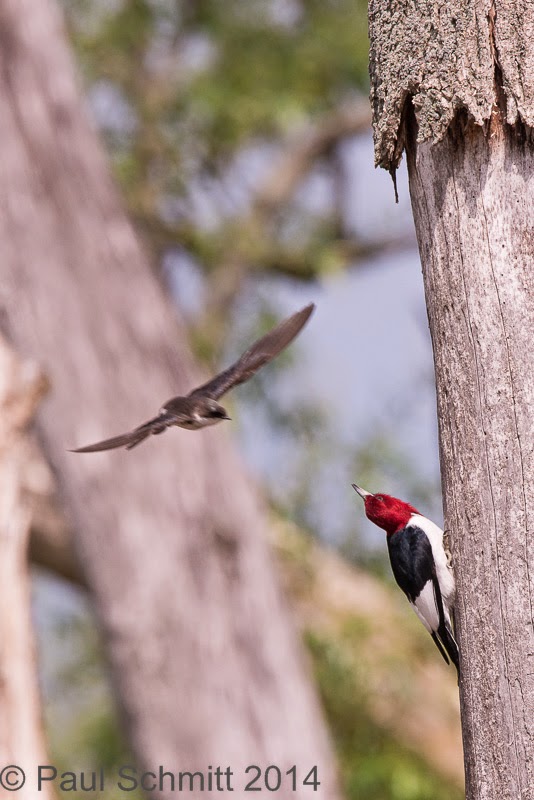
Now, these cavities are prized by a number of other birds seeking a nesting spot, so there can be conflicts.  I saw one such episode where the woodpecker was protecting the cavity from the much smaller Tree Swallow.


 In this case, the swallows quickly abandoned the plan.  Starlings have also been seen trying this with a more serious conflict resulting. 

One of my goals has been to capture the birds in flight at the nest. They are very fast when flying, but after many attempts I finally got one leaving the nest to the care of its partner.

 
I'll be continuing my attention at this nest and hope the pair is again successful in raising young this year.  

Paul


Sunday, April 27, 2014

You don't always get what you want

Twice I have gone to a nearby wildlife refuge with the expectation of getting close to some entertaining bird behavior. There have been a few close encounters such as with this pair of Ringed-neck Ducks.  Overall it has been frustrating as the birds are always distant.

The Ringed-necks are an interesting diving duck.  The male's beak is brilliant and his eye glows in direct sunlight.  Getting the pair together on the surface is a bit of luck and anticipation.  But, I wanted more and was fortunate to capture one image of the male in flight.  (Not easy.)


What is really cool is that I caught just a little of the purplish band on his neck, that early ornithologists chose to apply the "ring neck" descriptor.   It's right at the base and maybe calls for a little imagination to see.

So, why was I not getting what I wanted?  Because there were tons of other ducks, and all of them were too far and much too skittish and most days have been very windy and rainy.  Bad conditions.

So, I went off of my program and found cooperative Tree Swallows, which are as about as plentiful as American Robins.


Nice color on them but only a so-so photo, and not interesting behavior.

On the second day in the refuge, the birds were even more distant and the intermittent showers made for crummy light. We were coming along a line of flooded timber paralleling the road and  searching for a pair of Wood Ducks that might have landed in some trees.

There in a large maple tree in the flood plain was a suspicious cavity that seemed all fuzzy and hard to focus upon.  At first, it was the rump of something very hairy.  As it shifted, we discovered  something to substitute for the distant ducks.


So, I surely did not get what I wanted, but I was given something that I could not have expected. The Raccoon is pretty clearly a juvenile.  (Second one I have seen in the refuge.)  So, I have learned that the key to getting interesting natural world images is simply two fold - first is to know your camera so you can react quickly, and second is just to get out in the field. I'm pretty happy with this shot.  it encourages me to just keep trying.

So, I am abandoning the refuge and going to some private locations.  Today, as I was preparing a site for tomorrow morning, I had a juvenile Bald Eagle fly out of a tree directly overhead. I have never seen a Bald Eagle at this location in the about five years.  I'll be alert for him in the morning.  So, will it be ducks, bald eagles or even warblers? If one of these shows interesting behavior, then I will get what I want, just not always what I expect.

Paul Schmitt


Wednesday, April 2, 2014

Snow Geese!

I've been  hard at work redesigning my website with little time out for actual photography.  After reading for nearly a week about the huge numbers of Snow Geese flying north through the Finger Lakes, I finally got a good day to see for myself - sunny and mild. 

The most striking thing about Snow Geese is surely the overall effect when they fill the sky with a nearly complete mass of flapping wings and fill your ears with a raucous cacophony of voices.


They often seem to become excited for no apparent reason, and waves ascend to land in another nearby marsh.

It is a challenge in such a mass of birds to concentrate on just a few at closer range. Tracking them through the viewfinder is not always easy, nor is there much time to decide which birds to include.


Another beautiful aspect of the show is the coordinated flight of pairs. I assume they are bonded pairs since it occurs so often as two, not three or five. 


Now, it is back to my work on my website.  The redesign is complete today.  I've worked to make the watermark less intrusive.  (It is only on the web pages and not any purchased images.) There are now two featured galleries at the top, one of select images suitable for decorating home or office, and another one of colorful images sized to make beautiful mouse pads. You'll find one image on the mouse pad that is a sky full of Snow Geese.  The website is:  http://pschmitt.smugmug.com/

I've listened to suggestions for this redesign, and hope I have been able to meet those expectations.  I welcome any comments.

Warm regards,
  
Paul Schmitt