
We hope to spot a rare bobcat or snowshoe hare. We'll settle for the first group of bison near one of the pull-offs. But what we often get is a spectacular landscape of the Madison River valley and a distant volcanic ridge. There will likely be some ripples on the river from a lone common goldeneye diving under the shiny blue surface for food. It is beautiful, and quiet. We all pile out of our three snow coaches to find the perfect spot for a landscape photo.

We quickly learn that when stepping away from the hard road surface of compacted snow, your feet will plunge in to deep snow, often up to your knees. Walking to the river's edge is laborious. Coming back is harder.
Our aging Bombardier snow coaches prove to be ideal for our day's journey. The tracks smooth out the undulations from the snowmobiles and the mammoth all-wheel trucks.
 Our coaches have two roof hatches that we can photograph from. This proves invaluable when we stop for bison. If they approach within 25 yards, everyone must be inside their vehicles, but unlike the trucks, we have hatches that allow us to continue photographing. On our next stop, there were bison in along the Madison rooting through the snow for grasses. They decided to climb the bank towards our coaches. Quick, into the coach.
There would be daily opportunities to photograph bison. And there would be numerous times when our drivers would negotiate bison on the road.

The bison herds in winter are chiefly cows and calves. Bulls are seen singly. They are all pretty docile with the focus on survival, not mating. Food is scarce and poor.

There are other critters to be seen along the rivers, like these trumpeter swans. They exist only because market hunters were unaware of a small population in the remoteness of Yellowstone.

 We rarely failed to stop at the Madison Junction for the facilities- clean, modern and offering a coffee and snack bar. Every stop there also included looking for the dusky grouse that occupied the spruce trees along the entrance road. Sometimes one was sitting in a snow bank.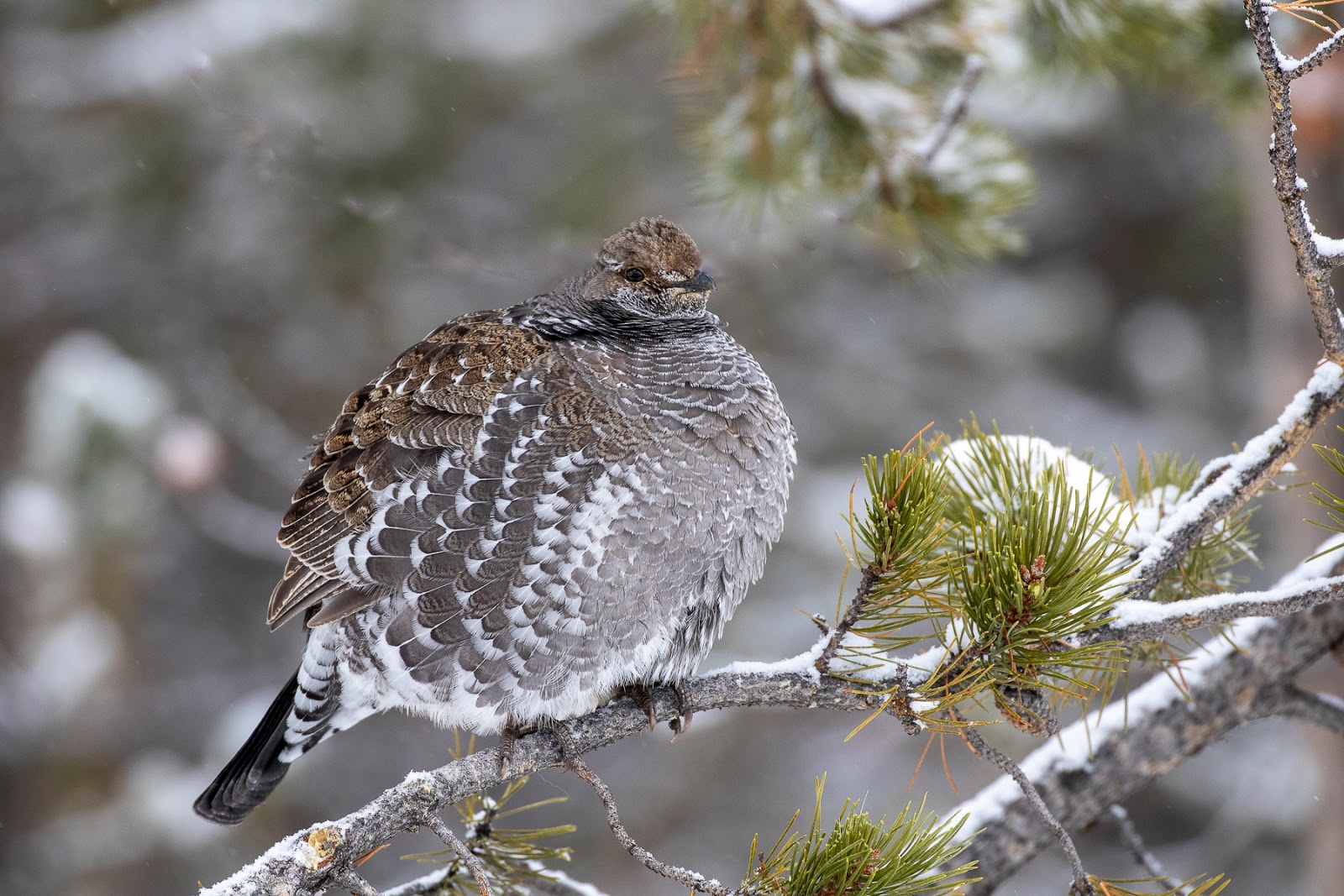
But, as we motored, most eyes were looking for animals. Our experienced drivers were always alert. I had a camera body with a long zoom lens ready. Sometimes the opportunity was too brief, and it was down to a quick popping up through the roof hatch. The first passenger ready gets the first shot. Such was the case for this bald eagle along the Gibbon River.

On another day, a bedded coyote was spotted some 200 yards across the Madison River. We'd seen a pair there the day before. Suddenly I saw the reddish coat of another coyote at the river edge only 50 yards away. It was hunting a little side slough of the stream.

Soon, everyone was out of the coaches and we watched the coyote meticulously patrol along the slough. It focused its attention and pounced!

The evidence of critters in winter is sometimes slender. We'd stopped along a river for landscapes. This small spruce was growing on a glacial boulder in midstream. I was attracted to the tree's shadow that led the eye to an even smaller seedling atop the boulder.

I became bored with the location while most others were still exploring the river. I looked upstream where there was evidence of nighttime visitors, possibly two kangaroo mice.

There were other signs in the snow, too. On the Yellowstone River near the falls were river otter tracks along the icy stream, but no otters. There is another side to Yellowstone in the winter, the landscape. There are icy waterfalls, thermal hot springs, geysers and wintery shapes on the mountain walls. That will be in Discovering Yellowstone in Winter - Part Two.
Enjoy.
Paul Schmitt


