Showing posts with label Yellowstone. Show all posts

Monday, February 10, 2020

Discovering Yellowstone in Winter- Part One

Entering Yellowstone in winter is very different from the summer routine. There are no lines of private cars and tour buses. Sunrise is later, and often a gradual event under thick clouds.  The tour leader presents documents and park passes to the ranger and comes back with a large bag of candies from the ranger.  At 8 o'clock, we are ahead of the snowmobile groups as the snow coaches proceed along the Madison River.  Soon our focus is on spotting critters.

We hope to spot a rare bobcat or snowshoe hare.  We'll settle for the first group of bison near one of the pull-offs. But what we often get is a spectacular landscape of the Madison River valley and a distant volcanic ridge.  There will likely be some ripples on the river from a lone common goldeneye diving under the shiny blue surface for food.   It is beautiful, and quiet.  We all pile out of our three snow coaches to find the perfect spot for a landscape photo.


We quickly learn that when stepping away from the hard road surface of compacted snow, your feet will plunge in to deep snow, often up to your knees.  Walking to the river's edge is laborious. Coming back is harder.

Our aging Bombardier snow coaches prove to be ideal for our day's journey.   The tracks smooth out the undulations from the snowmobiles and the mammoth all-wheel trucks. 

Our coaches have two roof hatches that we can photograph from.  This proves invaluable when we stop for bison.  If they approach within 25 yards, everyone must be inside their vehicles, but unlike the trucks, we have hatches that allow us to continue photographing.  On our next stop, there were bison in along the Madison rooting through the snow for grasses.  They decided to climb the bank towards our coaches. Quick, into the coach.


There would be daily opportunities to photograph bison.  And there would be numerous times when our drivers would negotiate bison on the road. 


The bison herds in winter are chiefly cows and calves.  Bulls are seen singly. They are all pretty docile with the focus on survival, not mating.  Food is scarce and poor.


There are other critters to be seen along the rivers, like these trumpeter swans.  They exist only because market hunters were unaware of a small population in the remoteness of Yellowstone.


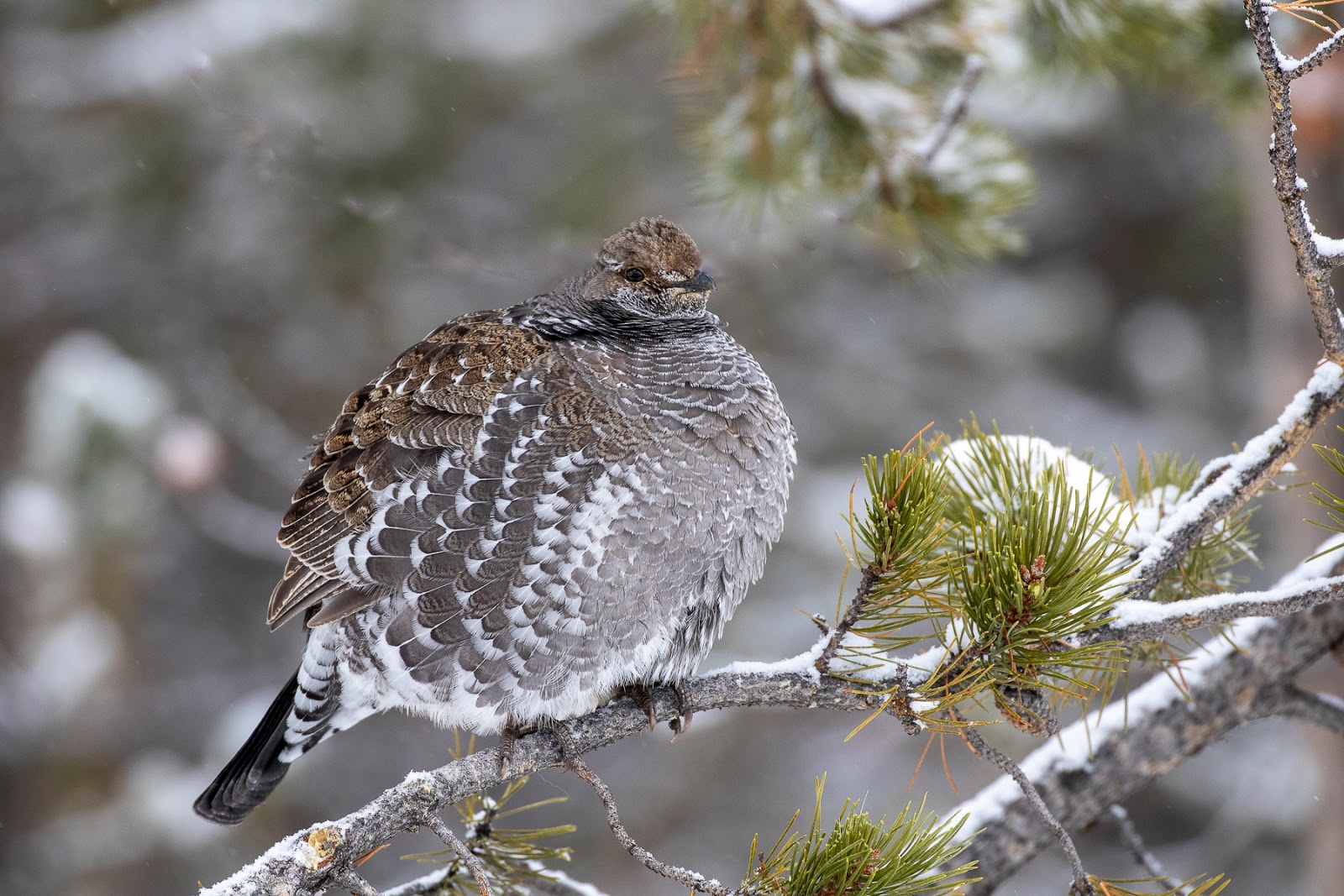
We rarely failed to stop at the Madison Junction for the facilities- clean, modern and offering a coffee and snack bar.  Every stop there also included looking for the dusky grouse that occupied the spruce trees along the entrance road.  Sometimes one was sitting in a snow bank.
But, as we motored, most eyes were looking for animals.  Our experienced drivers were always alert.  I  had a camera body with a long zoom lens ready. Sometimes the opportunity was too brief, and it was down to a quick popping up through the roof hatch. The first passenger ready gets the first shot. Such was the case for this bald eagle along the Gibbon River.

On another day, a bedded coyote was spotted some 200 yards across the Madison River.  We'd seen a pair there the day before.  Suddenly I saw the reddish coat of another coyote at the river edge only 50 yards away.   It was hunting a little side slough of the stream.  

Soon, everyone was out of the coaches and we watched the coyote meticulously patrol along the slough.  It focused its attention and pounced!

The evidence of critters in winter is sometimes slender.  We'd stopped along a river for landscapes.  This small spruce was growing on a glacial boulder in midstream. I was attracted to the tree's shadow  that led the eye to an even smaller seedling atop the boulder.

I became bored with the location while most others were still exploring the river.  I looked upstream where there was evidence of  nighttime visitors, possibly two kangaroo mice. 


There were other signs in the snow, too.  On the Yellowstone River near the falls were river otter tracks along the icy stream, but no otters.  There is another side to Yellowstone in the winter, the landscape.  There are icy waterfalls, thermal hot springs, geysers and wintery shapes on the mountain walls.  That will be in Discovering Yellowstone in Winter - Part Two.

Enjoy.

Paul Schmitt


Sunday, February 9, 2020

Grizzly and Wolf Discovery Center- West Yellowstone

I have long wished to see the snow-covered landscape of Yellowstone National Park.  In late January 2020, I began this long-anticipated trip a day early to avoid any weather related delays.  My  trip was led by John Gerlach, a long time resident of West Yellowstone (and an accomplished photo instructor).

Flying over the plains of Montana approaching the Bozeman airport, I was concerned by what I saw beneath me.  The only snow visible from 35,000 feet was hidden in the lee of small ridges.   Would Yellowstone be barren of snow?  I over-nighted in Bozeman and boarded the Karsch Stage's bus at 4:30 am for West Yellowstone.  As the bus approached the Big Sky ski resort for an inter-mediate stop, my fears were gone - maybe not deep snow, but enough to suggest that at the higher elevations, there would be deep snow.  Nothing to worry about; and, the forecast was for mild temperatures between 12 and 30 degrees.  Perfect.

Arriving in West Yellowstone at 08:00 am, the streets were snow-covered.  A hearty breakfast at Three Bear Hotel told me that John Gerlach had picked a great place for our group's lodging and food.

The Gerlach program did not begin until after dinner, but I had plans to fill the day. It was a short two block walk over to the Grizzly and Wolf Discovery Center in West Yellowstone.  My goal was to get some practice in action photography. I scouted in the morning, and returned after lunch with camera.

The center has multiple groups of grizzly and wolf.  For both species, they have large outdoor runs that are kept meticulously clean.  The outdoor run is prepared with treats and natural scents before a group of 2 or 3 animals is allowed out.  They enter stimulated to explore the area, and the local ravens are actively interacting with them, too, as they look for food scraps. 

Let's look at the grizzly first.  The keepers hide treats under some logs in the enclosure.


One of my first lessons was how difficult it is to see a bear's eyes.   There are nearly no whites to see, and they are very dark.   Another challenge is separating the bear's shape from the gang of ravens.  Patience.


Another lesson is using a wide open lens aperture to keep the background indistinct. The bear enclosure had limited angles where the fencing is unseen. It was still very useful practice.

The wolf enclosure was also fruitful, with the wolf's fleetness offering challenging but rewarding photography. The eyes are easily seen, and capture your attention.  This wolf was prone to bursts of running, that often were free of any elements of the fencing.


Most of the wolves were towards a blackish color, and this one particularly attracted me.


On my first day at the center, it often snowed.  In the bursts of snow, it became impossible to lock focus on the eyes of a running wolf.  The camera always locked on a large snow flake closer to the camera.  On the last day of the Gerlach program, we returned to the Grizzly and Wolf Discovery Center, giving me another opportunity with moments free of snow.


There were other attractions in the discovery center.  The Great Horned Owl pair were attractive, but the enclosure always ruined the photo with fencing.  There was an indoor space with River Otters and a fish pool.  I'd  wondered if the fish were to feed the otters. No, I was told; that would have made for some wild viewing.


As it was, I did get a short clip of a lone River Otter while using my mobile phone.  I'd hope to see the otters on the Yellowstone River later in the week.  Had to settle for seeing their tracks in the snow.


One last goal on my trip was getting a good image of one of the Ravens.  It's hard to get the dark eyes and tones of their feathers.  On the last day, back at the Grizzly and Wolf Discovery Center,  I closed my visit out with checking off the Raven from my photo list.


I will soon provide coverage on my five days in the winter wonderland of Yellowstone Park.  You will see that the park has a different personality in winter. Snow and ice create a new landscape.  A vastly smaller number of visitors present cleaner landscapes.  The bison are plentiful and present many interesting portraits.  The winter light is less harsh than summer.  I loved it and only want to experience it again.

Paul Schmitt