Wednesday, September 6, 2023

Winged Gold- Late Summer

My last post was titled Golden Joy.  Now those sunflowers are all mature seeds.  I am continuing the "gold" theme with two flying critters that also deliver joyful reactions.  

One principal source here is cone flowers. Top on the list of seed eaters found on them are the Gold Finches.  The male at left is just pausing. When his crop is full, he'll soar away to feed the chicks. Initially, the female stays on the nest and I only see males. But soon, the demand by the chicks is too much for the male, and both of the pair engage in furious harvesting. Then, in a few days, the chicks fledge and the activity nearly ceases.

Often, the Gold Finches are mostly hidden in the densely packed clusters of cone flowers. After many largely hidden birds, one male chose a nice single stalk to feed on. The camera jumped into long runs of high speed shooting. The result was two "keeper" images out of a sequence of over sixteen. 


Another golden flyer is the Tiger Swallowtail butterfly. This one was feeding on other cone flowers in a more southern location, where they hadn't yet gone to seed. You can tell that it is recently emerged.  With time, they can get pretty ragged on the fringes.


A few moments later, I found a butterfly bush in full bloom.  I was amazed to see two swallowtails sharing the same plant.  


These golden flyers won't be around long.  I'm schedule next week for a short outing to see bugling elk in western Pennsylvania.  Autumn is just around the corner. 

Paul Schmitt

Thursday, August 17, 2023

Golden Joy

It's pretty safe to say that a laughing baby brightens up any moment. It's golden. There's another discovery that is pretty sure fire.  Sunflowers!  A short detour from my outing to fill the car's gas tank this morning took my mind off the long "to do" list that I faced.

Today was a very busy day as we prepared to depart for some granddaughter time.  I had only minutes to explore the field.  I think the field will have a long run as a succession of golden flowers reach peak, and then fade into reddish seed heads. 


I think the flowers take on facial characteristics, as some look joyfully upward and others nod downward as maybe being thoughtful.

Maybe the sunflowers energized me.  As I write this, my entire list for the day is completed.

I hope you can find some sunflowers just as I did.

Paul Schmitt


Thursday, August 10, 2023

Traveling Light on a Foggy Morning

At 6:30 am this morning, I began a walk at a nearby park with the aim to get it done before the morning rain arrived from the west.  I am not a regular early walker unlike several gentlemen. As I turned on to the abandoned Rhode's farm road, one of the regulars called out "what, no camera today?"  He knows me.  My reply was simply "I'm traveling light!"  Light meant my iPhone 13 Pro seen at right.  I expected mostly a nice walk and maybe a few birds.  

I'd forgotten how nice the early morning is with everything damp from some fog.  The first discovery was a trio of teasels newly in bloom.  Notice how they begin blooming at the top and work their way down.   Bumblebees love them.

I rediscovered using the portrait mode on the 13 Pro.  Portraits keep the focus near the front and rather shallow, so the background doesn't compete with the people (subject).  If your phone has a portrait setting, give it a try for more than people shots.

I really did not pause very long to photograph, as the rain was on the radar. My next find was a wild Morning Glory.   The pink flowers are low thistles that will soon be the target for Goldfinches collecting seeds for newly hatch chicks.

Next, I had to stop for a single Sumac.  The dampness produced richly saturated colors, and soft light avoided any shiny hot spots.


Again, the portrait mode blurred the background.  The key for capturing my attention was a single isolated subject.  I wish that early in my learning a teacher had explained the value of composing  without confusing intersections (called conjunctions.)  

I got underway quickly and was maintaining a good pace until I saw a two layer composition-  teasel and goldenrod.


You might complain that the goldenrod is not quite sharp. True.  The teasels are closest and brightest.  That's where nearly everyone starts, and surely we know the form of goldenrod sufficiently.  

Back underway, I reached the end of the road and turned back.  Have you ever walked a long hiking trail, and when turned around, the view was unfamiliar?  You might even be confused.  Well, I was not puzzled, but I did see another interesting composition. None of the Queen Anne's lace seemed attractive. But now it was floating over the abandoned road showing me the way home.

Again, the subject avoids being conjoined with the green surrounds. 

Now, back towards my car. Reaching Lowe Pond, I just had to stop for this single Purple Loosestrife.  Yes, it's an invasive plant that will never yield its place, but using the portrait mode did make a nice result.

I could now see sprinkles on the pond, so there were no more stops. The tracker says 2.03 miles in 58 minutes.  Not bad considering nine stops along the way.

Paul


Friday, August 4, 2023

Kenilworth Aquatic Gardens

Along the banks of the Anacostia River in the District of Columbia is the Kenilworth Aquatic Gardens. It's operated by the the National Park Service.  In mid-July, it's predictably hot and humid, so I arrived when the gates opened at 8:00 a.m.  As you can see at the right,  it does get crowded around 10:30 am, when I'm leaving for the day. 

The main attraction for me is the large number of water lotus in bloom.  The huge flower is matched by the disc-like seed pods that appears later.

Photographing the water lotus has its difficulties.  They grow in large, shallow water pools that are easy to admire, but much more difficult to photograph from dry land.


Luckily, on this visit there were no mosquitos at add to the challenge.  I find the new flower buds very appealing, if I can find an uncluttered setting with a bit of early morning light.

Another favorite setting is the combination of a new bud plus a fully open flower.

Mixed in with the lotus are pools with water lilies.


Water lilies are more challenging because they are not standing on a tall stalk at my eye level, and frankly, getting down to their level muddied my knees, and attracted bemused looks from non-photographers.  (I'm used to it.)


There was another unexpected flowering plant in the shallow water, identified by my friend Rosemarie Parker as spider lily.  It's appearance suggested tome "orchid", so I had to once again get down low to capture its beauty.

I was rather pleased with the resulting image.

An added bonus to my early bird arrival was capturing one of only three parking spaces under some shade trees.  

Paul Schmitt


Wednesday, June 28, 2023

Snapshots of Prince Edward Island

The eight mile long Confederation Bridge was opened in 1997.  The idea of a bridge was heatedly debated before a referendum passed by 59.4%.  It transformed life on the island and eventually gained widespread approval.  We arrived at the bridge on a windy, rainy morning.  New visitors frequently stop at the viewpoint on Cape Jourimain as these young people did.  The ride across the bridge is smooth, but we'd have liked to have had a clearer view.


Once on the island, one soon sees hallmarks of this small province with only about 150,000 residents.  The sea is always nearby, so a great variety of lighthouses are seen.   This is Cape Bear Lighthouse where the first radio message was received from the stricken Titanic.

Largely, the lighthouses are wooden.  The island lacks hard stone that is so often used elsewhere.

Two more constants are flowering lupines and small fishing harbors.  The lupines are widespread.


There is abundant seafood to feast upon.  This lunch featured a fresh haddock sandwich and bay scallop tacos, both with PEI potato salad and cabbage slaw.  You can't drive more than 5 kilometers without passing a field of potatoes. 

Another certainty is friendly people.  Pam and I agree that the residents are another hallmark.

Our first three days were marked by cloudy and breezy days - not ideal for photography but fine to explore.  On several occasions, we visited locations marked by seaside tragedies.  This is Covehead Lighthouse.

 
The Yankee Gale of  October 3, 1851 claimed 74 ships and 150 lives.  The fishing fleet was calmed in the evening and unable to return to harbor.  In the night, the gale drove the fleet onshore with no mercy.
 
For most of our days on PEI, I searched for that perfect display of lupines.  There was this small bouquet framing a grave marker next to a rural church.  Not many are colored pink so I liked these.

My luck changed when we visited an abandoned shipyard at Murray Head across the bay from Georgetown.  Wow, three lupine colors in one place.
 
While researching places to visit, I discovered a number of "Pioneer Cemetery" listings.   There was one near Cavendish called "Yankee Hill Pioneer Cemetery".  It also had a lighthouse nearby.  Walking in on the private road, we were greeted by the owner who was in the process of clearing the trail to the side.   Bruce highlighted the history and paused mowing while we explored.


These are the stones for Mary Pickering (1792-1878) and Thomas Pickering (1790-1878).  They had eleven children.  He was a farmer, mariner and shipbuilder. 

Another was a marker for George McKay, a native of Durness, Scotland.  (1763-1816)

Bruce is building a home on Yankee Hill with a ocean view that includes a view of this lighthouse on London Bay.

It may seem unusual to include cemeteries in an itinerary, but in Atlantic Canada, they are  a continuing link to people's pasts. We stopped at the Brackley Beach Cemetery on the north shore where two ladies were unloading trays of flowers for placing on markers of family members.   In Cavendish Cemetery, this marker honoring mariners lost in earlier mentioned Yankee Gail of 1851.  At a cemetery in Georgetown, this marker remembers a boy lost at age four.  Note the childhood ornaments for those who died young.  I've seen this elsewhere.

At our last hotel in Montague, I woke for the very early sunrise.  The highway bridge was lined with planters full of petunias.

The sunrise was framed with three large cast sculptures of cormorants.


It was now time to head home.  Again, we stopped at the Confederation Bridge for one last look.


We paid our $50.25 toll and returned home..

One last comment is for golfers.  The island has many lush courses that could be imagined to be in Scotland- rolling hills, sandy bunkers and picture perfect greens.  We met several people touring across the island for a new course each day. Sadly, I was terrible at golf.

Paul Schmitt

Monday, June 12, 2023

Sauntering in the Shenandoahs

Now these mountains are our Holy Land, and we ought to saunter through them reverently, not 'hike' through them.       

                                                John Muir

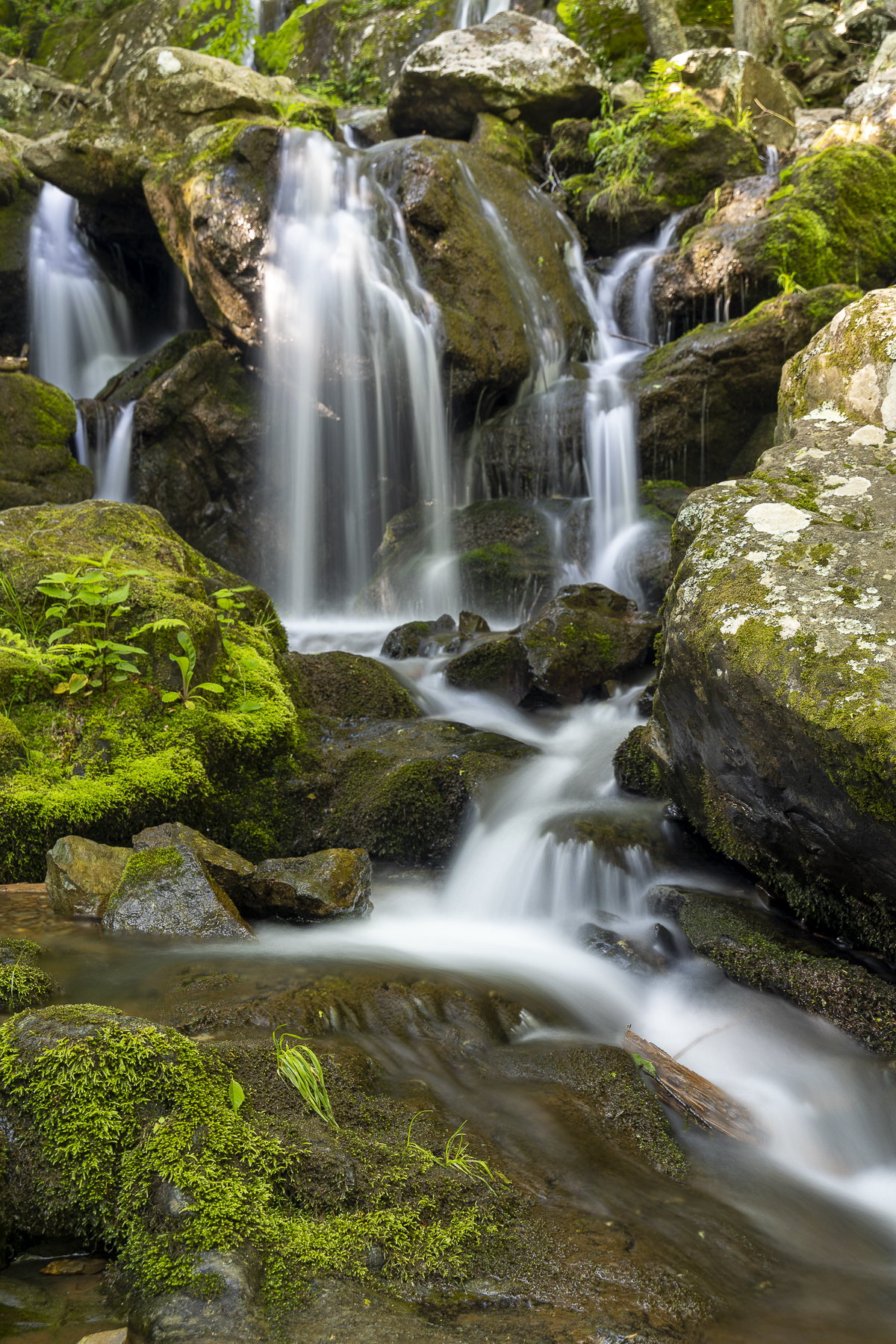
Here are a few photographs which appealed to my eye at various places along the Skyline Drive, Virginia.  True to Muir's idea, I tried to keep my pace slower.  First are two falls found in Dark Hollow near Big Meadows.   The upper falls has several drops on it's way to the viewer:

I chose to include the lower three.  What most appealed to me was the mossy covered rocks framing the milky white water.   Just below this was another smaller scene that I labored to frame while simultaneously keeping my boots dry.

Why use such a slow exposure?   The slow, steady movement down Dark Hollow stream was peaceful. So, the silky water matched my feelings.  There is no one right shutter speed, but there can be one that conveys how I perceive the motion.

On Limberlost trail, I hoped for some wildflowers.   This fascinating flower seems related to Columbine, but the color seems unusual.  The small spider makes it special.   It appears in only one of the seven images in the stack necessary to capture sharp focus on the entire flower.


Also on the Limberlost trail there was a Pink Lady's Slipper, Cypripedium acaule.  These are truly a wild orchid since there has never been a success raising them from seed.  So, every one I see is exciting.


This was a big surprise given the large population of whitetail deer in the national park.  There was sign of some browsing on some plants.  There has been no deer hunting in the national park since it inception in the 1930s, and in my personal opinion the forest under story is greatly diminished in its diversity.

There were also some "critters" in the park that were of interest.  I value a singing Indigo Bunting as always a treat.  There were dozens at several overlooks, and a few that perched in an uncluttered place  to perform.


As I drove the Skyline Drive,  giant yellow swallowtail butterflies soared past, and sometimes found suitable blooming flowers to feed upon.  On one occasion, one of them found a spot at an overlook where one could safely park.  Hesitate, and they are soaring off to a distant place.


At another stop, an Eastern Towhee jumped into song (as the males are so oft to do.)  They really throw everything into the song.  Again, the trick is to wait for an uncluttered perch.

There was a heavy fog one morning, or perhaps the mountain ridges were just in the clouds?  There is a softness to the light and a quietness that mutes any traffic.   Only a little yellow color was revealed.  This took me back to foggy morning scenes around 1953 at my uncle's farm in southern Indiana.  These were the same -Moth mullein- yellow flowers. 


Finally, the distant hilltops and ridges in the Shenandoah are best seen in monochrome. 


Life is old there, or so the saying suggests. Ninety years with no logging produces some massive trees.  But I saw few sapling trees to replace them.  I wonder what the future will bring?

Paul Schmitt

Saturday, May 27, 2023

Three Favorites from May 2023

It's time to wrap up May with three bird images that have some meaning to me.  First, is an elegant Cedar Waxwing that was part of a group of about five that were gleaning caterpillars incredibly close to my parked car.

Waxwings are a huge treat when they appear.  Their contact singing is so extremely high pitched that any background noise will surely leave it disguised.  They move through the cover like ghosts.  

On the same morning, a pair of Brown Thrashers appeared.  Not shy like waxwings: rather bold in human terms.  More often they are in grass fields, so finding this one perched was unusual. It appeared to be surveying the grasses for insects.

The thrashers generally nest in a series of dense thorn bushes.

Bobolinks are always a subject for my May outings. It seemed to be an off year for them and most outings were failures, especially in the quest for flight images.  This boy did stop to sing in the hope that the females had arrived from South America.  The rich yellow cap on the head plus the bold black and white patterns on the back (not visible) are supplemented by their bubbling song. Look at the scalloped ends on the tail feathers. 


Two weeks later, all of the singing was over and the ladies were in their ground nests. 

I noted the black and white patterns on the back.  Well, the otherwise inadequate flight image on the left does illustrate one more reason I track these boys in May.  This was at 1/2000 second, and I still couldn't precisely track his flight.  Next year!


Next for me is June in Shenandoah National Park.

Paul