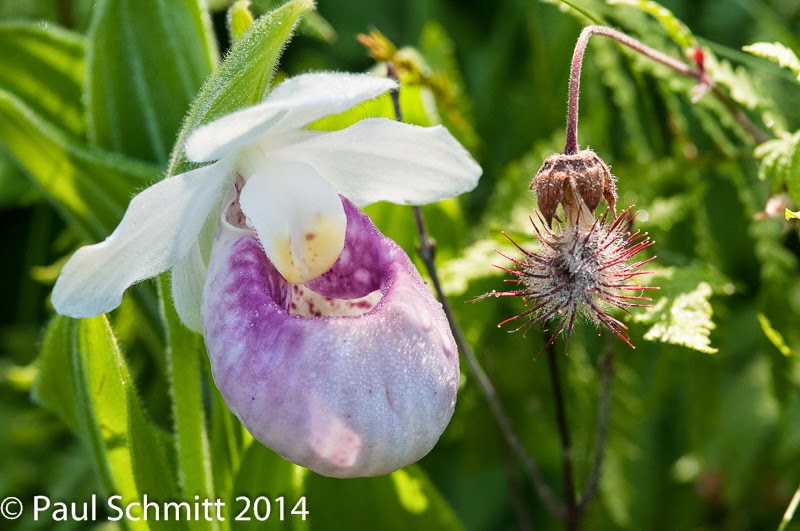
A first visit to the Smoky Mountains offers the opportunity to find and photograph native wildflowers not common to the northeastern United States. The trip was a success, and I'm sharing images of six native wildflowers that I found most interesting.
When I scheduled the trip for the first week of April, I feared I could only find the earliest spring ephemerals. But this has been an extremely mild winter and a very early spring, so the early ephemerals were mostly finished. As an example, instead of blooming Hepatica, I found its seed head and new array of leaves that are formed only after blooming is complete. This meant I'd be looking for the later blooming natives, and of course adding some waterfalls given the wet spring they were having. I'll share the waterfall images in a later blog.
 |
Showy Orchis
|
So, here is the first of six native plants that I found in bloom. All are interesting to me, and hopefully to you. The Showy Orchis (
Galearis spectabilis) seen at left
is in some ways similar to the much larger Showy Lady's-Slipper (
Cypripedium reginae). Standing only 5 to 10 inches high, it presents a cluster of blooms. It has two basal leaves and a leaf-like bract at the base of each flower.
I found it in numerous locations within the Smoky Mountain National Park including the Roaring Fork Motor Nature Trail, the Porter Creek Trail, and several trails near Elkmont campground. It was also prolific in the Joyce Kilmer Memorial Forest just southeast of the park.
 |
Crested Dwarf Iris
|
The second wildflower that I found interesting was the Crested Dwarf Iris (
Iris critata). Standing only 4 inches typically, I was sure to get muddy knees every time that I got down to photograph it.
Each sepal of the bloom has a yellow crest, and the leaves have a rich spring green. We found this in many moist locations, sometimes in great clusters. This proved a difficulty in that I wanted a single plant isolated so its form was immediately recognized.
It is a very lovely plant that seems to fade rapidly. Probably the largest numbers were on the Porter Creek Trail in the park.
Foremost on my list of plants were two trillium that are unique to the area, Catesby's and Vasey's Trillium. Each is a nodding type where the bloom hangs down below the leaves. Neither is widespread.

|
Catesby's Trillium
|
I was successful in finding a very few Catesby's Trilliums (
Trillium catesbaei) at a location near Cades Cove. This example has white petals, but I also found one with a light pink as the field guides suggest. In any future visits, I will concentrate more on areas around the Joyce Kilmer Memorial Forest near Robbinsville, North Carolina. In this first visit, I mostly stayed on established trails so that I could cover more ground and learn the best areas. I did see a few possible examples of the Vasey's Trillium, but I was uncertain of the identification and will not include those images.
Now to the fourth and arguably the most interesting flower, a relative
of the Wild Ginger common from the northeast to the
Smoky Mountains.
 |
Little Brown Jugs
|
Little Brown Jugs (
Hexastylis arifolia) is a Birthwort which stands about 4 to 6 inches tall. The waxy arrowhead shaped leaves are distinctive for identification. That is fortunate in that the reddish -- mauve?-- flowers on nearly every plant I found were hidden within the leaf litter. The only exceptions were with a few on steep hillsides. The flowers are reported to be pollinated by fungus gnats. Noting the small opening in the flower, it certainly must be a small creature.
A local book reported that the stems were used to make a tea used to treat whooping cough.What else did they have in that early era?
Now to a flowering plant that may not be unusual, but is charming. We had talked with one of the visitor center ladies in Cades Cove, who volunteered that concerning wildflowers, "Joe knows". So we found Joe and he suggested some great places including a rock cut on the Laurel Creek Road coming out of Cades Cove. We found it. It happened to be one of the few with a flat area to safely park in.
 |
Wild Bleeding Hearts
|
The nearly vertical rock face was dripping with water and a huge number of plants grew on the rock faces and small ledges. Stonecrop, trillium, violets and beautiful Wild Bleeding Hearts, (
Dicentra eximia). This plant was growing out of a moss covered vertical wall which I have to assume remains damp all summer.
 |
Squaw Root
|
Finally, a most unexpected plant was Squaw Root (
Conopholis americana). The average height was about 6 inches. It is a parasitic plant that derives nutrition from oak tree roots since it has no chlorophyll itself. To me, it looks like small ear of corn. Each protrusion from the stalk is a flower. I often found large clusters of Squaw Root, as many as ten in a single group.
My main challenge in photographing this unusual plant was to find a fresh example as it appears to quickly turn brown. Black bears are know to feed upon them although we saw no evidence of that.
Now, final comments on visiting the Smoky Mountain area. First, consider if your visit coincides with school breaks in spring; ours did and it made for more traffic. Next, consider some alternatives in lodging location. The most popular town for lodging is Gatlinburg which is a huckster's dream and at times approaches gridlock. If a quieter visit the north side of the national park, I suggest looking at Townsend. It is closer to some prime areas such as Cades Cove and trails such as Chestnut Top, Lead Cove, and Elkmont. Cades Cove can be excellent in early morning for wildlife too. Finally, recalling that I was very impressed with the Joyce Kilmer Memorial Forest, I also recommend looking for lodging in the southwest corner between Robbinsville and Tapoco where you are more likely to find only B&Bs. Keep in mind that US129 west of Tapoco is a twisting road that attracts large numbers of motorcycles. Lodging near Tapoco might be a tad noisy at times. We often noted the profuse number of Rhododendrons and wished we could also visit when they are in bloom. Some of the waterfalls and cascading streams would be spectacular when they bloom. I guess you can't have it all in one visit.
Paul Schmitt