Showing posts with label New York. Show all posts

Monday, February 12, 2024

Learning from a Winter without Snow

When the Art of Winter program by creative photographer Chris Murray was announced, there were justifiably visions of snowy forests with stark birch tree stands and graceful glacial drumlins across the land.  The hope was to find scenes like my March 2021 image at right of Cayuta Outlet near my home.  Sadly the Thousand Islands this year in February had scant snow cover.

The three days were going to be challenging,  yet that might actually turn out to be a better learning opportunity.  There arrives a call to more deeply observe and really understand what draws your interest. What follows are a selection of images that offer enjoyment and hopefully also ideas for coping with rainy days, dull light and otherwise disappointing situations.  Hasn't that happened to everyone?

On one morning we went to Dewolf Point State Park on Wellesley Island.  It is on a bay with only a very narrow connection to the main river.  Unlike most river areas, the bay is largely immune to river currents, so there was plenty of good ice. Arriving shortly before sunrise, two fishermen were soon loading their sheds.  We'd walked out to a line of summer cabins facing the expected sunrise.  The view did not impress me.  As I walked back to another view with a stately red cedar, the sound of the anglers' sheds crunching on the ice suggested they were on a path towards the point of the sun's appearance.   Backtrack quickly!  The sun can't be delayed.  See this!


There were two images to select.  When they were standing, the man's head on the right touched the dark treeline.  Creatively, it's called a conjoined element and is to be avoided.  Later, there were more fishermen on the ice but the missing starburst lowers the result to ho-hum. 

Once my gear was packed and I climbed the path from the view, there was warm sunlight bathing one of the summer cabins along the path.  Not wanting the open my pack again, the iPhone was pulled out.  This is an excellent time to ask the simple question, "what drew you to take an image?"  I hope you say something about the warm light on the line of icicles across the roof line of snow and also in the brilliant window reflections.

That was the answer for me. I am guessing this cabin is already reserved for most weeks in the summer.  Another thought is that a quick photo sure beats just ignoring the opportunity.  

Winter is also a rich source of beautiful monochrome images.  The next setting drew my interest as I saw this large snow capped rock with a fringe of icicles dipping towards the St. Lawrence River's waves. Many photos were run in continuous batch to get the best shape on the water. 


In other years, the river would be all ice and the wave shapes and fringes on the rock missing.  It's really a very simple photo.

The ice along the river builds forms often dependent on wind direction and the rock formats.   Here's another situation where the ice laid up a scalloped pattern.  

The real challenge for the above was getting into the narrow trough of rocks where the forms were free of distractions (and then climbing back up after my one leg fell asleep!)

The next image presents a contrast between a geological form and a seasonal form.  Hard rock and hard ice drew my interest.
 

I saw a sort of yin-yang pairing that was better in black & white. 

Later that morning at Dewolf Point, our leader took us to a long spine of hard rock that paralleled the northeast lay of the bay.   I conjecture that the spline resisted the glacial assault that excavated the bay.  Here's a wide view of the wall of rock exposed.


The panoramic image distorts the shape of the wall.  It's nearly horizontal on the top.  The height is close to 20 feet. One could spend a long day exploring the many patterns in the the stone.   The section below fascinated me.


So, I looked more closely and explored what I interpreted as a tree in a violent turmoil, perhaps a firestorm.  The large tree is in the far left and flames swirl away in a maelstrom.


That morning was surprisingly rich with ideas.  The afternoon was a bit challenging until the sun collided with a distant shore of the St. Lawrence River. Not any clouds, but a nice starburst framed by a nearby point.


The final morning sunrise was a bit richer when some wispy clouds appeared to capture the warm hues.


In terms of whiz-bang images, it was not easy.   But, measuring the lessons gained absent any "easy", it was extremely valuable.  I am not at all hesitant to share these images.  In every one, there is a clear reason why the subject was chosen and how it was arranged in the overall location. You cannot see what was excluded carefully to avoid any viewer confusion.  Success is knowing what to take and what to leave behind.  That's a line from a John Denver song "Friends with You."

Learning usually comes from challenges. 

Hope you enjoy the message.

Paul Schmitt


Sunday, September 11, 2022

Taughannock Falls- Seeing It in Six Images

In the Algonquin language,  Taughannock  means in the trees. The gorge is still surrounded by huge trees.  It is the tallest free-falling waterfall east of the Mississippi River. Those 215 feet have been most impressive to me in deep winter when it is covered with heavy ice, and growling with a deep-throated voice. The walk up from the bottom of the falls is a popular winter outing for many.

I realized I had not explored Taughannock in summer for over ten years.  So, today I took the challenge to create a fresh view of the falls in six images.  I first stopped at the overlook perched high on the edge of the gorge's north wall.  The September morning was foggy with a few wisps still in the tree tops.

The majority of visitors travel the 3/4 mile trail with few pauses to even look at the minor waterfall near the parking lot.  I find it has a lot of attractive smaller drops across its width.  Looking at right of center, I find a section with five different steps from top to bottom. In winter, much of the flow is hidden under large ice formations.


Even farther to the right edge, there is a set of three steps created by the layers of sedimentary rock.

I spent over half an hour just finding interesting patterns of falling water. So, these are my first three images, and I am still nearly 3/4 mile from the big drop. Time to work up stream.

From the first falls, the gorge closes on the creek. The fog began to disperse, revealing blue sky and painting the north wall with warm light.  It's a pretty spot and easy to walk into the stream bed.

I like this view for what it tells you about the steep north wall of the gorge and the gentle steps where the stream drops a few feet to the next level. Somewhere on the vertical wall up there is a peregrine falcon nest. (I saw it this summer with great difficulty.  It's very distant and the falcon's coloration blends in with the gray rocks.)

On to the falls.  The first photo that I offered is all you need to understand Taughannock's height.  I chose to concentrate on it's power. After a free fall of 215 feet, the water is moving so fast that it is a blur even at 1/250 second shutter speed.   The spray coats the rock walls for many times the width of the cascade.

Now, I am down to image number six. Between this falls and the first one I presented, the stream works down over several layers of relatively flat stone.  The surface has gentle ripples and puddles that create hundreds of small reflective "ponds". On a still day, these produce a patch work of images from the canyon walls. Seen below are islands of blue sedimentary rock in a sea of golden tree leaves on the distant slopes.   I find them entertaining to explore.


These are my six from today.  Allow me one more image from December, 2013 that reveals why winter is still my favorite.

And, yes, it was really cold.  I am thinking maybe I can find another Seeing It in Six in October, if  there are come good autumn colors.

Hope you find this enjoyable.

Paul Schmitt


Thursday, July 9, 2015

Thinking Back for Two Months

The pace has been so fast, that I have fallen behind on sharing images. So, I've looked back over May and June to find those images that recall special days.  My first close encounter with a Marsh Wren in the Montezuma wetlands in May came as a surprise. He landed in an odd perch and stared at me with defiance.


Closer to home at the Newtown Battlefield Reservation this Hooded Warbler, like the Wren above, chose a nice spot to sing for me. I can regularly find one of them along a particular trail.


For a third year, a pair of Sandhill Cranes was spotted in a marsh near Watkins Glen. Would they be nesting this year?  The quest to answer that landed me on sight for some colorful mornings.


I found the cranes on several different days in June in the tall grass, so any chicks would be hidden. Then, on one day as I approached my parking spot to explore for the cranes, they were standing out in a corn field in plain view.  Dropping into a drainage ditch for concealment, I got very close; it was obvious that they did not have chicks this year.  Mixed with  disappointment was the interesting display that one crane made.


In addition to the larger animals, there is a much smaller world that can be interesting.  This black ant was feeding on the nectar in the blooms of my rhubarb plants.


A good part of June was directed at the Bluebird Trail Farms, which was the subject of an earlier message.  Surely a favorite of the grassland natives was the Eastern Meadowlark.  It is a very strong singer for its size.


I have created a new gallery on my website devoted to grassland flyers - birds and a few butterflies. See it at:  http://pschmitt.smugmug.com/Grassland-Flyers/

In late June and early July, some of my attention moves to orchids and other beautiful flowering native plants. Arguably, the most exciting are the Showy Lady's Slippers. This cluster of blooms was photographed with my smartphone.


Most exciting was this pair that provided the two orthogonal views in one instant.


Back at the Newtown Battlefield Reservation, a White-breasted Nuthatch found a spider nest under some peeling bark of a White Birch, and I captured the moment when it pulled out the spider.


The American Goldfinch is a seed eater, so it nests later when the grasses are going to seed. This male is in fine colors as July begins.


In the meadows and grasslands, the birds' young are fledging, and one is more successful finding colored butterflies like this Fritillary.


Saving one of the best subjects for last, we come to the Canada Lily.  It's hard to find, because the over-abundant Whitetail Deer find it tasty.  I was introduced to a pocket of them isolated between a big river and a railroad yard in an urban location. No deer get there. Arriving in early morning, I spotted the first plants next to the river.


Some of the plants had profuse blooms. It was very striking. This is just two plants.


One distinctive feature of the Canada Lily is the "freckles" on the petals.


So, there is a view into why my last two months have passed so quickly.

Paul

Friday, June 12, 2015

Bluebird Trail Farm- Meadow Birds and More


I joined my friends in the Chemung Valley Audubon Society on a Bobolink outing  to the Bluebird Trail Farm in Caton, New York a few weeks ago. The visit sent me back for some serious photography.  There were abundant Bobolinks, plus many other grassland birds and an inquisitive Alpaca.  Actually, it is an educational farm with chickens, ducks, sheep, and goats, in addition to vegetable and fruit gardens. It is a great outing for the family. The Barn Swallows are plentiful, and a joy to watch returning to their nests in the big red barn. There are a variety of activities on their website plus clear directions. Check them out at: 

 www.bluebirdtrailfarm.org


So, what did this photographer find at Bluebird Trail Farm? Yes, there were Eastern Bluebirds actively feeding young in nest boxes. They were a little leery of my approach, so I left them to their duties.  Bluebirds offer some challenges.  The sun's direction plays a big role in showing their brilliant blues, and the only place to see that was too close for them. There were so many other exciting birds in the grasslands that I did not feel disappointed.


There were many Tree Swallows, including some resting on various perches.  Away from the nest, they were much more comfortable with my approach. Tree Swallows are a common species, yet their appearance and acrobatic flight are very appealing.  Given the great number of insects they catch, they deserve to be appreciated. I got quite used to their flying within feet of me, as they swooped and rolled over the grasses. When I was under camoflage, one nearly landed on my head. 

The Tree Swallows in the nest boxes were very actively feeding young, and they, too, were more comfortable with my location. I took it as a challange to capture their rapid flight towards and away from the nest box.  The colors on the male are brilliant in the sun. It is a delight to stand a comfortable distance away and watch their nimble flight.


Capturing that moment when the bird just touches the box meant that I triggered the shutter when it was still some 4 feet away, and then just hoped I had it right. As I reviewed the photos, I noticed a wide array of insects in their beaks.  All were flying insects.  Other birds in the grassland had different menus.


Capturing the departure presented a new challenge. On approach, I could see the birds some twenty feet away and triggered the shutter as it passed a mark in the background. When it is leaving, there is just a bit of head showing, and often I reacted to a little twitch in the head that was just that. Other times it was the only warning of the explosive launch into the air.


So, Tree Swallows were abundant and provided a great challenge.  The Bobolinks offered a different entertainment.  First, their bubbly song is one I would never tire of hearing. However, the females  nest in the tall grass, and the males are often in the grasses searching for both larva and flying insects to feed the nestlings.  Even when feeding young, they do sing among the grasses.


Here is one male who gained a perch before delivering a catch of insects to a hidden nest in the grasses. The Tree Swallows in the nest box did not seem to object to the Bobolink.


The female Bobolinks are very differently colored to hide in the grasses. I captured this one flying towards a hidden nest.


This brings me to the more elusive of the grassland birds at the farm, and arguably the most colorful and musical, the Eastern Meadowlark. The bird proved difficult to locate, and required complete camoflage before it would approach a favored spot to sing.  It was worth the effort.  Thankfully, they are slower on the wing than a Tree Swallow.


The Eastern Meadowlark takes the posture of an operatic tenor to belt out its song with full voice.  I wonder if I could be so lucky as to record one on video?


Bluebird Trail Farm is not just for the obsessive nature photographer who needs to get ridiculously close to get a full frame image.  With a reasonable set of binoculars, one can get detailed views.  Absent binoculars, the views are reasonable, and the distinctive birdsongs clear to the ear. It is a wonderful place for the young and the young at heart.   Check out their website, and give Margie a call to arrange a visit.

I'll be posting more of my photos at:   http://pschmitt.smugmug.com/

Paul

Monday, April 6, 2015

The NEW Corning Museum of Glass

Living in Corning, New York keeps one constantly aware of  the events at the Corning Museum of Glass.  From a first visit in 1971, the CMOG has been a fascinating place. My favorites are in two dissimilar genres.  I love the intricate detail of the Venetian glass and the beauty of their forms. Their collection of whiskey bottles from early Americana has also captured my attention.  And watching hot glass forming is always exciting.


During my forty-four years in the community, the CMOG has evolved in several steps. Each time, the museum has become much more than before.  This March, the CMOG opened a new wing that brings huge display spaces for large works of art plus a greatly expanded hot glass theater, where state of the art facilities allow visitors to watch the creation of amazing glass forms not previously possible.


Entering the new gallery of contemporary art and design, the beautiful natural light displays the installations in the best possible way. There is no glare on the brilliant glass surfaces that would come from direct lighting. While easily missed, this is the result of very sophisticated ceiling panels. Throughout, one sees great attention to the details.


The exhibits engage the viewer in many opportunities for discovery. A close look at this large glass platter reveals an intricate detail reminiscent of Venetian glass from centuries earlier.  It differs from that genre in the color of the glasses brought forward.


There is also room for large display pieces that engage the mind in an exploration of deeper meaning.  The work below combines a fallen chandelier of ruby red glass with apparently ravenous crows.

The  gallery of contemporary art and design leads one to the second great addition to CMOG, the hot glass theater. This is where the visitor gains a full appreciation for the artistry seen in the rest of the museum. You see the skill required in a spiral of color in the image above, or in the hundreds of red forms in the assembly at left. For a family, the hot glass show is sure to be a highpoint of the visit, as the children's attention will be complete. 


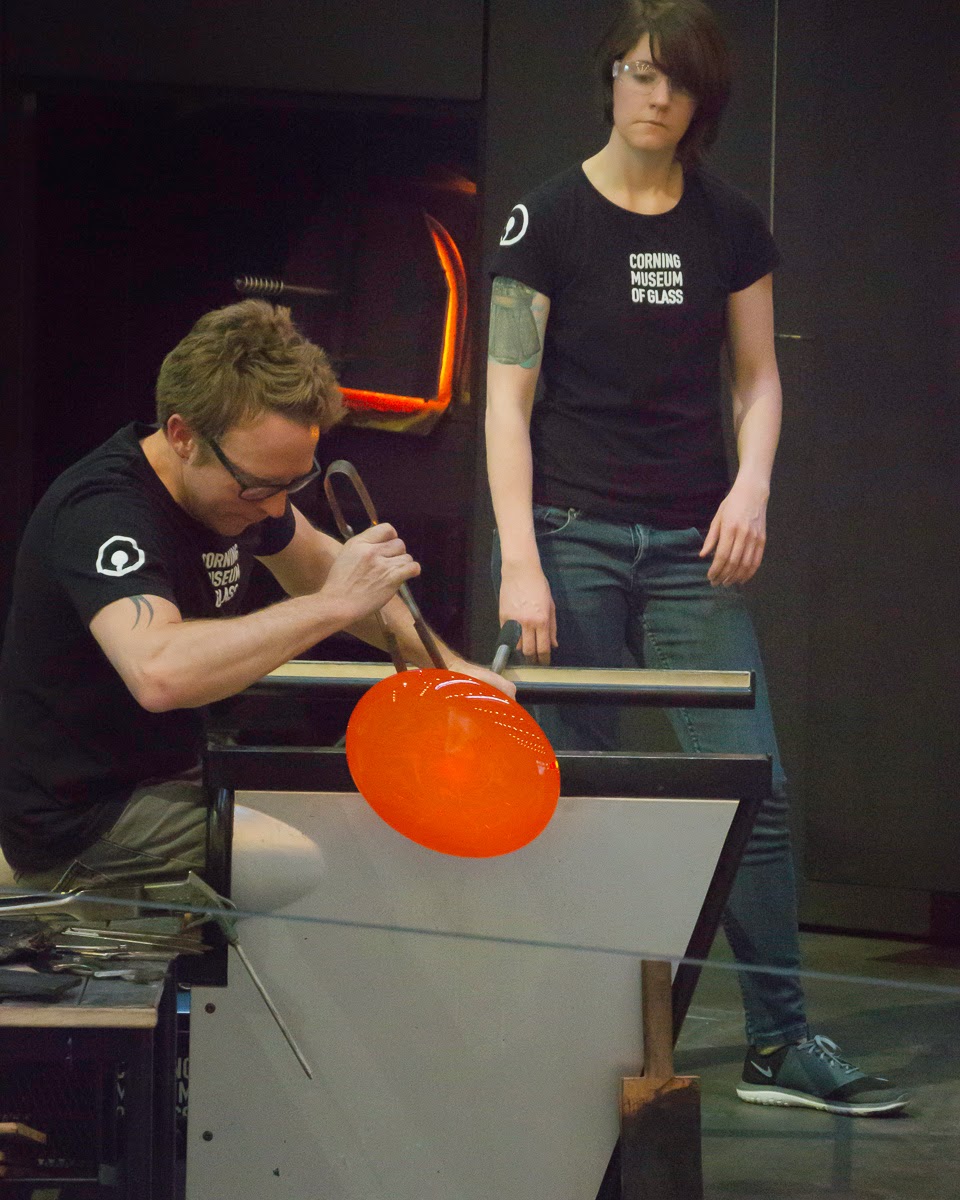
On the day of my visit, a team was creating a large oval platter in a ruby red glass.  At the high forming temperatures, the color of the glass is not apparent. The gaffer began with a large gather of glass attached to an iron pontil.   Bringing the glass out of the "glory hole" where it is reheated when it has cooled,  he sets to forming a precise shape.


While the gaffer is responsible for the overall creation of the object, there is a team of comparably qualified individuals devoted to supporting the lead gaffer. They will form smaller pieces to be attached to the main body and simultaneously work portions of the object as the gaffer directs.  It is a team effort, especially when large objects are being worked.

Below you can see the teamwork required to lay a different color glass on the rim of the platter as it nears completion.  There are often parallel tasks being done to prepare for future steps in the creation of a piece.


After about an hour's work, the final form is achieved with three skilled gaffers coaxing the platter into shape.


All that is needed is to release the platter from the iron pontil, so the team member can carry it to the annealing oven for a very slow cooling to room temperature.


The visitor to CMOG consistently leaves the hot glass show with a sense of awe, and a new appreciation for the many glass objects seen in the museum.  It is a perfect combination of art and technology. This show gives me a greater appreciation of what I see whenever I go into the museum's collection of ancient glass.

As I leave the hot glass show, I think of the challenges to making a simple glass bottle before the age of science. It seems unfathomable that such complex objects were made without thermocouples, chemical analysis, gas furnaces or exotic refractories. This is what makes the Corning Museum of Glass so interesting to me. It is a must see for everyone. If you were there ten years ago, go again.  It is so expanded, that it will be like a first visit, again.

Paul Schmitt