Sunday, April 30, 2023

Ask Five Times- Can I do that?

Over the last two years, I have been moving past  objectively showing the things I love in nature towards a more subjective result based on why they engage me.  The aim is to build a style that has more meaning.  Sakichi Toyoda of Toyota Motor Company fame introduced the approach of asking why five times.  For art, this hopefully will lead to images having stronger meaning.  

At left begins an example from a series of three images that I captured one year ago.  It is a beautiful objective image that defines the subject. Let's ask about the meaning:

  1. See the rich colors in the bird.
  2. It's a beautiful blue sky day.
  3. The apple blossoms look nice.
  4. The focus is sharp.  Ho hum.
  5. ....sort of running out of meaning.


 Move to the second image and try for five better whys:

  1. The Oriole is after something in the flowers.
  2. Does it mean there is nectar in the blossoms?
  3. There is something to be learned here.
  4. If there isn't nectar, are there insects maybe?
  5. What is to be learned next?


On to a third image seeking greater meaning for the five whys:

  1. Wow, there are little yellow caterpillars inside the apple blossoms.  Look in his beak.
  2. It's not nectar.
  3. Orioles are visiting the apple trees for protein.
  4. This is unexpected!
  5. Next year I should check the trees for this.


The third images shifts my style from a mug shot to showing a relationship between bird, tree and insect.  It has more meaning. 

Note:  In April 27, 2023,  the same tree is in blossom and there are no caterpillars, and hence no Orioles.

If at this point you are lacking interest in the five why's exercise, it is fine to just enjoy the pics absent the text. 

That is the background to what I pursued in April while I was in the Washington area on family business.  It's a far different locale than my strongly rural Finger Lakes home.  Could I create meaningful images in this new neighborhood with limited natural scenes?  Can I answer the why question five times?  Here goes my test.

Rock Creek on an April Morning
  1. There is a surprising wildness so close to the sounds of DC morning traffic.
  2. The foreground pulls me into layers in middle and far that feel rural.
  3. The spring greens are the same as I'd see at home in the Finger Lakes. 
  4. A city can be inviting. No trash to see seen.  Bravo.
  5. Rock Creek has a restorative power for residents, and me.

Another good place is Brookside Gardens in Wheaton, Maryland.  It's a Montgomery County Park.  Early mornings are quiet and beautiful.  Here is why I always enjoy my visits.

Pavilion at Brookside Gardens- Wheaton

  1. The hallmark of Brookside garden designs are rich foregrounds that welcome the eyes to explore.
  2. Exploring, I find layers to search in near, mid and far layers.  It's far from stale.
  3. The visitor immediately wants to find the path to the pagoda overlooking the lake.
  4. The reflections on the lake double upon the distant background.  
  5. The park is a refuge from the hectic crowded city.
There is another magical place in Brookside Gardens in April when the Wisteria is in bloom.
 

The Wisteria Bench
  1. Who could pass up a chance to sit on this bench? 
  2. The flowers have a delicious perfume.  The photo helps to remember it.
  3. The color of  wisteria blooms and the surrounding greenery are ephemeral. 
  4. Knowing the flowers will soon be gone keeps you lingering a bit longer.
  5. This is a calming.  I dream of sitting here next year with my 1/1/2 year old granddaughter.


The Purity of a Dogwood Flower 


  1. Here I see the purity of the beautiful Dogwood without distractions.
  2. My eyes always start at the white, which is as I intended.  
  3. The branches support my eyes exploration of white petals, lively green leaves and some reds too.  
  4. There is a purity that welcomes returning to view this image repeatedly.  Background is blurry complementary without distracting.
  5. It seems like a visual solo performance.

There are some wildflowers that I would never expect to find near DC. One is Virginia Bluebells; but to my surprise I found them on the perimeter of Brookside.  They were in a lovely setting too.  What can I do with the five questions?

Virginian Bluebells Found  at the Creek


  1.  I find two very similar Bluebell stalks that create a visual echo between near and mid distances.
  2. The light is nice and warm in the morning light.
  3. The distant ground is just enough to suggest a wooded forest.
  4. Technically, I have a green, blue and red split complementary color design that is very pleasing, with no deviations from those three.Very harmonious.
  5. I believe the viewer can return to look at this often.
  6. Adding another answer, the image tells the story of what they are, where to see them and why it is worth looking for them.

Asking the five why's does slow me down to the speed of seeing and understanding in a more subjective mode.  It would seem to apply widely in the pursuit of creative results.

I have come to realize that in my much earlier photography,  I would often come home with photos wherein the aim was just getting the right exposure, focus and maybe composition without pausing to ask why.  Part of that was the more difficult steps required using film.  The process was exposing a roll of slide film, waiting two weeks to receive the processed slides and then finally seeing how many were as expected.  With current digital tools, the feedback is nearly instantaneous.  Never going back.


Saturday, March 25, 2023

Sakura- Cherry Blossoms in DC

It was good fortune to be in DC this year as the cherry blossoms came into bloom.  In Japan, the ornamental Prunus subg. Cerasus are symbolic of the ephemeral nature of life,  and also tied to national spirit.  -They are called Sakura in Japan.- These abundant flowering trees are native to Asia, and contrast with our native cherries that have modest blooms but yield abundant fruits.

While most attention is given to the cherry blossoms around the National Mall, there are many displays throughout Washington such as this towering cherry tree just off Rock Creek Park.

One early morning, I walked over to photograph the scene.  When I complimented the owner on the tree's beauty, he remarked that a professional arborist cares for the tree.

There are over twelve hundred cherries near the Tidal Basin.  They don't all bloom at the same time nor display identical coloration.  These pinks are just a little short of full bloom.


 Along the promenade one sees some very old cherry trees.  I was told there are twelve trees that date back to the original gift from Japan in 1912.  Perhaps this is one of those.


Walking farther along the path, the visitor comes to another striking monument, the Martin Luther King, Jr. Memorial.  There was a decision to make with this scene.  Where to put the focus?  My decision was that you immediately know it is MLK Jr., even if soft. The tree is less obvious out of focus.


And, sometimes the best scenes are found when looking away from the Tidal Basin. Here is a first surprise.  This is a rare location to capture the reflection of the Washington Monument.  All other places had tree branches over the monument.


It was time to return to our apartment, and the sun was so intense.  On the way to the bus stop near  the Mall, there was another cherry framing the Washington Monument.

I learned two things while doing these photos.  First, be there early if possible. By late morning, it gets very crowded.  Finally, use transit - whether the Metro to the Smithsonian station or a bus. I used the number 52 bus that delivered me even closer that the Metro.  Senior fare was only $1.   I walked one block to number 52 route begins, and arriving at 14th and Constitution it was only about four to the tidal basin.  Beats driving.

Paul


Wednesday, March 8, 2023

An Urban Exploration

 In 2023,  we will be spending about half of our time in Metropolitan Washington.  We are "grand parenting".  Can I find natural habitats to satisfy my photographic interests? This winter, I've been including a good number of black and white edits that look largely at form in an image when colors are frequently lacking.

An initial exploration was the Great Falls of the Potomac on the Virginia side.  It's a powerful falls, and that was my focus.


The falls is huge, but the real feel is better captured in a close view.  The sky would be a distraction, right?

Our location in DC requires only a five minute walk to be in Rock Creek Park where I can find many walking trails and also park roads closed to thru  traffic.  On one morning, I road a bus north towards the Maryland border and quickly was on a nice trail into the upper part of the park.  The traffic on Sixteenth Street was roaring, but in the park I only saw a few walkers.  The trail topped a rock bluff overlooking the creek.  The next day I returned to reach the opposite side of the creek.


I discovered several beds of wildflowers along my path.  Next week, I will be back for these as I expect the Snow Drops to be blooming.  

Along the creek, I discovered early hints of spring including these red maple tree buds. 


The stream side beech trees were still holding onto last year's leaves.


By all appearances, Rock Creek Park is an old growth forest.  There are no sawed off tree stumps; no evidence of any timber harvest in a century. I saw many truly massive trees.  Along the banks of the creek, large trees often send their roots over the bank toward the stream. Beautiful.


Near Military Road, I came upon the Joaquin Miller Cabin at a stream side picnic grove.  The cabin's namesake was an eccentric poet who lived in it from 1883 to 1885.  Originally located at Sixteenth and Belmont Streets, it was relocated to the park when city growth targeted it for removal.


Here's a final discovery from my rambling along the creek.  I wonder how I will treat these scenes when the leaves begin to add greens and also start to hide some of the details I find so easily now?

Of course,  I did find some colors to celebrate even in early March. This bunch of daffodils is far removed from any garden.  Perhaps the squirrels relocated them?


Another good location I have found is Brookside Gardens in Wheaton, Maryland.  It is rich with carefully designed flower beds and ornamental trees.  These Asian Witch Hazel flowers were more dazzling than the nearby native varieties.


On my next visit, I am hoping to find more flowering trees including the famous Japanese Cherry Trees.  Finding them in bloom will require some mastery of the bus system plus some magic with the spring weather. I make no promises. 

I am actually surprised at what I could find to photograph, and also that Rock Creek Park was largely free of litter.

Paul

Tuesday, February 21, 2023

It's a Maine Thing

The Mid-Coast of Maine is a favorite place for me.  I've been long overdue to return, and last week I finally took five days there. In winter, it is far quieter - so much so that it can be difficult to find restaurants staying open.  I was one of eight photographers in a program offered by Hunt's Photo in Boston.

I arrived a day early for a more leisurely pace.  After a 5 hour drive, my stop was just over the border at Kittery.  Before dinner, I went over to the Nubble Lighthouse.  The wind was "brisk", but it did not discourage locals from enjoying the sunny day. I shot about 40 images to freeze the wave in the foreground.

Up early,  I hurried north to the iconic Portland Head Light.  It you look closely at the light keeper's building closer to the base of the tower, you can see three orange rectangles.  Those are where huge January waves  crested over the rocks and broke out windows. 


The waves were far more modest during my visit.

With all of us in our lodging in Wiscasset and introductions made, we visited South Bristol Harbor.  It is a small working harbor with little tourist activity. Central to the village is Osier's, which is a grocery,  food takeout, lobster pound and roadside gas pump. 


There is a lot to discover.  Buoys draped in a dead tree branch.

On the dock behind Osier's I found piles of fishing gear.


I can't tell you what this net is used for, but the form was attractive, so I had to share it.


The next day we had some dreary weather, so we explored some local museums.  There were some interesting discoveries.  Ropes in a shipbuilder's shop.

Antique car grills at Owls Head.


The next morning was cold but favorable at Pemaquid Point.  This is my favorite lighthouse of all.  Down here you can grasp the height of the promontory it occupies.  The sloping layers of rocks rise from the waves dramatically.  (The tide was rising, and shortly after this I had to retreat upward. )


Up at the lighthouse, there are, even on a cold and icy morning, some hearty people coming out for the view.


Every visit I have ever made to Pemaquid has been inspiring. Soon afterwards, we were at Deb's cafe for hot coffee and great food. It was worth departing at 5:15 am to be there for another beautiful dawn.

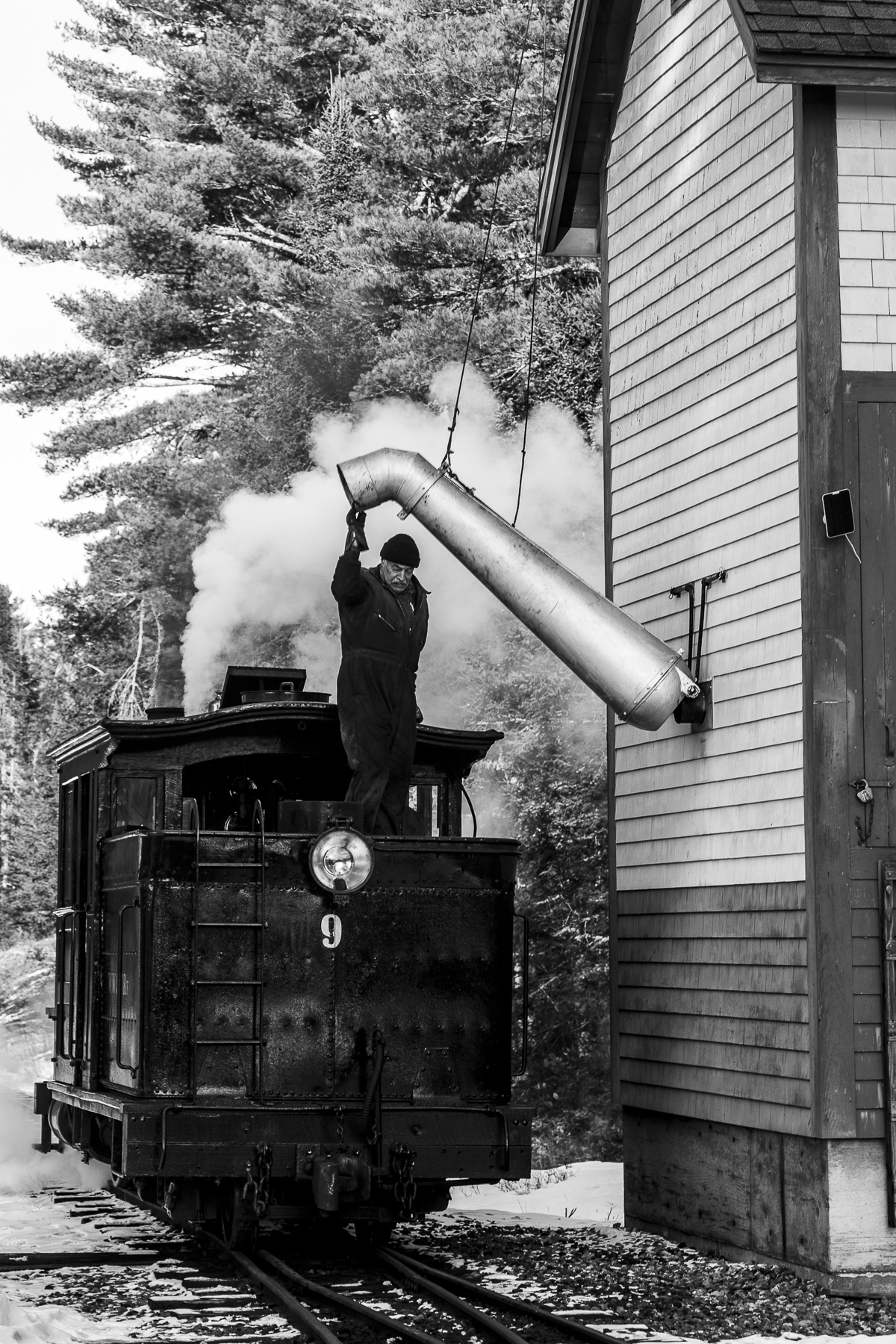
That afternoon, we made a big shift in subjects to a small narrow gauge railway near Wiscasset, the Wiscasset, Waterville & Farmington.  It's totally volunteer based and very busy even in February. Here are a few images:


Our final morning was at Friendship Harbor. Again, this is a working harbor with little tourist flavor.  It was another early start.

There was a very creative Christmas tree still on the one dock in mid-February. 

The sunrise cast a golden glow on one of the fish houses.

Nearby was another fish house with buoys that seemed best in monochrome to reflect on time.

Maine in winter is clearly not dreary, nor boring.  Just a little patience is called for when weather is in control.  Natives seem to thrive in winter. 

Well, this ran into more images than is my usual.  Hopefully it is sufficiently entertaining.

Paul Schmitt

Thursday, February 9, 2023

Frozen in Time

 Winter strips the landscape of a lot of noise.  The inner form of trees is simplified absent the leaves.  Waterfalls become clearer with the trees bare.  The precipices are covered with ice, and sometimes the flow of water is nearly stopped.  Early in my discovery of waterfall photography, I was directed to this hidden falls in Lansing (New York).  It was part of a family's backyard.

I even returned at night to make extremely long exposures and painted the ice with colored lights. 

The little falls had no name and likely was never seen in a postcard. Big falls are often seen on postcards and imitated by newbies.  I did that at Niagara Falls in 2013.  The falls are illuminated every evening.  Many capture just what was seen on the postcard.  There is also much more to see when exploring more closely.  

Seen below is a small portion of the American Falls that was created in the late morning when the sun created a rainbow.  Now, the sun moves pretty quickly across the sky so the rainbow is not static either.  Keeping the rainbow on that ice-capped rock keeps the photographer shooting, and quickly moving the tripod while not bumping into other people next to the railing.

This image of the American Falls was much more memorable in part, because it is not found on a postcard and will not be repeated exactly like this. 

Here in the Finger Lakes, the iconic falls is arguably Taughannock.  At 215 feet of straight drop, it is higher than Niagara and easily approached to the lower level, even more so in winter.  It's my favorite, especially when ice covered.  On this morning, there was a strong flow contributing to widespread ice well away from the drop.  It was also extremely cold; my fingers were nearly numb even with glove liners plus mittens.  (It was worth the walk up the gorge to hear and feel the giant in winter.)

There is, however, much more to portraying the mix of solid and liquid found in such a scene.  This is an ever-changing sculpture of  hard ice and liquid water.  This is an instant in time that will never be recreated. 


The photographer has the choice of shutter speed that creates an interpretation that can be faster or slower than how our brain processes time.  Seems fascinating to consider.

There are other winter scenes to explore. At the base of Ithaca Falls, there are ice formations found away from the falls.  They are the result of wind blowing the water spray, and also the rise and fall of the flows.  As the day warms, the flow increases and the ice creeps higher.   This image presents two levels - Ithaca Falls and the crooked willow on the edge.   That seems more interesting.

I think it wise to begin with a local favorite and conclude with an exotic favorite - Gibbon Falls in Yellowstone in early February 2020.  The river is not frozen because of thermal springs feeding the river.   One of the attractions for this location is the beautiful circular path presented to the viewer's eyes. 

A week later after making this image, we were all learning about a global pandemic and foregoing travel. So, that makes it a little more memorable.

I hope you find this enjoyable.

Paul Schmitt