Thursday, October 27, 2022

Autumn's Second Season

My engagement with the scenes of fall has been extended by a simple idea.  When the brilliant red maples shed their leaves, it is not over.  I move in to see more closely. On a recent Sunday, I walked along Corning's riverside trails and found unexpected inspiration.  Hidden in an alcove of Corning Incorporated's headquarters building were some hold-out colors reflected in the facade.


Continuing along the river, I found an unexpected wide landscape.  Substitute red sumac for the maple's reds.


Now, let's get a look at what I found on another day along an abandoned farm road.   Again, it's red sumac.

A bit farther along the road, I looked down and found this.  This time, no reds for a change.  Still works.

There doesn't need to be any catchy color, or even color at all, to speak of the second season of autumn.  The killing frost earlier this week removed all green from the delicate maidenhair ferns growing in a corner of my garden.


But, I have to complete my story with a magical jumble of leaves that I found. I could never have assembled such a screen deliberately.  The single feature that stopped me was the beads of water on the overturned leaf in the upper part of the frame.   I recall that this was just after a brief shower.

So, this is my piece on the delights of the second season of fall.  It extended my autumn.

All of these images used my recently acquired iPhone 13 Pro and the ProCamera app that extends controls greatly beyond the Apple offering.

Paul Schmitt


Tuesday, October 18, 2022

Adirondack Autumn Concluded- Seeing in Sixes

Waterfalls and autumn colors are a strong combination.  Here's an image that I had to work hard to compose and yet leaves me with mixed feelings. Why?   The central drop over the precipice hits a huge boulder in the lower right corner and is strongly redirected by 90 degrees to the left.  My eye often follows the flow downward to the right and continues out of the frame; but at times I accept the redirect to the center.


Another waterfall looks best in monochrome.  This has a backstory of a missed opportunity.   A fisherman was casting a fly rod next to the left bridge foundation.  I wanted to show the beautiful arc of the rod as the line looped out over the stream.  That would add a beautiful plus in the composition.  Needed to increase shutter speed.  In the half minute to make the change, he moved downstream and out of the frame.  Lost it!

Never assume the magic with continue.  Still, I like the image as is.

The Adirondacks are about rocks, often big ones.  The huge ones are called glacial erratics.   Their size and mass amazes me.  A rough calculation suggests that this one weighs about 110 tons.  In the fall, the fallen leaves starkly reveal its size.


In fall, I am often looking at the ground after any rain hoping to see mushrooms. That explains why my right knee is often dirty, as I find it necessary to get as low as possible.  The variety of sizes, colors and forms seen in fungi is of great interest to me.  This guy was hard to initially see, as it blended in with the freshly fallen leaf litter.  It's part of the classification called LBMs,  Little Brown Mushrooms.

While exploring the trails at Lake Durant, I discovered a nice joke.   Someone pried open the hollow remains of a fallen tree to position a nice bird box in the center.  Maybe a good caption for the photo would be: 

Is anybody home?

Probably not in October.

After the group dispersed, our leader Chris Murray noted in a message that there is a second part of autumn, which I take to be when attention shifts to smaller areas closer to the ground and more intimate.  Here is the final image that takes it direction from Chris's teaching.


 It offers simple colors and no distractions from the central subject.  I am continuing to photograph here at home mostly using a new phone camera with multiple lenses.  I will post on my progress learning the new system soon.


Paul Schmitt


Wednesday, October 12, 2022

Adirondack Autumn Continued- Seeing in Sixes

Autumn in temperate regions carries many meanings.  It is a sign of the impermanence of life.  There are abundant examples in the fall colors, foggy mornings, killing freezes in the garden, apple harvesting and the need for a warm sweater.  A calm October day in the Adirondacks stirs the spirits while reminding one that it is ephemeral. A cold front with steady rain will erase the view.


  The sensible person does not delay.  


It is also a time to look deeper, maybe lower to the textures that the falling leaves create.  This scene captured my attention. At the tree's base are different measures of permanence.  Soon, the fern will  wither like the tree's leaves. 

Water and autumn colors are sometimes a magical combination.  The first image of leaves reflected on glassy smooth water is highly attractive.  Add moving water and a bit of fog to add drama.

Maybe it time for a more serene moment to see the patterns usually overlooked.  The red and yellow are backed by green with little to confuse the brain.  Lovely.


 Now for a sundown finale.  


It was amazing.


Paul Schmitt

Tuesday, October 11, 2022

Adirondack Autumn- Seeing (It) in Sixes

Back from two and a half days exploring a small part of the Adirondacks during peak color.  The beauty at that time can be overwhelming and even intimidating.  It is so easy to create a repetitive package of photos that fail to really explore anything beyond the sweeping landscape view for example.  I will limit each of my blog posts to a set of just six images. Each photo is selected to offer a different subject and also use a different expanse of the shot.  (In video production, the type of shots used go from the master shot to the close up in six steps.)  Consider this an experiment in creativity.

Let's begin with the early mornings in autumn.  It's quiet and chilly that early.  Often it offers soft light on a foggy mountain lake as below.  A distant point on the lake is obscured by the fog.

After day break on another morning, the water is far from placid where the Raquette River cascades  toward Long Lake. The golden birch on the distant bank becomes a dappled reflection in the foreground.

Looking more closely in the forest, there is a pleasing symphony of colors.  Reds and yellows are separated the the bluish green of a few pine boughs.  This is easy to miss amid the temptations of waterfalls and wide angle views.

Autumn offers offers many ways to become immersed in the day.  Doesn't an afternoon paddle on the lake sounds wonderful?  Take your dog too.  Heavenly, I'd say.

For a new twist, let's abandon the fall colors to look at how weather can create an interesting image. The autumn fog that hugs the lake is flanked by a distant cloud bank, and both are duplicated in reflections on the lake with some detail added by the lake grasses.  It resembles some supersonic passage of some strange projectile. 

Now for the final image from my first day. On that particular night, the lunar cycle was approaching the Hunter's Moon.  It's bright.  I'm back on the same lake seen above, but at night.  The moon is so bright that I can dimly see the form of a canoe and a red kayak on the shore.  The fires of a few campers appear on the lake shore.  Above the canoe in the sky is Jupiter plus a few stars.  


What a way to end a day of photography.

Paul Schmitt

Friday, September 30, 2022

Fall Mushrooms- Seeing in Sixes

Looking at any of my mushroom field guides, I am intrigued by the variety of forms and colors I see.  The arrival of some nice September rains whispers to me "mushroom foray."  True, a foray is supposed to involve a group collecting fungi for food.  I collect only images, and there are few willing to tolerate my spending 30 minutes photographing just one subject.  So, it's a solo foray.

One rule for my Seeing in Sixes posts is that I can only include new images.  The fun is in the hunt for something new.  Let's begin with a decaying tree stump that resembled a mountain peak.


It reminds me of the rugged peaks in Patagonia that I saw in 2019.   The little orange mushrooms seem to be ascending the steep slopes.

Recalling how I am attracted to the colors seldom seen, the tender purple color of the next fungi was impossible to bypass.  The yellow and light orange leaves also attracted me as they are complementary.


Some would find it humorous to see how obsessed I was with finding the right background.  That clearly explains why I do this solo.

Next is a fungi that really excites me when I find one.  Coral Tooth-fungus presents itself in many forms as it erupts on the side of a tree.


This one had a nice green growth of what I believe is lichen.  It is difficult to capture slightly off-white textures, but luckily the sky was cloudy so there was no sun to blow out the whites. 

Next I found a two-for-one to share.  Fresh Chanterelles on the right are accompanied by the dried shell of a puffball.   (I really got my knees dirty getting down low for this shot.)


The best part here was that nothing had started eating the trumpet edges.  The next mushroom was not quite as fortunate.  Still, I liked the cap's rich color and the setting in the lee side of a decaying limb.


So, I am now at number six.  I wanted to end with this abundant cluster of individual mushrooms.  It is uncommon to see so many so closely packed.  There are at least twenty-six. 


Sometimes, I am asked if a particular fungi is edible. Not important to me.  My reply sometimes is on the line of "sure, but you may have a terrible experience a bit later." I am quite pleased with what I can buy in the grocery.

This is what I found in two outings this week.  I hope it is entertaining to you.  Perhaps it will inspire you to find similar beauty after an autumn rain.

Paul Schmitt

Sunday, September 11, 2022

Taughannock Falls- Seeing It in Six Images

In the Algonquin language,  Taughannock  means in the trees. The gorge is still surrounded by huge trees.  It is the tallest free-falling waterfall east of the Mississippi River. Those 215 feet have been most impressive to me in deep winter when it is covered with heavy ice, and growling with a deep-throated voice. The walk up from the bottom of the falls is a popular winter outing for many.

I realized I had not explored Taughannock in summer for over ten years.  So, today I took the challenge to create a fresh view of the falls in six images.  I first stopped at the overlook perched high on the edge of the gorge's north wall.  The September morning was foggy with a few wisps still in the tree tops.

The majority of visitors travel the 3/4 mile trail with few pauses to even look at the minor waterfall near the parking lot.  I find it has a lot of attractive smaller drops across its width.  Looking at right of center, I find a section with five different steps from top to bottom. In winter, much of the flow is hidden under large ice formations.


Even farther to the right edge, there is a set of three steps created by the layers of sedimentary rock.

I spent over half an hour just finding interesting patterns of falling water. So, these are my first three images, and I am still nearly 3/4 mile from the big drop. Time to work up stream.

From the first falls, the gorge closes on the creek. The fog began to disperse, revealing blue sky and painting the north wall with warm light.  It's a pretty spot and easy to walk into the stream bed.

I like this view for what it tells you about the steep north wall of the gorge and the gentle steps where the stream drops a few feet to the next level. Somewhere on the vertical wall up there is a peregrine falcon nest. (I saw it this summer with great difficulty.  It's very distant and the falcon's coloration blends in with the gray rocks.)

On to the falls.  The first photo that I offered is all you need to understand Taughannock's height.  I chose to concentrate on it's power. After a free fall of 215 feet, the water is moving so fast that it is a blur even at 1/250 second shutter speed.   The spray coats the rock walls for many times the width of the cascade.

Now, I am down to image number six. Between this falls and the first one I presented, the stream works down over several layers of relatively flat stone.  The surface has gentle ripples and puddles that create hundreds of small reflective "ponds". On a still day, these produce a patch work of images from the canyon walls. Seen below are islands of blue sedimentary rock in a sea of golden tree leaves on the distant slopes.   I find them entertaining to explore.


These are my six from today.  Allow me one more image from December, 2013 that reveals why winter is still my favorite.

And, yes, it was really cold.  I am thinking maybe I can find another Seeing It in Six in October, if  there are come good autumn colors.

Hope you find this enjoyable.

Paul Schmitt


Thursday, August 4, 2022

Discovering the Watkins Glen Gorge


The entrance to Watkins Glen State Park has recently improved with a new welcome center and expanded parking, and the welcome given the first time visitor has not diminished.  Local people just love the Glen.  After decades of visiting the gorge, this summer I attempted to put myself back into the mindset of my first visit.  Actually, I just stood back and observed newbies and did some listening. It refreshed my perspective.

The glass facades maintain a connection to the gorge itself.  Then, as the visitors approach the start of the gorge, the new landscaping has beds of summer flowers with a background of the first gorge walls. Stately  pink cone flowers towards the north wall are complemented by native bee balm in other areas.  

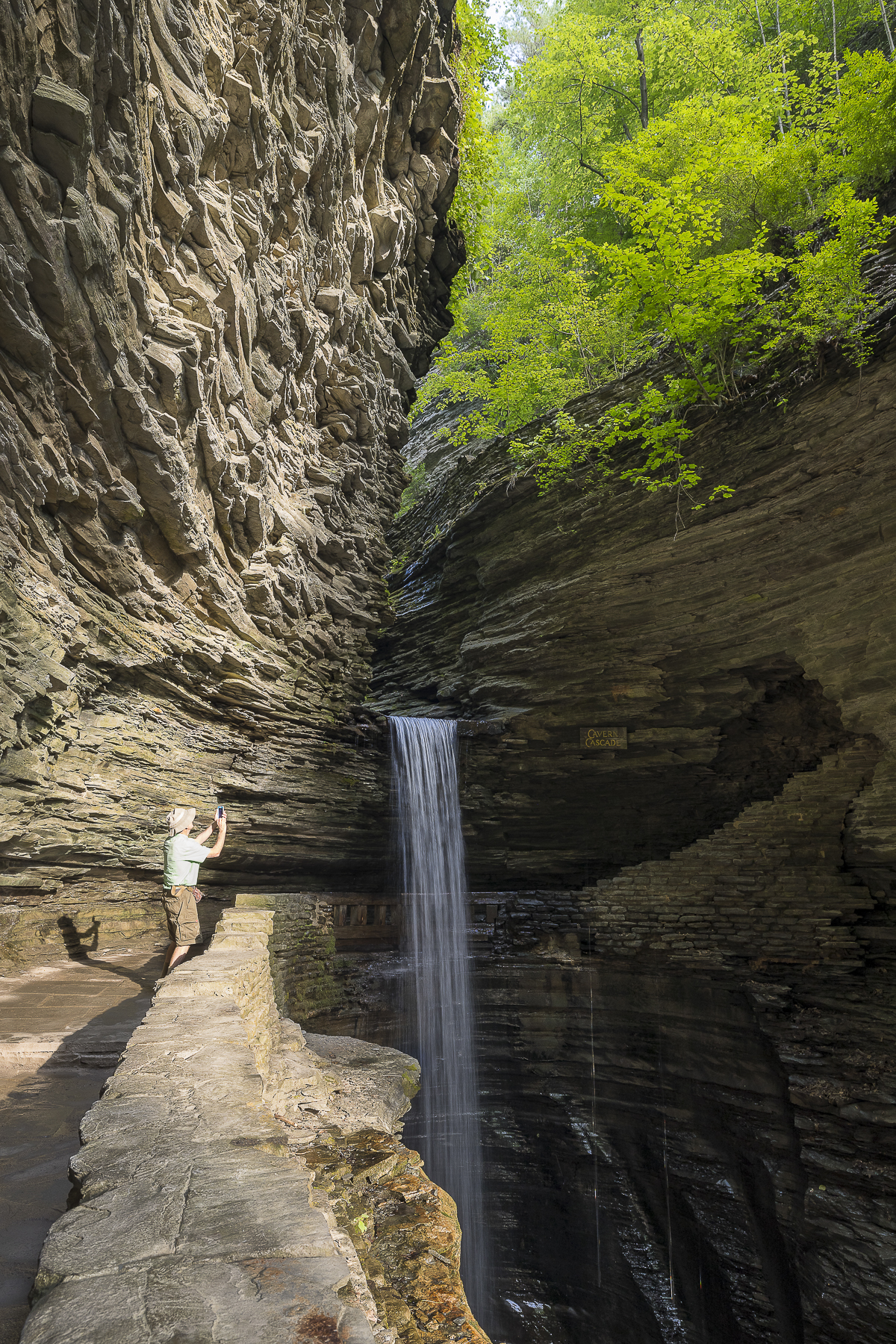
One enters the gorge through a tunnel and into a grand view up the gorge with the Glen Creek, weaving its way towards the valley.  Ahead is the first big "gotcha" at Cavern Cascade.  The fascination for first time visitors is seeing the path go behind the Glen Creek. 

This is a great place to observe visitors' reactions.  First, they want a picture and then they want another with a companion in it.  (I can't remember how many times visitors have asked me to take their picture on their phone.)  Next, as they walk under the water, many want to look back for a much different view.  Roughly one in ten reaches out to touch the falling water.   It gets really crowded under the stream at times.  Magical, I'd say.


After passing under the falling water, the trail enters a spiral tunnel leading up to a long stretch of sinuous channels carved over a ten thousand year post-glacial period.  Its easy to lose sight of many small features.  It follows the idea that many look, but few actually see.  Here's a delicious spinning eddy below a minor drop in the stream.  With normal rainfall, this would be covered by fast flowing waves. 


On my recent hike through the Glen Cathedral, there was  Purple Loose-strife blooming in spare rocky debris.  Most overlook it.  Just a weed, and considered an invasive specie in New York.


Continuing up the gorge, one reaches what many consider the most captivating part of the glen, falling from the south wall, an overhanging spring drops a veil of water over the path.  I call it the Bridal Veil.  Beyond it is a beautiful bridge where many pause to take in the beauty below them.

In early August 2022, the drought has reduced it to a gentle thread of water. Still beautiful to see.  That can change.  On July 25 of 2018,  the Glen Creek presented a different personality for the Bridal Veil. 

At the top on the Rainbow Bridge, I note a person watching under a large umbrella.  The gorge has many versions.  This one was a powerful one.  These different faces are what draw people back for additional visits.  Watkins Glen is truly a gem.

Paul