I confess that I have had a love-hate relationship with autumn. It is arguably the most difficult season to really capture in photos. Are you surprised? Blame it on how our brain builds a collage of the scene.
On a recent trip to Adirondack Mountains, I never drove past this barn without seeing one to three cars stopped to photograph it. It is dull. Our brain sees the distant colors and cancels out the dull reds of the barn and the fading grasslands. Only a small portion of the photo really has colorful trees. But, that dull red barn is the introduction to the story our photo is telling. Do you read a book with a dull first chapter? Not often.
So, I am going to share some ideas for transforming your autumn photos from average to very interesting. First, you should be able to describe what a photo is saying in one sentence. This photo said to me:
It was worth the half-mile hike on a cool fall morning to see the rich colors at Round Pond.
It has some interesting shoreline in the foreground to lead the viewer toward the colorful trees, and then to the deep blue sky with wisp colds. As a bonus, the trees and sky are doubled up as reflections on the mirror-like water. Compare it to the first photo that has only mediocre foreground, modest color and a modest blue sky with no clouds to add interest. Here are the first two concepts to make better fall photos:
- Put something of interest in the foreground.
- Only show the sky if it is interesting.
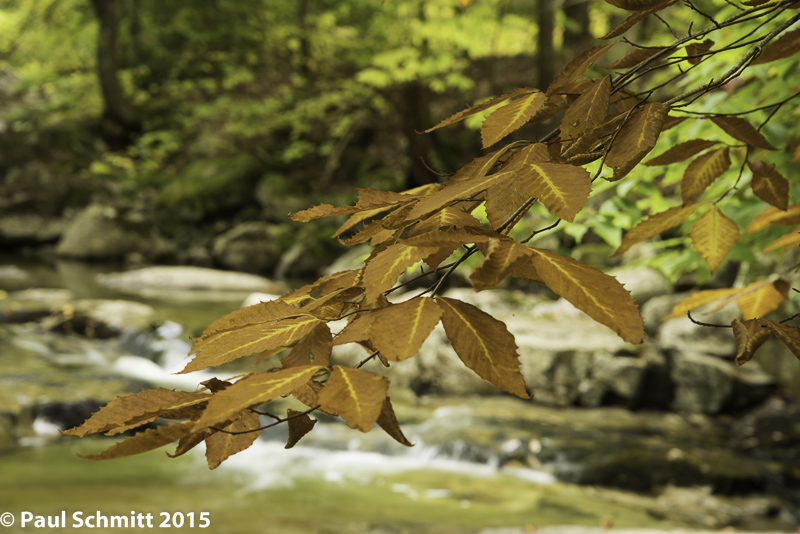
Yes, cut out the sky if it is uniform. Here is a photo on a day with a flat white sky, but putting colorful beech leaves in the foreground told a story of a rocky ledge on a mountain brook in fall.
This image also introduces a third concept:
- Use selective focus to identify the photo's subject and control where the viewer enters the scene.
The beech leaves are our introduction, as the eye begins exploring the scene. We see color and know the season. The background does not have to be sharp for the mind to understand the setting. With a large aperture (meaning low
f number), the depth of focus is shallow and the leaves are sharply delineated. If you are not sure which aperture to use, shoot a range of values and pick the best when you get home.
Selective focus goes in hand with another key concept.
- Make a range of shots just like the movies where they have eight different shots defined.
We can compose shots that range from the extreme wide angle --
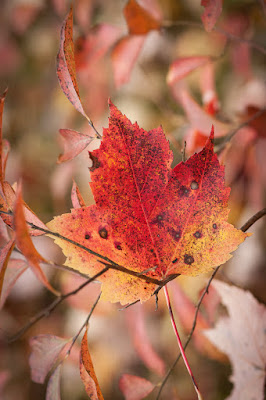
Think the barn photo that I began with.-- to a close up which may only have an actor's face. My version of the close up at right tells the story of a red and orange maple leaf, whose fall landed landed on a tiny branch. Again, see how selective focus started the viewer on the leaf, and the background is understandable, but not competitive. Do this when you show people in the scene. Put them close to the camera with a pleasing background that is not competing with them.
While I did travel to the Adirondacks for the first two images, it is not necessary to make a long drive. The maple leaf photo at left was on a nature trail only a few miles from my home. Also, you do not need to have the so-called peak colors to capture autumn. This photo was made past peak, when I looked as much on the ground as into the tree tops.
This brings me to another idea for really seeing all that autumn can offer for photography. It is not just about colorful trees. There is much more that is happening. On yet another walk near home, I traveled an abandoned farm road looking for migrating birds. I saw none, but a wandering eye saw the milkweed in the process of casting its wispy seeds into the wind. This, too, is the season.
So often there is just too much going on, both in our daily lives and in the photos that we make. That introduces another concept for both:
Telling the story of an autumn day when I stopped at an orchard needed two photos. The first about the fall harvest, and how we celebrate the season.
The second photo, well simplified, is why I was at the orchard.
Another concept is about keeping your photos real.
- Keep the colors real. Don't overdo the colors.
Colors in a photo are like the music at a concert. If the band is always blasting away at full volume, there is no place for subtlety nor real beauty. Yes, use a polarizing filter if your camera will accept one, but resist the temptation on your computer to over saturate the photos into a fake. The reflections on this pond could have been overdone, but then the gentle mood would have been lost. (My short sentence to describe why I wanted the photo was "rockin' colors". )
Finally, I offer a word on weather.
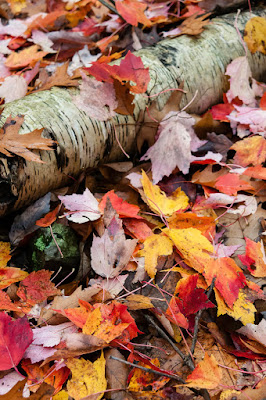
In addition to those brilliant blue sky days with big puffy clouds, the wet days offer special opportunities to really show the colors of autumn. The clouds keep the light uniform and free of those shiny highlights that blind the eye. The leaves are damp and revealing richer color. This absence of sun means does not dark shadows. It's perfect to show a rich mix of colorful leaves draped around a fallen birch tree. Absent a real downpour, damp days are perfect to add intimate photos that only miss the rich smell of fall. Don't stay home. Get out and explore.
I appreciate your interest and hope these concepts make for special fall memories in your photo collection.
Paul


 While exploring the trails at Lake Durant, I discovered a nice joke. Someone pried open the hollow remains of a fallen tree to position a nice bird box in the center. Maybe a good caption for the photo would be: