Showing posts with label sunrise. Show all posts

Friday, August 25, 2017

Along the Way to Newfoundland

Our summer of travel concluded with a road trip to Newfoundland with the usual stop in Freeport for the LL Bean store, plus a few discoveries along the way. On day two we were near Lubec at the border with New Brunswick.  Rising early, I watched the sun rise over Campobello Island across the Lubec Narrows. As the sun rose directly behind the Mulholland Point Light, a lobster boat motored past on the way to run their traps.  Serendipity.  This is now on my list for a longer explore including Campobello.


Our drive north took us to Hopewell Rocks on Fundy Bay.  The huge tides there cycle up and down on tall pillars of aggregate.  We'd been there decades ago with good memories.


It seemed much more crowded now  and  more like an amusement park. It was less enjoyable this time.  I guess the first time was enough.  We moved on to our appointment with the ferry to Newfoundland.

Arriving in North Sydney, the sight of the MV Highlanders is impressive.  At 200 meters, it is the largest ferry I have seen.  It has eight decks including four for vehicles.  It can load and unload from both bow and stern at two different levels. We made the mistake of being early, which put us on board first and thus in the lowest level - which I dubbed "the catacombs". It was pretty tight down there.
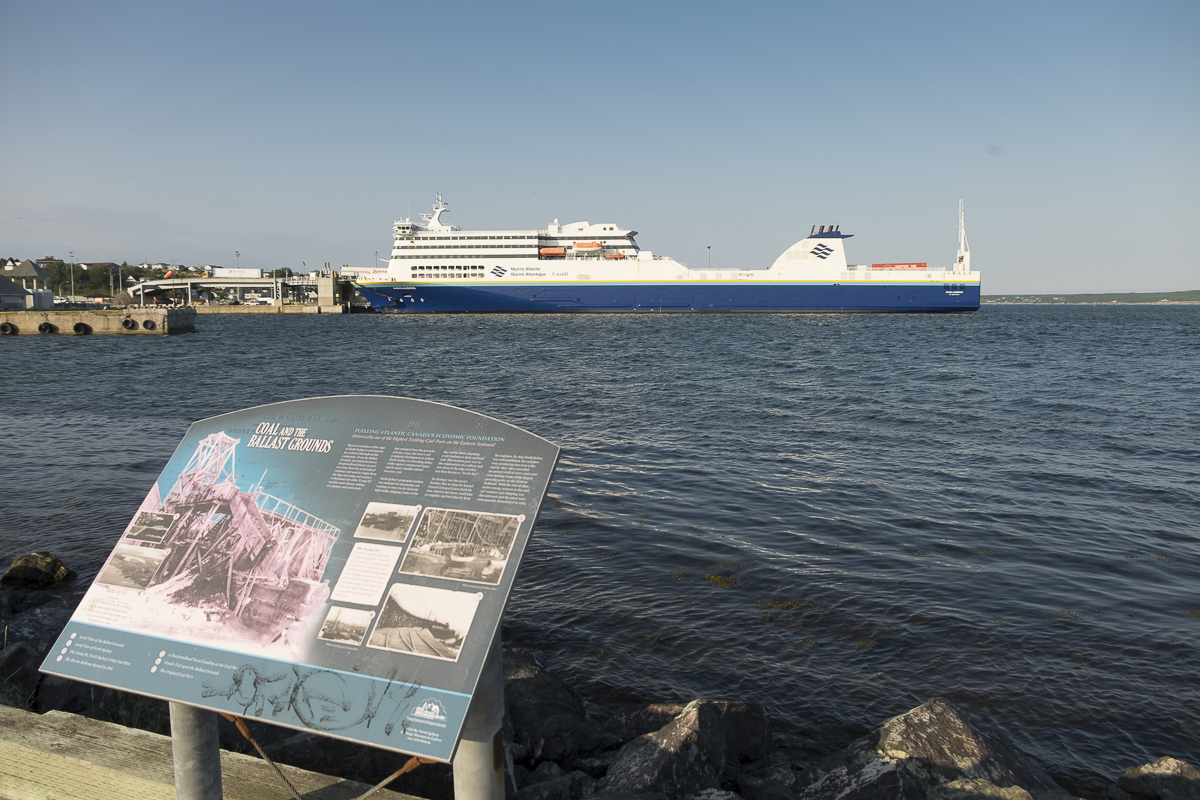


But I make no complaints.  The accommodations were superb. Our cabin overlooked the bow directly below the ship's bridge where we could watch the loading process.  After a restful night with calm seas, we were in Port aux Basques and ashore in time for a nice breakfast in town.

Our first of two objectives was Gros Morne National Park.  To understand why we went there, see this link:  https://www.tourgrosmorne.com/ 

Up early on our first full day, I explored a lighthouse at Lobster Cove just outside Rocky Harbor.


The lighthouse grounds were well restored, giving a feel for their history.  Coming over the rise from the beach, one found the route to the light keeper's garden.


The day continued with an early start towards Western Brook Pond. This is a stranded fjord.  Once open to the sea when oceans were higher, its mile wide glacial moraine now seals it off from the sea.  There are excursion boats hauled there on sleds over the moraine in deep winter.  With no road, we had a 3/4 hour walk to get to the docks.  Along the way, I found this odd fellow hanging out at a viewing platform.  He seems to be everywhere I go.


As you trek to the pond, the massive walls of the fjord reveal themselves across one of the many shallow ponds on the moraine. 


Once at the boat, and looking upwards, the fjord gains its true character.  There are massive hard rock walls on both sides.  (Here is a great photo that Pam made of the place.)


Along the way, the rock walls offer an infinite range of features, some capturing our tendency to see figures in the stone.  Can you see the man's face in this wall?  (Left of center looking right.)


There are more curiosities to be found at Gros Morne.  Just north of Western Brook Pond are some sea arches that seem out of place being surrounded by glacial moraines.


There is another side to Gros Morne. Across Bonnie Bay to the south of our cabin in Rocky Harbor, lie small fishing villages and the expansive Tablelands.  At Woody Point, I found one of the small lights guiding boats into the bay's west arm.


These are active fishing towns.  We ventured to Trout River where the stacks of wooden lobster traps reminded me that some still do things the traditional way.


No visit to Gros Morne is complete without a visit to the Tablelands.  Several hundred million years ago, a tectonic plate collision forced up material from the earth's mantle. As you enter the elevated valley, you see hard rock to one side and crumbly yellowish-red rock to the other. This softer rock, called mafic rock is peridotite thrust up from the earth's mantle. It is low in calcium but high in magnesium and iron with a toxic mix of heavy metals.

The plant community is drastically different.  We walked a small loop and found hundreds of Pitcher Plants. They love alkaline conditions and thrived wherever there was a water.


Along this little-used trail were unusual rocks. The rock appeared to be glazed with a blue-black lacquer. It is serpentinite, so called because it resembles snake skin.  Get this, it is a hydration and metamorphic transformation of ultramafic (mantle) rock.  Beautiful.

We spent three full days at Gros Morne and could have explored more, but we had a full day's travel to relocate to Cape St. Mary's for some serious birding time.   I will be back with a second part devoted to that.

Paul


Wednesday, April 16, 2014

Oh Zion!

Made my first visit to Zion National Park this April (2014).  Describing Zion National Park is beyond the scope of a blog.  It changes with the four seasons and with the hour too.  It seems largely about the light, as is all landscape photography.  So, let's begin with a sunrise near the Canyon Junction.


This is on my second day. The sky on the first day was a uniform white; not very good. The rule seemed to be "if you see a good sky, shoot fast before it disappears". 

A key factor in Zion is the play between the sunlit and shaded sides of the canyons.  The rock walls take on quite different colors as the light changes, and I discovered the fine red sand in the air on windy days creates a haze on shaded walls that comes from the light diffraction around the backlit particles.  Just below the Temple of Sinawava, I found a classic example of the sun and shade sides.


To experience Zion National Park (and just about any significant landscape), you have to do some mildly serious hiking and also to slow down enough to really see what you pass on your way to the endpoint.  An early beginning allows for an uncongested trail.  A favorite hike was to Lower Emerald Pool near the Zion Lodge.  Here is my friend Patrice Kerevel standing beneath the wispy waterfall at Lower Emerald Pool.


As I said, the other key to really discovering the park is to slow down and look.  I found freshly blooming Eastwood's Paintbrush along a narrow mountain trail.  Few, hurrying past, even paused to see the brilliant flowers growing at the edge of a massive sheer wall of rock.


The above flowers were at the east end of the tunnel on the Zion-Mt. Carmel highway.  We arrived there to the most delightful surprise.  A band of Mountain Bighorn Sheep ewes and their lambs were feeding on the bushes around the ranger station. (Glad that I took a larger zoom lens!)  They were REALLY close.


They were shifting in and out of sight. At a lull, I was talking with the ranger when pebbles came bouncing down the rock wall.  There, just above us, and in beautiful light was this ewe.


The photo was easily the best part of the trip to Zion.  There was no cropping to this photo.  Very close.

Further up the highway, my photography totally shifted gears.  I just love the simple view of the Pinyon Pine growing out of a crack in bare rock.  Pretty rough place to survive.


One of the biggest draws to Zion National Park is the hike up the Virgin River above the Temple of Sinawava. Called the Zion Narrows, at about a mile it becomes a wet  hike.  There are awesome views.  A wide angle lens is the only way to portray the landscape.


At about a mile, you must enter the stream and enter a section of essentially vertical canyon walls.  I'm saving that experience for a later visit.  I've learned to stop and look behind me, and as I returned downstream I saw that I had missed a nice little falls in the river with beautiful color in the river.


I believe that one of the visually pleasing aspects of Zion is the prevalence of complementary red and green colors - red sandstone in many hues plus (at least in spring) the fresh green leaves on the trees.  And on top of that, there can be such deep and rich blue skies due to the dry climate. I am demanding in this regards; I want some nice puffy clouds among the rich blues.  My final image to share has just that combination, found at the Towers of the Virgin. (This is at the Zion Human History Museum stop on the shuttle bus line.) There was a nice shaded ramada in back of the museum that offers refuge from the strong midday sun. The combination of shade and beautiful landscape was welcome after a strenuous hike in the morning.


With all of this beautiful scenery, the sheep were still the highpoint. After all, all of these other subjects are fixed in place, but I may never find wild sheep so close.  Oh Zion, what a good time you showed me. I will be back.

Paul Schmitt