Showing posts with label Corning. Show all posts

Thursday, October 27, 2022

Autumn's Second Season

My engagement with the scenes of fall has been extended by a simple idea.  When the brilliant red maples shed their leaves, it is not over.  I move in to see more closely. On a recent Sunday, I walked along Corning's riverside trails and found unexpected inspiration.  Hidden in an alcove of Corning Incorporated's headquarters building were some hold-out colors reflected in the facade.


Continuing along the river, I found an unexpected wide landscape.  Substitute red sumac for the maple's reds.


Now, let's get a look at what I found on another day along an abandoned farm road.   Again, it's red sumac.

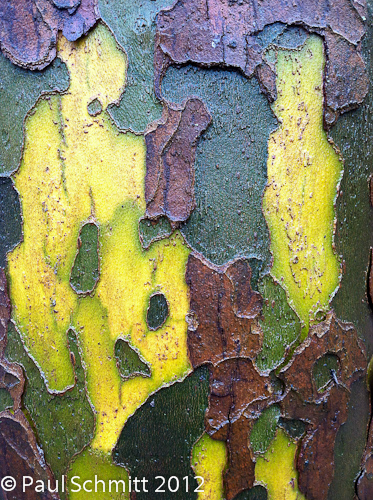
A bit farther along the road, I looked down and found this.  This time, no reds for a change.  Still works.

There doesn't need to be any catchy color, or even color at all, to speak of the second season of autumn.  The killing frost earlier this week removed all green from the delicate maidenhair ferns growing in a corner of my garden.


But, I have to complete my story with a magical jumble of leaves that I found. I could never have assembled such a screen deliberately.  The single feature that stopped me was the beads of water on the overturned leaf in the upper part of the frame.   I recall that this was just after a brief shower.

So, this is my piece on the delights of the second season of fall.  It extended my autumn.

All of these images used my recently acquired iPhone 13 Pro and the ProCamera app that extends controls greatly beyond the Apple offering.

Paul Schmitt


Thursday, January 26, 2017

Chaos and Creativity

We live in a chaotic world. This is true in both our Mother Earth and in humanity.   Order is only occasional.  I have set aside time this winter to explore the creative side of my photography.  Perhaps the lessons learned will be useful or, at the least, entertaining.

The seldom used railroad tracks at Centerway in Corning offer the order of the track's gauge.


Consider the art of music.  In music, like the rest of life, we yearn for order.  Melody presents order over cacophony. That is why I like Dixieland jazz, but have often found it necessary to leave modern jazz performances at intermission.  Some of it lacks the order of melody. It just runs scales.

A composer of music gains acceptance by a fresh progression on new melodies that explore new forms. They exhibit an absence of prejudice.  So it is that I pushed myself to seek new subject matter on a few winter days.  Dead grasses have not been one of my preferred subjects.


In recent days, I have sought subject matter outside my usual preferences.  Globs of half melted snow on a small outdoor statuette offered an unexpected composition; I don't usually think in monochrome.  It just seems to simplify the message.


I also have a prejudice against blah winter skies with no color nor texture.  Overcoming that brought me to use negative space to show the naked form of a deciduous tree.


So much of winter seems better in black and white.  Color does have a place, such as this cluster of oak leaves clinging to the branch in spite of harsh winds. Telling that  message with clarity meant paying more attention to the background than the leaves.  Busy "stuff" in the background would confuse the message.


I finished today's photo exploration outside the headquarters building of Corning Incorporated.  The black reflective glass walls offer an orderly facade to reflect the hard winter scene in the adjacent park. I prefer this reflecting wall in summer when it includes strolling visitors against a backdrop of leafy green trees and blue sky. 


I had to overcome my unfavorable opinion of the scene.  My preference is to photograph elements of the natural world such as bird behavior, flowers and landscapes, always in color. I will continue preferring this, but I believe the exercise has led me to approach each day without prejudices on what will be offered of merit. 

Paul Schmitt

Monday, April 6, 2015

The NEW Corning Museum of Glass

Living in Corning, New York keeps one constantly aware of  the events at the Corning Museum of Glass.  From a first visit in 1971, the CMOG has been a fascinating place. My favorites are in two dissimilar genres.  I love the intricate detail of the Venetian glass and the beauty of their forms. Their collection of whiskey bottles from early Americana has also captured my attention.  And watching hot glass forming is always exciting.


During my forty-four years in the community, the CMOG has evolved in several steps. Each time, the museum has become much more than before.  This March, the CMOG opened a new wing that brings huge display spaces for large works of art plus a greatly expanded hot glass theater, where state of the art facilities allow visitors to watch the creation of amazing glass forms not previously possible.


Entering the new gallery of contemporary art and design, the beautiful natural light displays the installations in the best possible way. There is no glare on the brilliant glass surfaces that would come from direct lighting. While easily missed, this is the result of very sophisticated ceiling panels. Throughout, one sees great attention to the details.


The exhibits engage the viewer in many opportunities for discovery. A close look at this large glass platter reveals an intricate detail reminiscent of Venetian glass from centuries earlier.  It differs from that genre in the color of the glasses brought forward.


There is also room for large display pieces that engage the mind in an exploration of deeper meaning.  The work below combines a fallen chandelier of ruby red glass with apparently ravenous crows.

The  gallery of contemporary art and design leads one to the second great addition to CMOG, the hot glass theater. This is where the visitor gains a full appreciation for the artistry seen in the rest of the museum. You see the skill required in a spiral of color in the image above, or in the hundreds of red forms in the assembly at left. For a family, the hot glass show is sure to be a highpoint of the visit, as the children's attention will be complete. 


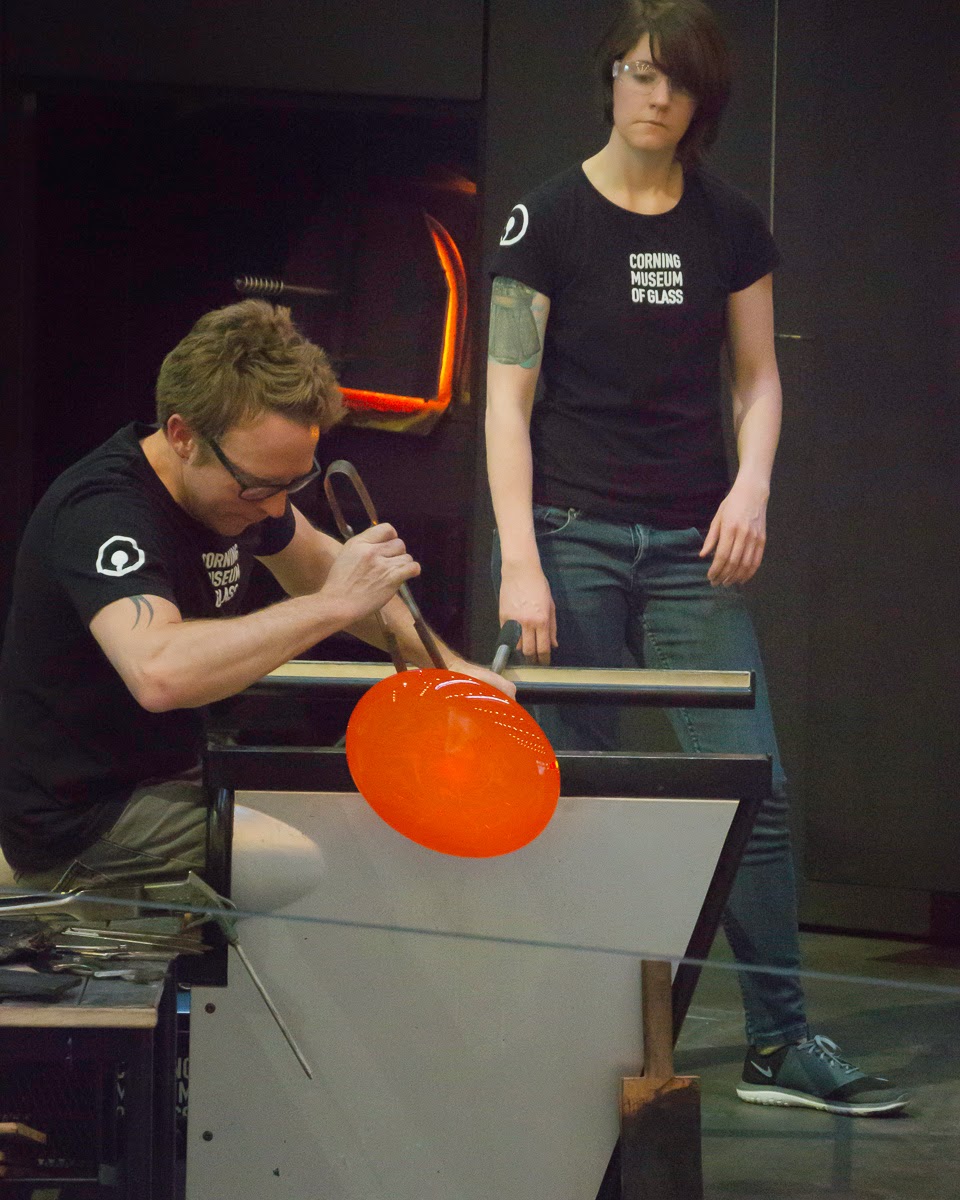
On the day of my visit, a team was creating a large oval platter in a ruby red glass.  At the high forming temperatures, the color of the glass is not apparent. The gaffer began with a large gather of glass attached to an iron pontil.   Bringing the glass out of the "glory hole" where it is reheated when it has cooled,  he sets to forming a precise shape.


While the gaffer is responsible for the overall creation of the object, there is a team of comparably qualified individuals devoted to supporting the lead gaffer. They will form smaller pieces to be attached to the main body and simultaneously work portions of the object as the gaffer directs.  It is a team effort, especially when large objects are being worked.

Below you can see the teamwork required to lay a different color glass on the rim of the platter as it nears completion.  There are often parallel tasks being done to prepare for future steps in the creation of a piece.


After about an hour's work, the final form is achieved with three skilled gaffers coaxing the platter into shape.


All that is needed is to release the platter from the iron pontil, so the team member can carry it to the annealing oven for a very slow cooling to room temperature.


The visitor to CMOG consistently leaves the hot glass show with a sense of awe, and a new appreciation for the many glass objects seen in the museum.  It is a perfect combination of art and technology. This show gives me a greater appreciation of what I see whenever I go into the museum's collection of ancient glass.

As I leave the hot glass show, I think of the challenges to making a simple glass bottle before the age of science. It seems unfathomable that such complex objects were made without thermocouples, chemical analysis, gas furnaces or exotic refractories. This is what makes the Corning Museum of Glass so interesting to me. It is a must see for everyone. If you were there ten years ago, go again.  It is so expanded, that it will be like a first visit, again.

Paul Schmitt

Thursday, March 8, 2012

iPhone photos- Can they be creative?

When a leaky zip lock bag proved to be the undoing of my cell phone in August 2011, I made the leap from a very basic cell phone to an iPhone.  I was wading in a river with my camera on an inner tube float and my cell safely protected by a zip lock bag, or so I thought. It got very wet.  So, I went from saying "it is just a phone" to saying it was my link for checking weather radar and getting birder updates on where to find the best birding. I had not included the camera in the iPhone as part of my decision.  That would change.


The change in my opinion began one afternoon when I was wandering through the herb garden at Cornell Plantations. The light was good, and I had been lazy.  My DSLR was not with me.  I decided to "play" with the iPhone camera just as when I experimented with a Holga toy camera. It had a single element, uncoated plastic lens. There were  two aperture settings, one shutter speed and no meter.  Basic.  Very basic.

Now, the iPhone is a bit like the Holga  too.  There is one aperture, f/2.8.  Since the lens is very wide angle, there is a large depth of field.  Correct exposure is dependent on the automatic metering to set shutter speed.  This makes for a good test of the photographer's basic skill set and understanding of wide angle photography.

My first images surprised me.  Was this capable of more than snapshots?  I immediately saw the first challenge, namely holding the iPhone so my fingers did not get into the image.  In addition, I was so close to the subject that it was easy to shade the subjects.   Those are good basic skills to keep in mind.

A next question to me was about the wider landscape image.  Could I use the wide angle to show a perspective of flower beds and their surroundings? 

I found the size of the iPhone made it easy to hold it in unusual positions and see the result on the image screen.

This image would have been better if I had a short stool to stand on, but I loved the color, and the instant review of the photo. The colors were looking pretty good too. This  image was at 1/125 second and ISO 100, naturally at f/2.8.  The previous image was at 1/120 second, ISO 80. I was surprised that the sensor ISO speed went down to 80.


So, I went looking for some more images.  If you are photographer, you know how a few good images inspires a burst of creativity with no apparent sense of time passing.

 The images kept coming as I awakened to the possibility of a creative camera that is so small and as ever present as a cell phone.

Parallel to this discovery was the delight I felt when I could pull the image I just made into a photo editing application, and make some simple adjustments.  If you can remember shooting a roll of slide film, mailing it to a processor and waiting for the return mail some week later, then this is revolutionary beyond the initial digital revolution when you could download a memory card to your computer the same day and edit.  Now you can do edit and email it to someone within minutes, and it can be a  pretty good image.


Here is a good example of how the iPhone can capture an unexpected creative image. We were visiting our daughter in Washington, DC this autumn and with some unexpected time, headed across the Mall to see the new monument to Martin Luther King Jr.

 In the interest of  honesty, this is a digital composite. The sky was a dull and uniform grey, so the sky  is added.  My point is that I was able to capture the critical image data and create an artistic and reasonable image to express the feelings I had at this sculpture.


Just this past week, I was feeling cabin fever after a day of pouring rain, and went in search of images with both my iPhone and Canon G9 point and shoot.  I wanted to compare the two cameras critically.

I think this is a pretty good image.  It was made with the camera very low to the pavement in order to correctly position the reflections. Which camera would you expect to have created this landscape image?


So, after deciding on the   source of the landscape image, decide which camera likely made the portrait image at that follows. It is in the same light.

Well, the first image is from the iPhone.  The tipping of the Corning clock tower and the bank building suggest a wide angle shot with the lens tipped upward. This causes keystoning.  The second image uses a longer focal length to limit the portion of the scene in the image.  There is less keystoning. The colors are pretty good in both with a slight edge on my screen to the G9, a very slight edge.

I asked the question whether the iPhone is capable of creative photograph, and I think the answer is a qualified yes.  It works where wide angle distortions are not a problem.    (Note that the  one common complaint is that people's faces are distorted to look bloated and warped. That is to be expected from a wide angle lens.) I do think it is important to get close to a foreground element that can fill the image.  Objects in the distance become very small and are lost to the viewer.


The simple truth is that the camera you have with you is better than the one you left at home.  Another lesson is that a simple camera can yield creative results if you have learned how to use it to its potential.  The iPhone camera is fully capable of creative images within its limits, and it is fun.

I have begun a gallery of iPhonography in my website and hope you will visit it at:

Natural World Photography by Paul Schmitt


Here is my final image from when I was leaving clock tower area.  Can you tell what it is?


Paul Schmitt