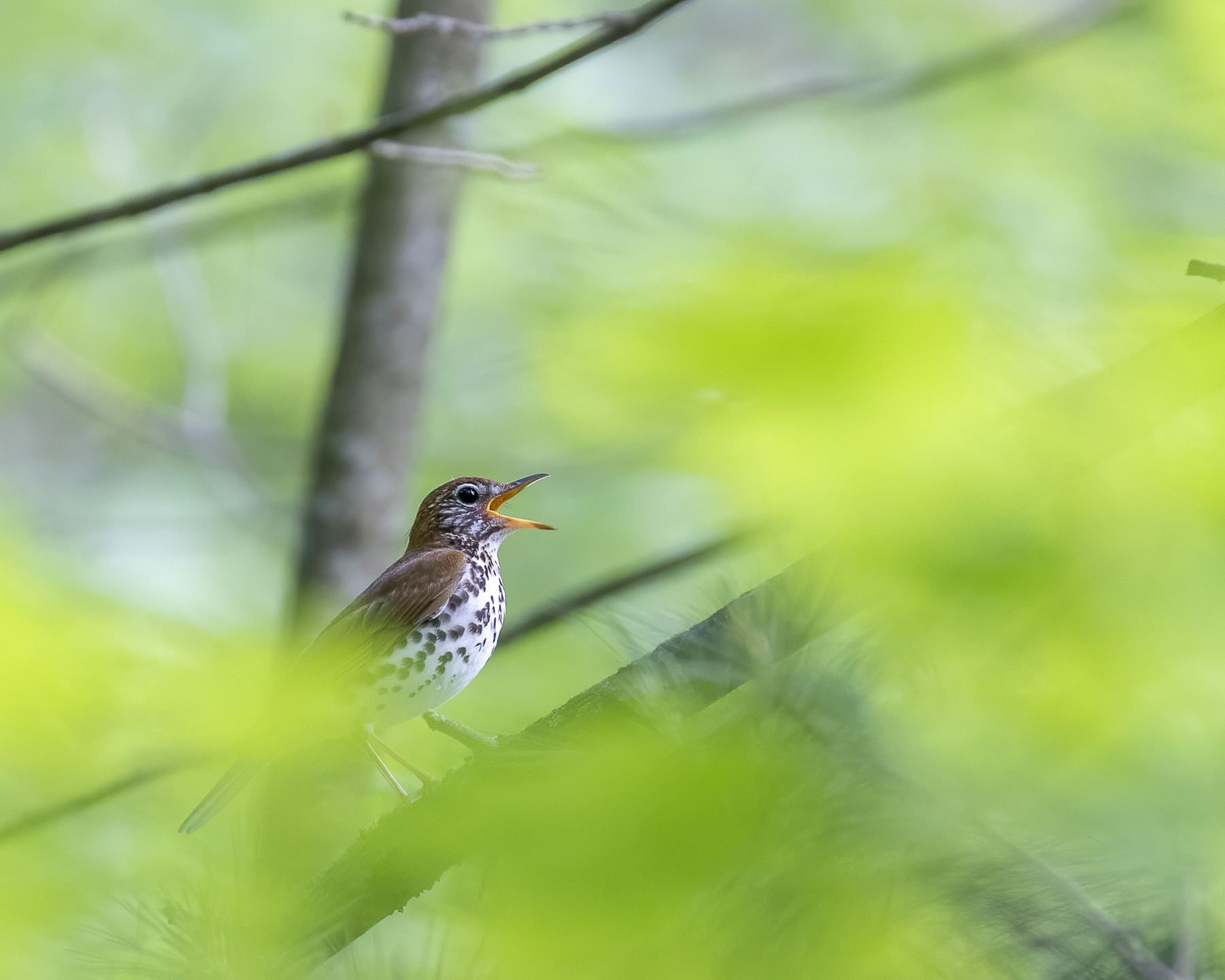
Thursday, June 23, 2022

The Tuxedo Bird

Rising early on a June day, I recalled when I did this daily in the glass plant.  No more. Now, I shared the road with unfortunates who have to do this daily.  Instead,  I had a rendezvous with the Tuxedo Bird, aka the Bobolink.

Note: Best viewed on tablet or larger screen.

Once plentiful, habitat loss and changes in grassland farming practices have reduced them.  On this morning, I am at Greenspring Natural Cemetery near Ithaca.  Their grasslands are not mowed until late fall.  The birds benefit. Listen to his song:

 https://www.youtube.com/watch?app=desktop&v=LOlO_kN0KiA

Bobolinks are not particularly shy, so I can just stand quietly in plain sight.  Last year's weed stalks are among the few perches for the  male to use while broadcasting his bubbling song.
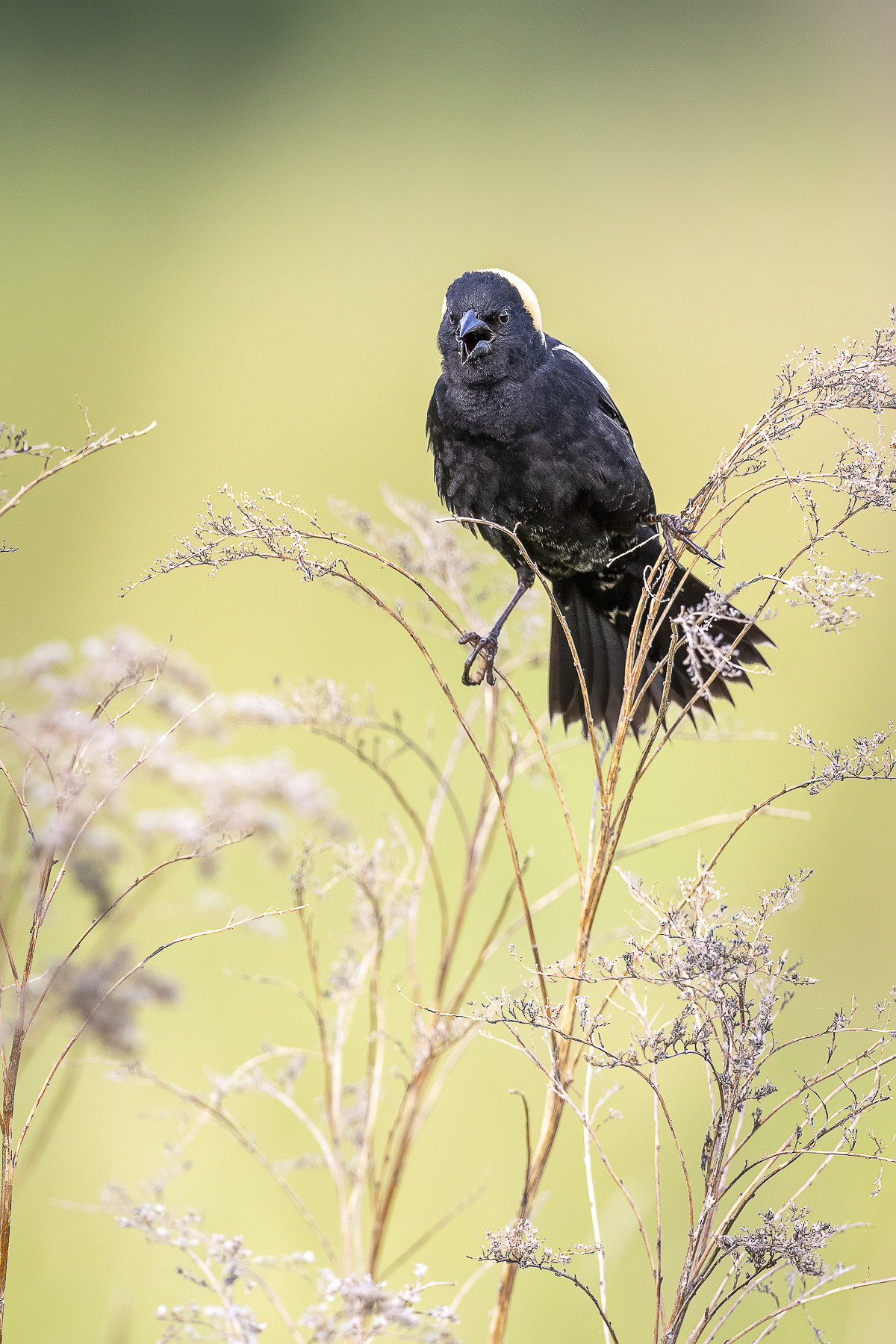
He puts his full energy into the song.  I love how his tail feathers splay out, revealing the scalloped tips on each feather.  It's quite a display.

Unlike last year, the female Bobolinks are still visible suggesting they are not yet preparing their ground nest.  One researcher told me it is all but impossible to find her nest in the tall grasses.   I'd never try. 

This is truly the best scene I have ever captured of a Bobolink. 

While the male's energy was mostly split between attracting the female and repelling a neighboring male, the female was also probing for insects hidden in the dry stalks.
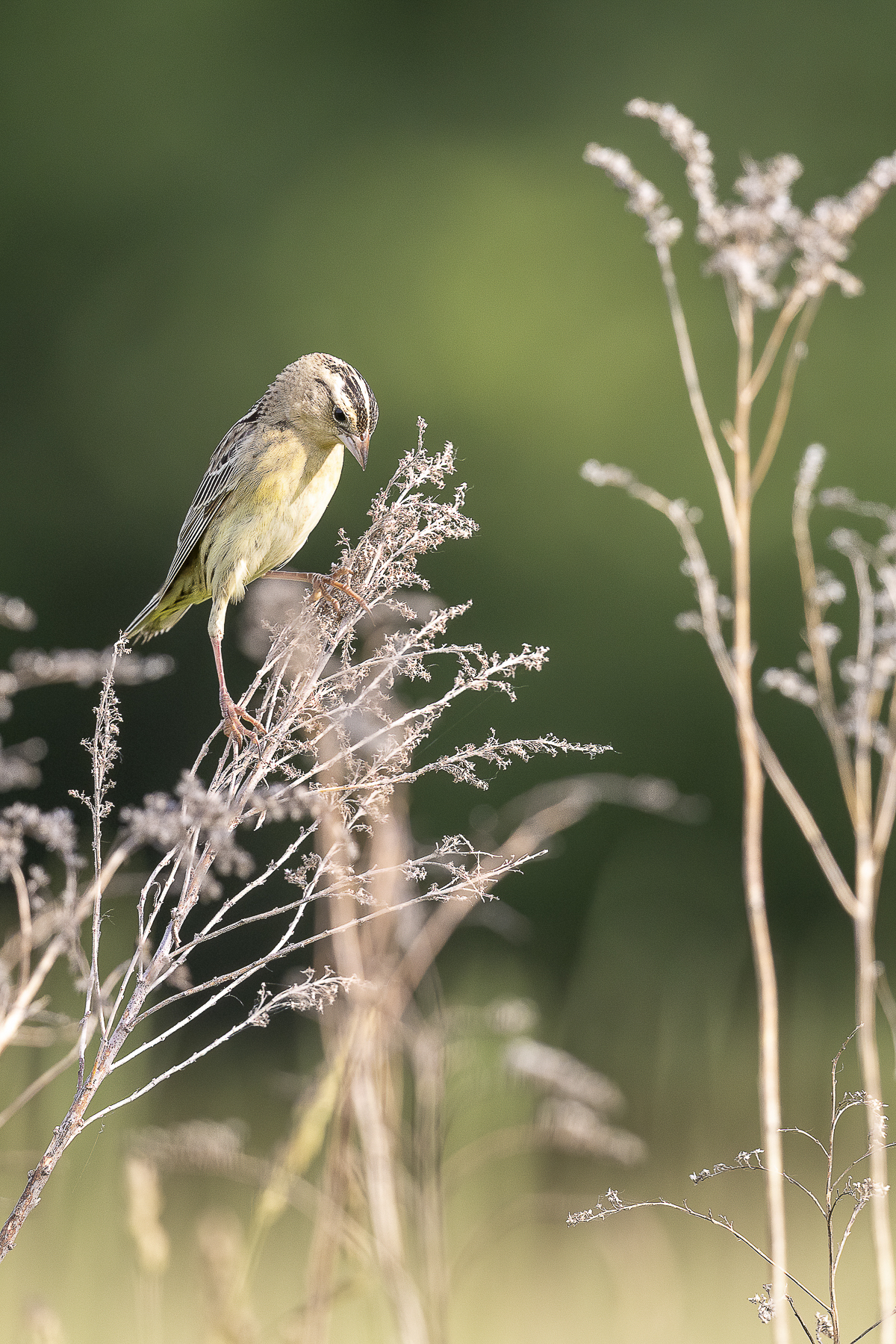
I did have one image showing an inchworm she had pulled out. Her rapid movement left it a bit blurred.  (Oh well, another time maybe.)

I did also see evidence that the male spares a little time to look for insects.

I also suggested that the Bobolinks were tolerant of me, but there were a few times when the male seemed to be giving me a hard look.

Maybe it was just happenstance that chose to direct his song directly towards me. Still, I love the look.

As a side note, this is about a 25 acre field and I did not follow the bird's movements.  After some observation a previous day, I picked a spot and avoided unnecessary movements. The males seem to have favored perches. The best strategy seems to be pick a spot and be patient.

After breeding season, the males molt and acquire plumage like the female for their trip to South America.  I'd bet the males never sing once south.

Hope you enjoy my ramblings.

Paul Schmitt


Sunday, June 5, 2022

My Gear: Getting Back to Basics

When I was looking at best images for June, there was seemingly a strong mismatch.  I think it reveals a lesson that applies beyond photography to avocations like gardening, fishing or (shudder) golf. Let's call it getting back to basics.   Maybe big versus little lens?

I began in June at an apple tree loaded with fresh blossoms.  I know that every May, Baltimore Orioles arrive to feed on small caterpillars hiding in the center of the blooms.  My gear is a 500 mm f/4 lens, with a 1.4x multiplier to push the lens to 700 mm focal length.  It's supported by a rugged tripod. Overall it weighs 17 pounds.  A monster to carry, but it does what no lightweight setup can do.  The result keeps me ignoring the hassle. 

This image speaks to me about the oriole's elegant posture, colorful markings and his faithful memory of where and when to find the apple trees

Sometimes,  I just want to explore for new beauty without anything complicated.  Enter an entry-level camera with the basic 50mm kit lens that matches the first camera I used 36 years ago.  It only weighs 2.3 pounds.  One morning in June, I looked outside and wanted to explore this blooming pink dogwood.  I saw only two colors, hot pink and spring green, a perfect complementary pair.   Here, I see a bright, friendly member of my garden that washes away winter. 


The little Canon R and inexpensive 50 mm lens is often in my day-pack for hiking.  It offers simplicity and satisfaction.

Still, I am drawn back to the big lens.  I know that the little camera tests my skills and pushes my creative perception.  But, I am drawn to finding beautiful birds.  So, after the Orioles are gone farther north, I continue to look for situations that demand the big Canon lens.  There sometimes are Scarlet Tanagers, for instance, and when they sing it is magical.

The male is proud and driven by his genes to sing for unseen females.  His head turns just enough for the sun to illuminate his eye.  Again, red and green complementary colors, background blurry for the image to be all about the bird.  Listen to a tanager song on the internet to know more of what the image feels like to me.  But, let's get back to simplicity.

I believe the little camera plays a role in keeping me creative.  I treat it as sketching.  Most recently, I carried only the small rig on a hike up a forest road in Arnot Forest.  I actually expected to mostly be using binoculars to find birds, but I kept getting derailed.  Here are three examples.  Each has a name which speaks to what I saw.

A Beacon in the Forest

The Wild Marigold Sisters

A Lone Wild Columbine Deep in the Arnot Forest

I think what I saw in the forest matches what I saw for the birds.  When one starts a new activity, photography or golfing for example, gear seems to be so important. It isn't.  Must have the same clubs Tiger Woods uses.  That's normal.  As soon as the gear is understood, it's how you approach the golf course or the images.  I think my use of the little "carry about" camera spills over into what I create with the monster lens.  I know what I create is more dependent on my mind's eye than the gear.  This is an image from my five year old iPhone 8.  The flowers look like a row of bells.

After the Rain

I am satisfied with the images it produces and find no need to upgrade the phone.  No, my gear is not mismatched.  They are excellent tools, and the iPhone 8 belongs, too.

Can you relate this to a personal avocation which gives you satisfaction? Baking, cabinetry, fly fishing or sewing maybe.

Paul Schmitt

Friday, June 3, 2022

Who's Playing a Flute?

A dear friend, Julie Albertalli, spoke of a fond recollection about the arrival each spring of the Wood Thrushes on the family farm's hillside woods.   Here's one I discovered lurking in the shaded woods of the nearby Newtown Battlefield State Park.  That's just up the hill from her homestead.  This is often all you get to see of a thrush among the trees.


Julie's joy centered on the Wood Thrush song that drifts down from the tall hardwood trees with the sweetness of a solo flute.  Here's the sound from the Cornell Lab of Ornithology's collection:

https://www.allaboutbirds.org/guide/Wood_Thrush/sounds

It's a rare situation where I actually see an entire bird singing on a sunny perch.  Note the rich color displayed: 


Today, I was back in a woods near to where Julie grew up hearing their song.  There was a bird foraging in the lower levels (mostly for caterpillars).  It's spreading its wings to take flight.


On very close examination, I can see a small insect in its beak.  That's probably an indication that they are feeding young, so I expect the singing will decline as territorial protection is reduced.  I will have to wait until 2023 to easily hear the flute's melody.

Paul Schmitt

Monday, May 16, 2022

A Lunar Eclipse- Two Views

 Last night was one of two lunar eclipses for 2022.  (Another is on October 28.) Unlike the majority of such events in Corning, the sky cleared.   Failure is surely an option in much of the Northeast US for any given eclipse on the calendar.


There are two ways to see the eclipse, the first being as the unaided eye offers it.  The moon is actually quite small, and even smaller seen in a cell phone's wider angle lens.  You can see that eclipse is too high to include landmarks on the ground in the scene.  Here is the view across the river towards the Corning Incorporated Headquarters.  This was early in the eclipse.

I actually like it because it puts a lot of attention on the iconic Little Joe Tower that is emblematic of the city and the company.

That's fine, but you really want to see the blood moon which quickly crosses the sky.  Here is my presentation of about 8 minutes elapsed as it approached maximum color.

Note that as the eclipse darkened, a few stars were visible.   The moon is red because the shorter wavelengths of light bouncing off the moon are filtered out by the atmosphere.  

As I was packing my gear to return home, the air becoming foggy. Typical.

Paul


Saturday, May 14, 2022

Sketches: Eastern Bluebirds

Last summer we had a pair of Eastern Bluebirds nest in the nest-box we installed.  It was their second brood of the year; they nested in our neighbors backyard in May.  To our delight, several of the first brood came along and helped feed the second brood.  It was sort of an apprenticeship for these recent fledglings.

This week, I found an active nest with adults that were very comfortable with my presence.  Looking at the location, I decided to arrive in early morning shortly before the sun cleared the eastern treeline, putting the nest in good light.  The male was perched outside in the cool light.

Insect activity was low in the cool damp morning air.  He seems fluffed up to keep warm in the early chill.   I was surprised at how rich his colors were in the shade.
 

Soon, the sun bathed the nest box, and deliveries began to the  nest.


The first deliveries were mostly spiders.  I expect the larger insects in the grasslands surrounding the nest are keep down when the dew is heavy.  It will surely shift quickly.

Bluebirds are very fast so these images were taken using 1/2000 second exposures to freeze the motion.  This is a favorite of mine.  Putting on the brakes!


Another spider.  One difficulty is accurately anticipating where the next arrival will come from.


Love the color on the spread wings.

Lest you think only the male is bringing food,  here is one of many times the female delivered some sort of winged insect.


 She perched at the box entrance and hesitated to enter.


Wait, there is more to the story here.


 She had to wait her turn.


As I continued to watch, I realized there were two males, leaving me to believe that one of last year's fledglings was still playing the understudy role.  Fascinating.

That morning deepened my understanding of why so many people care for their bluebird boxes, and the reward they receive.

Paul Schmitt

Friday, May 6, 2022

Sketches: Winter Wren

Singing Winter Wren
I have a love affair with wrens that includes over thirty years of welcoming a pair of House Wrens to our garden.  They bring song and a steady harvest of insects.  My first memory was of a pair of House Wrens that nested in my mother's clothespin bag on our back porch.  When I was about 8 years old, Mom kept me home from school to watch the fledgling wrens exit the nest and perch on our porch railing.  Now I have added the same love for Winter Wrens, after I  discovered them in a deep forest gorge nearby.

I first found these Winter Wrens last year.  At left is one of last year's males in full song. It begins with the song. Here is a link from the Cornell Lab of Ornithology as an  introduction:

https://www.allaboutbirds.org/guide/Winter_Wren/sounds

There is a small stream that runs crystal clear most of the gorge. It has overhanging banks that are ideal for wren nesting and also food in the stream and the forest slopes.

On a recent morning in early May, I set behind my camera on the rocky stream bed expecting some males to begin singing.  A wren appeared to sing a bit, but then I saw something new.  It dropped into the stream's shallows to explore some aquatic mosses.


This was something new for me.  It explored the scene and clearly was picking food from the moss.  Maybe aquatic larvae?


I was excited to see this.  I decided to come back the next sunny afternoon when the light was better.  

When I returned, there was little singing, but I waited.  With a little chitter-chitter song, a wren arrived on a branch and soon dropped into the stream's edge.  (I theorize that this is a female since there was no elaborate singing.  Just a guess.)  

I expected some foraging in the moss like the previous day.  Wrong!

It was bath time.  The water was flying.  Sometimes, only the top of the back was visible.  I was firing off images rapid fire.  Soon, it was time to shake and preen on a large perch at stream's edge.


Then it needed to fluff up the feathers.


Then a call for a little more preening of the wing feathers.


Was that it?  No, time for another jump into the stream it seems.


Guess this was the rinse cycle.  Back on the perch for a last preening and the bath is finished.


Now to find a nice sunny perch to dry off.  Isn't she pretty?   

And, aren't I lucky?

Paul


Wednesday, April 27, 2022

Jewels of April

 The end of April is fast approaching.  The days of strong winds have been mixed with some wet snow  to limit the days suitable for wildflowers. Still, there have been some nice finds.  Early April reveals Sharp-lobed Hepatica.  Notice that sharp-lobed leaves appear old. Right!  They are last years. Unlike many plants, this one blooms before setting the current year's leaves.  Perhaps they are the only flowers out there for bees and get more visitors?

Another early blooming plant is Marsh Marigold.   (Not really a marigold.)  It loves wet, swampy places. 


My boots are usually muddy when I am photographing Marsh Marigolds.  (Add muddy knees to get down to its level.)   Perhaps that is why it is often overlooked.  The flower is a sturdy five petal bloom with a waxy surface. 

Another often overlooked plant is Blue Cohosh.  It has subtle coloration that doesn't catch your eye from a distance.  During the flowering stage, the plant often lacks even the expected green stalks.  (See below.)


A closer look at the flower reveals why I appreciate it's beauty.


Another April flowering wildflower is Bellwort.   It often is found in large clusters in wooded areas.  Over the years, I have never seen the yellow petals spread out in welcoming array for insects.   Seems a better common name would be Weeping Bellwort.  Still, I love the rich yellow and green display.


I am saving the last for two of my favorites.  Trout Lily (or Adder's Tongue) is another wildflower of the dry woodlands. Only opens its petals when the sun is bright, presumably timing that to peak bee activity.


I find it a graceful flower to explore in detail.


Finally,  here is royalty among the April display.  Purple Trillium,  Trillium erectum,  stands nobly on a steep slope in the Mundy Wildflower garden at Cornell Botanic Garden.

This is a mix of subjects, some overlooked and others eager sought each year.  I hope this encourages viewers to look past the obvious and appreciate the less noticed.  They are all jewels.

Paul Schmitt