Sunday, June 7, 2020

Watching in Awe- A Potpourri of Birds

A major goal of my bird photography is sharing examples of why I am in awe of the bird world. It begins with their amazing displays of ornamentation.  This facilitates breeding selection and extends into adaptation.  Not all birds follow ornamentation.  Some take a different path, wherein dark feathers contain melanin which makes the feathers stronger to resist wear.  It seems to me that each successful bird species finds a niche where it avoids direct competition with similar species. If there is direct competition between two similar species, one will adapt better and dominate.  For example, the different woodpeckers in our woods each have a different feeding sector or food preference in the forest.  The Downy does not compete with the Pileated Woodpecker.

Let's begin with a simple example of the Red-breasted Merganser.  It is quite different from the larger male Common Merganser seen at right.  In June, this bird is still in its breeding plumage. 

Enter the smaller Red-breasted Merganser seen below.  First, he has already molted and his iridescent green head is gone. He's now a reddish color. He molted two months before the Common Merganser.  Also, while the Common Merganser dives as deep as 100 feet in large lakes and river, the smaller merganser frequents very shallow water. I observed this reddish merganser picking snails off the cattail stalks.


Similar species, but they are successful in different habitats. Now that I have found this bird's breeding area, I hope to get its photo in breeding colors. Breeding is over, and this boy was silent and red.

Now, let's go to the tuxedo bird.  Some have suggested that the Bobolink looks like he put his tuxedo on backwards.  I was fortunate to capture this male in flight.


I think he looks like a professor in academic robes - pale yellow cap and fringed puffy shirt with a black robe beneath. Breeding was just beginning, so this Bobolink was very vocal.  It's a beautiful song.

I've been following a particular Osprey pair for several years. In the first year, the male had a tough time getting a female to look at his nest.  He called at every large bird that passed hoping it was a female Osprey.  Now, they are bonded and get down to business quickly. Two small chicks are in the nest, and the male has begun his regular fishing for them. I have a good view of their nest right at my eye level. Here comes the male with a fresh catch.


It's pretty easy to tell which is the male. First, he is notably smaller. Since he is diving into the water  for each catch, his feathers are cleaner than the female who spends long hours at the nest.  When the chicks get close to fledging, she will join in fishing to match the chicks huge appetite.

At this early stage, the chicks are small and their heads are barely visible - usually only seen when being fed as shown below.


The male won't stay long at the nest. He'll be back fishing soon. Note the bunch of bedding to the right on the nest. It looks like fibers from cornstalks to me.

This COVID-19 pandemic has closed a lot of parks and some favorite natural areas. One of my best locations just opened recently, any only for only three days a week. In the absence of visitors, a Red-tail Hawk has taken residence in the park's pavilion and the adjacent camper-cabin area.  There is staff working there on renovations, so the bird has become a bit habituated to small numbers of people.  I've been able to get close to the bird by being patient and not directly approaching it. Today, this paid off for me.  I was only 100 feet away.


I am guessing the hawk has been very successful here.  I only saw two squirrels and no chipmunks in the area.  She is pretty good at picking concealed places, such as this gnarled pine tree.

Note how well her body coloration blends in with the tree branches.  Both male and female share this coloration which supports hunting success.  It works. When I arrived two days ago, I knew she was in the area but could not spot her. Thirty minutes later I returned to my car, and she flew out of the tree across from my car.  I had looked there initially, and I can only gain respect for her ability to stay hidden.

There is a similar story for the warbles, and I hope to have the patience to find the subjects to fill in the narrative.

Kind regards,

Paul

Monday, May 18, 2020

Baltimore Oriole Feeding

It's been a slow spring.  By my records, wildflower blooms and migrating birds are at least three weeks late arriving.   So, I have been busy with a massive revision to my photo file, but it was not my first choice.  Yesterday I saw a good clear and calm morning that was perfect.  And, nearby apple trees were finally coming into bloom. I've always seen good numbers of birds in the flowering trees, but I have never been able to determine what they were feeding on.  Were the Baltimore Orioles somehow getting nutrition from the flowers themselves?  After all, it is common for people to put out orange halves and dishes of grape jelly for orioles.  Is there also nectar in the apple blossoms for them?  Well, I came home with a series of four colorful images that answered my question.

This colorful male came into my view at the top of a large apple tree that had just come into bloom.


 He began probing in the open blossoms.


 Soon his beak emerged with a caterpillar.


He shook it a bit and then it was up and in with a little flip of his head.  Down it went.


So, the answer is that the Baltimore Oriole was there for the high protein caterpillar.

The tree was alive with other birds including Redwing Blackbirds, Gold Finches and warblers.   The larger birds tended to be in the outer parts of the tree and also towards the top. The smaller birds were mostly in the denser parts.   They were more difficult to track.  There was one Tennessee Warbler that sometimes ventured to the edges.  Take a look at him.


There is a small caterpillar in the the tip of his beak.  He was there for the same thing.

Now, it is dark and misting.  Back to the computer.

Best,

Paul Schmitt


Thursday, February 27, 2020

Orchid Extravaganza at Longwood Gardens

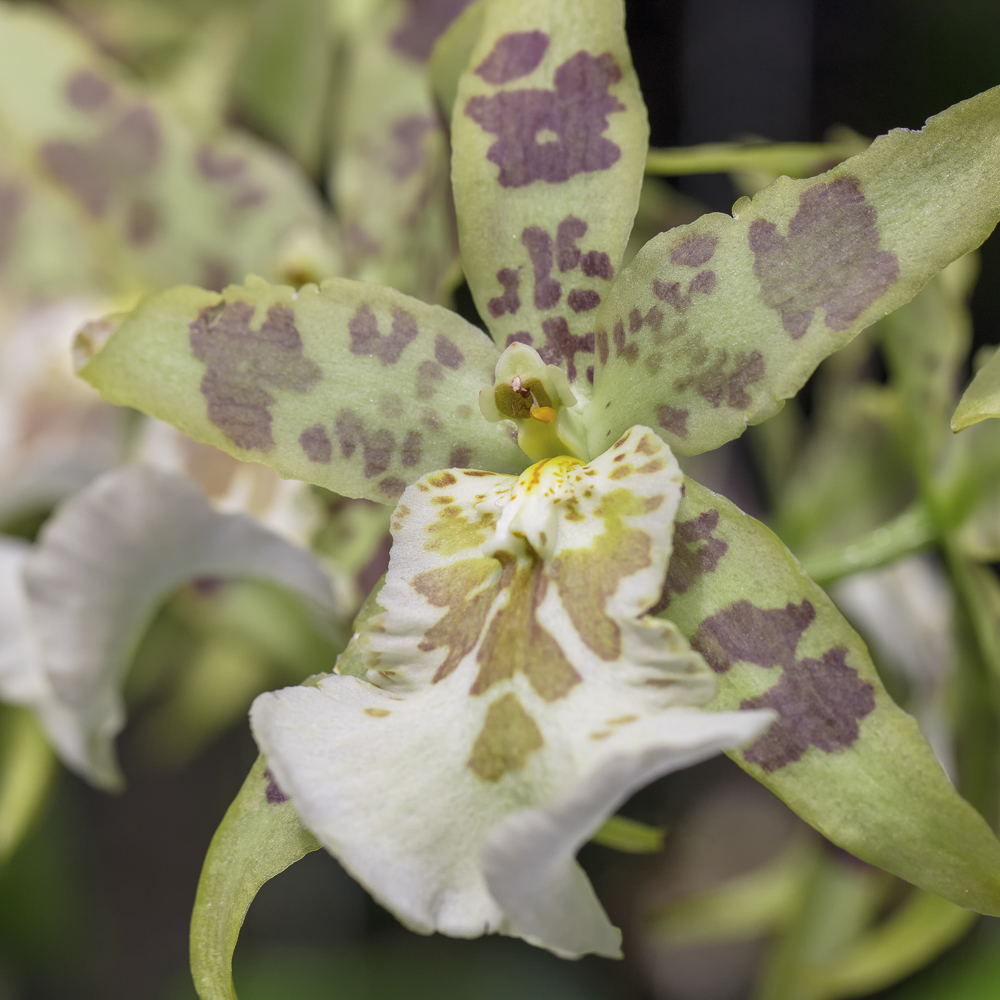
By the end of February, winter is getting a little long.  It's time for a break.  The Orchid Extravaganza at Longwood Gardens in Kennett Square, Pennsylvania runs from January 18 through March 22. The number of brilliantly flowering orchids is beyond counting.  The Conservatory at Longwood displays much more than orchids.


Here a small selection of orchid images hint at the beauty to be found.  While there were some large walls covered with masses of orchids, I concentrated on the singular displays for their purity.


It seems that a small number of colors and a simple background speak clearly.


 These were all done handheld to minimize any inconvenience to others.  

 It was a Monday, so overall it was quiet; however, a tripod can be intrusive as the day progresses.


While orchids are often richly colored or even flashy, some are more subtle.


This intricate cascade of blooms stands out in part due to a simple green background.


Flowers seek to attract insects by color and scent.  I wonder if these orchids have added colors in the ultraviolet spectrum that the insects see? 


There can be no doubt that we are seeing the colors insects see in these blooms.


There are another sixteen really good images that I brought home.  These should be enough to put a winter-time orchid display on the list for a welcome relief from the February and March blahs.

Enjoy.

Paul Schmitt


Wednesday, February 19, 2020

Snowy Owls (plus a few bonuses)

Like many bird photographers, I will go a fair distance for a really special bird.  Snowy Owls are high on that list.  So, in February I drove up across the border into Ontario to follow their sightings reported since the first of January.  Pam and I arrived in late morning and began to crisscross local roads until I spotted a bluish white in a pure white field.  Can you see how the owls back doesn't match the snow exactly. (I hope your screen is color balanced.)


The bird was actually about 50 yards away, so it wasn't standing out quite like my long lens suggests.

This was a good start.  Owls are never as common as crows in an area.  Continuing on down this dirt road, Pam asked what the shape in the spindly tree was.  Binoculars revealed falcon, namely a female Merlin.


Like the owl, as long as we stayed in the car, the bird paid little attention to us.   I inched the car up several times before I got a little too close, and the Merlin flew farther up the road and out of sight.

We continued slowly along the road looking for owls.  Over the crest we saw the Merlin and again got close.  Eventually, it signaled that it was about to fly.


We continued our search encouraged by our early good luck. Anyway, we had all of the next day.

The sky was filled with light snow flurries through the night.  At early light, we headed to a location where I had seen birds twice in December. Assuming the Snowy Owls would again be on the ground, we trained our binoculars across both sides of the road.  Somehow, I looked up toward a telephone line that parallels the road and let out an exclamation (that I won't put in print).  There was an owl perched on top of the nearest telephone pole looking right at us.

It tolerated us, and ignored the snow plow that passed beneath.  I got out after the first photos and set up on my tripod.  Over fifteen minutes, as my hands became numb, I casually moved closer at a tangent to the direct approach.  Usually, I took a few steps when it was looking away.


The snow continued, and at times the bird fluffed up and shook off the snow from its head and back.  The cold eventually got the best of me, and I slowly retreated without the bird ever shifting away.

This was a good start to the day.  We moved on to continue our search.  I began to wonder if the snow was perhaps shifting the owls up onto perches.  Turning onto a dirt road, I spotted another Snowy on a fence post.   I got within about 30 yards and turned the car sideways to shoot out the side window.   It held its position.


All was looking good to get closer until a large truck approached at high speed with a wide swath of blowing snow.  I had to pull off to the side and the owl was gone.  It was still a good morning.

Farther along the same road, I saw a resident coming out to fill some bird feeders and stopped to
talk.  He had drawn in a good selection of small birds. Once he was back inside, I had a few Snow Buntings perch close.  They are very skittish, so this was good luck.

Soon it was midday and time to find the local cafe before continuing.   Then it was time to explore some new locations.  I had my heart on finding one of the large flocks of Snow Bunting that seem to blow into the corn field stubble with every gust of wind.  The plan was to pick a likely field and just let the flock come to us.  Gave it a good wait twice with no luck other than a shy Mourning Dove taking refuge from the wind.


We had one more road to try, and it was a hit.  About 60 yards out from the road was a long row of piled manure with an odd white clump of snow.  Make that a Snowy Owl.  It was far enough away that I could pull off onto a tractor path and assemble my tripod and long lens for a stalk.  The path angled off from a direct line to the owl, and it allowed that I was just passing by.  I cut the distance in half and made a favorite image.


This was a pretty good day.  After dinner, a review of the coming morning's weather was discouraging.  Temperature -10°F and wind chill near -30 °F.   Brutal.   Headed for home in the morning.

Paul Schmitt


Sunday, February 16, 2020

Discovering Yellowstone in Winter- Part Two


Beyond the wildlife in Yellowstone, there are the iconic locations that are transformed in winter.  Old Faithful Geyser becomes a solitary study in blue and white with no people in the scene. Our trip leader knew to take us behind the amphitheater-like semicircle of benches to face south into the sun.  The back lighting was dramatic, and no one else was present.  The foreground is textured with the outflow from the geyser.   It's lovely.

The eruption begins at a time that is plus or minus the posted time by maybe 10 minutes or more.  First there is a burp and a sputter.  Maybe there are several false starts over several minutes.  Then  the geyser comes to life with some commitment.


A key lesson about Old Faithful is to skip it on cloudy days.  It needs a blue sky to really shine.  Another lesson is to look around for overlooked scenes.  Walking 50 yards away from the view of Old Faithful, one finds a hot spring pouring out an amber stream into the Firehole River. It is blue  and gold.


Many (most?) visitors arriving at Old Faithful drive past an entrance to the Biscuit Basin.  It is a colorful basin with sapphire pools and steaming hot springs.


The vistas are dramatic, yet few visitors are there in winter.  All the better that we are alone.


The scenic variety of Yellowstone extends beyond the thermal features to places like Gibbon Falls.  The flow of water forms a backwards "S" from upper left to lower right, and in winter I particularly like the simple color set of red rock and touch of green.  In winter, the snow removes a lot of visual clutter.


Look at how beautiful and simple winter makes these landscapes.  One is an intimate setting.


Another captures the vastness of the Hayden Valley.


When you think of vastness, one has to include the Yellowstone Canyon in its many forms.


Forms that include the canyon walls.


The many shapes and colors of the thermal areas provide a balance with both grand views like this in Middle Geyser Basin.


And closer views that entertain.  There is a lot going on in this location with living colonies and hot spring mud. 

Other places have strange forms such as this hot spring above Mammoth, which seems to resemble the shape of South America upside down.


Some locations change on a daily basis such as these terraces at Mammoth Hot Springs.

Throughout the hot spring areas one sees trees claimed by the shifting thermal activity, standing like silent sentinels.  The land is alive with change as seen in Mammoth and all other thermally active areas.


We made a final stop at the Firehole Falls that I first saw thirty-two years ago.  It is so different in winter.  No crowds this time and a new-found beauty were there.  I saw this with new eyes ....


..  and I saw this for the first time on the rock walls of the canyon.


Traveling in Yellowstone with a group of highly skilled photographers, plus the expert teaching by John Gerlach, was a richly rewarding experience.  Across the group there was a quick eye for seeing and interpreting the scenes with no hesitation about what was significant.  Members quickly got set up and made their images so that next person could take their prime location.  The results shared on our last evening were full of memorable images that each told a story.  The absence of crowds made that possible.  I'd do this again.

I hope you both enjoy these images and also take away some useful ideas about seeing beauty as you travel.

Paul Schmitt

Monday, February 10, 2020

Discovering Yellowstone in Winter- Part One

Entering Yellowstone in winter is very different from the summer routine. There are no lines of private cars and tour buses. Sunrise is later, and often a gradual event under thick clouds.  The tour leader presents documents and park passes to the ranger and comes back with a large bag of candies from the ranger.  At 8 o'clock, we are ahead of the snowmobile groups as the snow coaches proceed along the Madison River.  Soon our focus is on spotting critters.

We hope to spot a rare bobcat or snowshoe hare.  We'll settle for the first group of bison near one of the pull-offs. But what we often get is a spectacular landscape of the Madison River valley and a distant volcanic ridge.  There will likely be some ripples on the river from a lone common goldeneye diving under the shiny blue surface for food.   It is beautiful, and quiet.  We all pile out of our three snow coaches to find the perfect spot for a landscape photo.


We quickly learn that when stepping away from the hard road surface of compacted snow, your feet will plunge in to deep snow, often up to your knees.  Walking to the river's edge is laborious. Coming back is harder.

Our aging Bombardier snow coaches prove to be ideal for our day's journey.   The tracks smooth out the undulations from the snowmobiles and the mammoth all-wheel trucks. 

Our coaches have two roof hatches that we can photograph from.  This proves invaluable when we stop for bison.  If they approach within 25 yards, everyone must be inside their vehicles, but unlike the trucks, we have hatches that allow us to continue photographing.  On our next stop, there were bison in along the Madison rooting through the snow for grasses.  They decided to climb the bank towards our coaches. Quick, into the coach.


There would be daily opportunities to photograph bison.  And there would be numerous times when our drivers would negotiate bison on the road. 


The bison herds in winter are chiefly cows and calves.  Bulls are seen singly. They are all pretty docile with the focus on survival, not mating.  Food is scarce and poor.


There are other critters to be seen along the rivers, like these trumpeter swans.  They exist only because market hunters were unaware of a small population in the remoteness of Yellowstone.


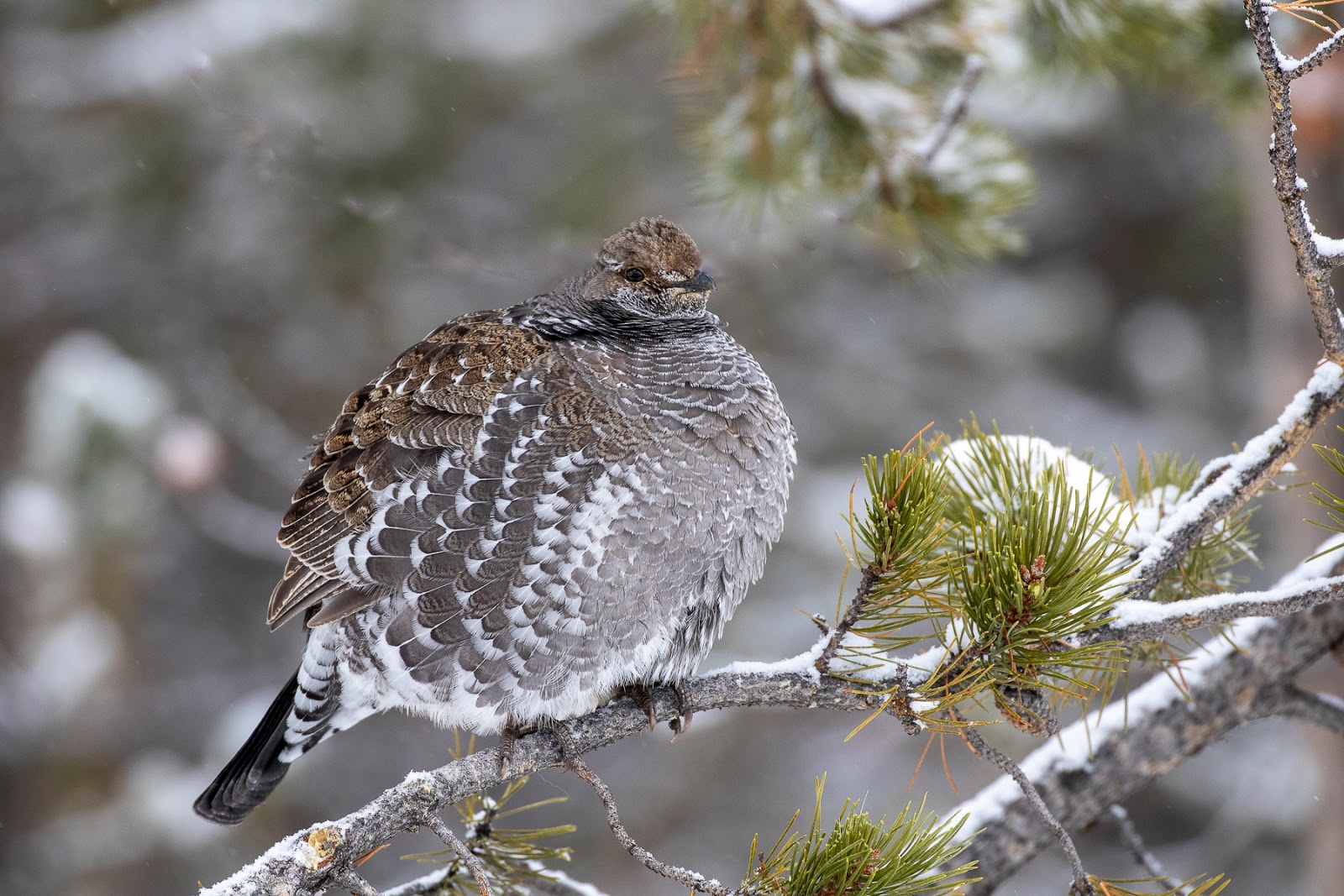
We rarely failed to stop at the Madison Junction for the facilities- clean, modern and offering a coffee and snack bar.  Every stop there also included looking for the dusky grouse that occupied the spruce trees along the entrance road.  Sometimes one was sitting in a snow bank.

But, as we motored, most eyes were looking for animals.  Our experienced drivers were always alert.  I  had a camera body with a long zoom lens ready. Sometimes the opportunity was too brief, and it was down to a quick popping up through the roof hatch. The first passenger ready gets the first shot. Such was the case for this bald eagle along the Gibbon River.

On another day, a bedded coyote was spotted some 200 yards across the Madison River.  We'd seen a pair there the day before.  Suddenly I saw the reddish coat of another coyote at the river edge only 50 yards away.   It was hunting a little side slough of the stream.  

Soon, everyone was out of the coaches and we watched the coyote meticulously patrol along the slough.  It focused its attention and pounced!

The evidence of critters in winter is sometimes slender.  We'd stopped along a river for landscapes.  This small spruce was growing on a glacial boulder in midstream. I was attracted to the tree's shadow  that led the eye to an even smaller seedling atop the boulder.

I became bored with the location while most others were still exploring the river.  I looked upstream where there was evidence of  nighttime visitors, possibly two kangaroo mice. 


There were other signs in the snow, too.  On the Yellowstone River near the falls were river otter tracks along the icy stream, but no otters.  There is another side to Yellowstone in the winter, the landscape.  There are icy waterfalls, thermal hot springs, geysers and wintery shapes on the mountain walls.  That will be in Discovering Yellowstone in Winter - Part Two.

Enjoy.

Paul Schmitt