Monday, April 27, 2015

Details Make a Difference

I began this last week scouting for a good location to photograph Eastern Bluebirds.  I quickly found them, plus the usual abundance of Tree Swallows competing for their nest boxes. The light was good, but I did not have time or tools to prepare the location for the best results. At right is what I captured for a Tree Swallow. The light is good; the bird is in an active pose.  The background is nice too. BUT, the white plastic pipe is plain ugly.  The technical details were fine, yet more is needed.


I returned a few days later with a pocket tool in hand, so I could add a natural perch to the nest box pole.  Swallows and Bluebirds frequently perch above the nest box that they are defending from interlopers.  The first Tree Swallow to approach immediately chose the dead stick over a plastic pipe.  I positioned the camera so that the background was very distant and entirely featureless.  Isn't that a lot more pleasing to view?  


There was also a tangle of briars that had been brush hogged in the fall.  Some of the briars had remained.  Noting that the Bluebirds were hunting from a perch on a briar stem, I jammed another dead stick into the pile to add another option for the birds.  That, too, brought immediate results.


It only took me fifteen minutes to find some nice branches and stick them into place.  The results were pretty immediate.

Paul


Wednesday, April 22, 2015

A Bluebird Day

I've sometime wondered if we use the term "bluebird days" because the sky is the same as the male bluebirds rich color, or if we associate sunny days with a lot of bluebird activity.  Yesterday had a brilliantly blue sky, and I found overflowing bluebird activity. (Today is rainy and I saw only one distant bluebird.) Going with the first explanation, the birds put on a nice show for me.  This male bluebird quickly became accustomed to my proximity.


Center of interest for the male bluebird is the female who is checking out the available nest boxes.


Anytime you are around bluebird nest boxes in the spring, there is a conflict with the ever- present tree swallows, that greatly outnumber them. So, the bluebirds often take up a perch on a box and withstand the fly-bys from their antagonist. I've seen the male bluebird spread his wings to appear larger in face of the harassment. Yesterday, I saw a new behavior as the pair stood together with some degree of solidarity. 


I mentioned a second meaning to "bluebird days" relating to the sky color.  So, as I was photographing the birds, I became aware of an unusual aircraft sound.  It approached slowly with a broad seemingly widespread rumble. I realized it was directly overhead and looked up to see this. The sky really was close to the bluebird color.


It was a KC-10 wide body Air Force tanker with six A-10 Warthog fighters at a modest altitude performing a refueling exercise.  (The KC-10 is a modified DC-10.)  In a few seconds, one of A-10s moved into position under the tail of the tanker. The muffled sound I was hearing was the combined noise from fifteen engines. 

In my previous blog, I noted to expect the unexpected.  So true. 

Paul


Friday, April 17, 2015

Expect the Unexpected

I just learned, or relearned, a lesson about being prepared.  Made a short drive to a nearby park to scout an abandoned road known to have a lot of birds.  I wasn't seeing a lot of birds, until I was nearly back to my car.  A beautiful Redtail Hawk flew in over my head and landed in a willow tree beside the road. I admired him with my binoculars and continued toward the bird, as a single crow fussed at the hawk. As I drew closer, the hawk flew very low over me and landed beside the road. Binoculars revealed that the hawk was returning to a rabbit kill. All I had was my cell camera. I had not expected the unexpected.

The Redtail Hawk held its ground, feeding eagerly, and allowed me to approach to a mere 12 feet.  It showed no concern with me, but that was my limit. I got low and attempted a photo with a very inadequate, wide angle lens.  My cropped image is below. Not very good.

I felt pretty stupid.  Not wanting to stress the bird which I decided was a juvenile, I walked back to the car  hoping that in the early morning, I could be there with a "real" camera when it returned. I was in the car with the key in the ignition when I felt pretty silly.  My full camera kit was in the trunk.  But, I also was elated to reverse course.  Now, birds don't see you in a car, so that greatly reduces any stress on the bird. I slowly drove back with my big lens and true to form, the bird ignored the car. Here is what I got for my effort.


It is a beautiful bird in nice warm light.  Soon, I backed out and went home with the idea that the hawk would again be there in the early morning.  Sure enough, I arrived to see it perched in a large tree next to the road.


I eased the car to the place I'd seen the rabbit, but it was not there.  I thought, "not a good sign", and backed  the car to where I could watch the hawk; it was attracting a chorus of Blue Jays and smaller birds.  It was a mob.  The hawk seemed to tire of this and swooped away into the dense brush near the kill.  After a wait, I eased there to see it pulling the rabbit back out. It had hidden its kill for the  night. Interesting. The hawk just about finished off the rabbit, and then "posed" for one last photo.


Hopefully, I learned my lesson.  My good fortune revealed some very close details on a glorious bird, and some greater understanding of hawk behavior. I'm hoping this juvenile will stay in the area and have continued success. The first year is pretty tough on a predator.

Be prepared.

Paul


Monday, April 6, 2015

The NEW Corning Museum of Glass

Living in Corning, New York keeps one constantly aware of  the events at the Corning Museum of Glass.  From a first visit in 1971, the CMOG has been a fascinating place. My favorites are in two dissimilar genres.  I love the intricate detail of the Venetian glass and the beauty of their forms. Their collection of whiskey bottles from early Americana has also captured my attention.  And watching hot glass forming is always exciting.


During my forty-four years in the community, the CMOG has evolved in several steps. Each time, the museum has become much more than before.  This March, the CMOG opened a new wing that brings huge display spaces for large works of art plus a greatly expanded hot glass theater, where state of the art facilities allow visitors to watch the creation of amazing glass forms not previously possible.


Entering the new gallery of contemporary art and design, the beautiful natural light displays the installations in the best possible way. There is no glare on the brilliant glass surfaces that would come from direct lighting. While easily missed, this is the result of very sophisticated ceiling panels. Throughout, one sees great attention to the details.


The exhibits engage the viewer in many opportunities for discovery. A close look at this large glass platter reveals an intricate detail reminiscent of Venetian glass from centuries earlier.  It differs from that genre in the color of the glasses brought forward.


There is also room for large display pieces that engage the mind in an exploration of deeper meaning.  The work below combines a fallen chandelier of ruby red glass with apparently ravenous crows.

The  gallery of contemporary art and design leads one to the second great addition to CMOG, the hot glass theater. This is where the visitor gains a full appreciation for the artistry seen in the rest of the museum. You see the skill required in a spiral of color in the image above, or in the hundreds of red forms in the assembly at left. For a family, the hot glass show is sure to be a highpoint of the visit, as the children's attention will be complete. 


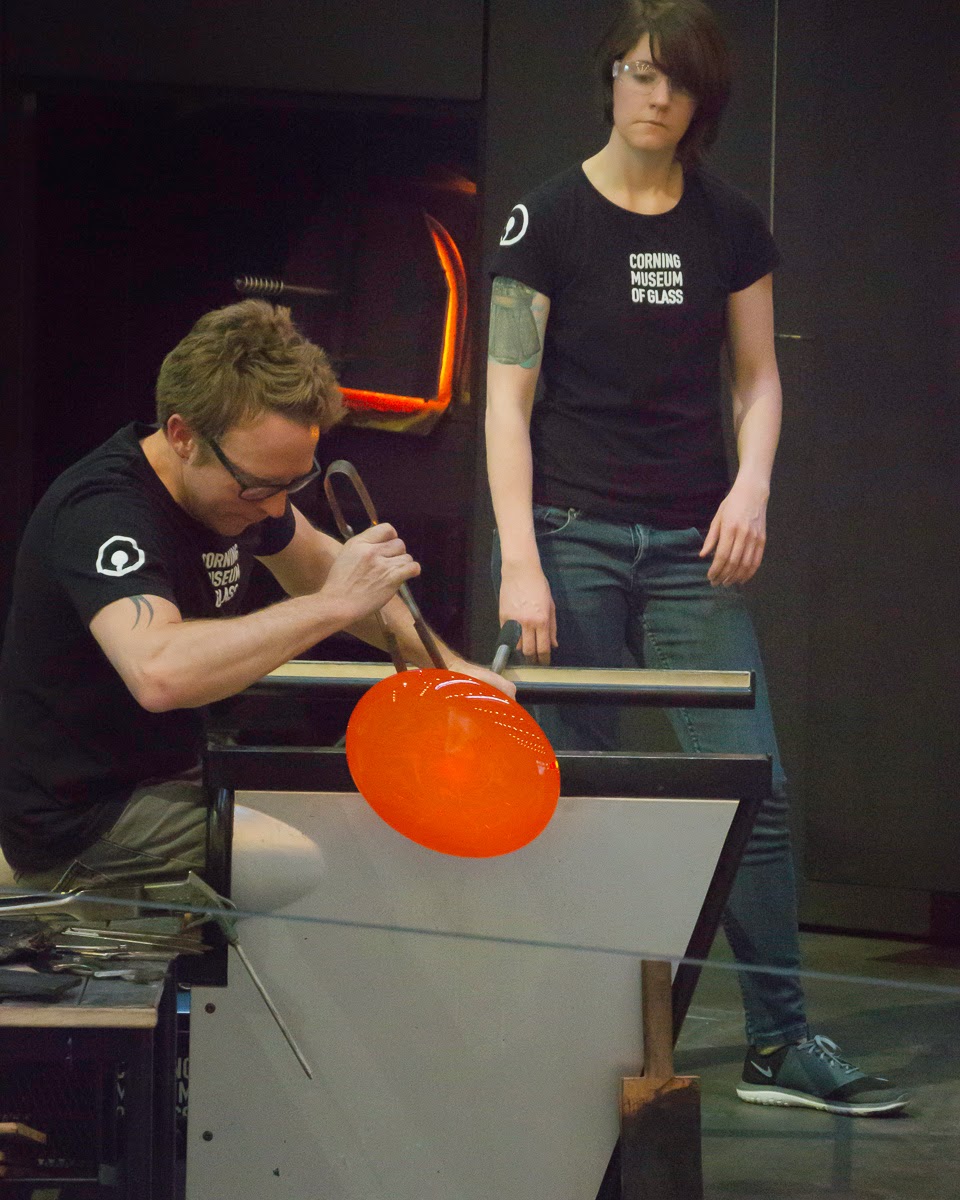
On the day of my visit, a team was creating a large oval platter in a ruby red glass.  At the high forming temperatures, the color of the glass is not apparent. The gaffer began with a large gather of glass attached to an iron pontil.   Bringing the glass out of the "glory hole" where it is reheated when it has cooled,  he sets to forming a precise shape.


While the gaffer is responsible for the overall creation of the object, there is a team of comparably qualified individuals devoted to supporting the lead gaffer. They will form smaller pieces to be attached to the main body and simultaneously work portions of the object as the gaffer directs.  It is a team effort, especially when large objects are being worked.

Below you can see the teamwork required to lay a different color glass on the rim of the platter as it nears completion.  There are often parallel tasks being done to prepare for future steps in the creation of a piece.


After about an hour's work, the final form is achieved with three skilled gaffers coaxing the platter into shape.


All that is needed is to release the platter from the iron pontil, so the team member can carry it to the annealing oven for a very slow cooling to room temperature.


The visitor to CMOG consistently leaves the hot glass show with a sense of awe, and a new appreciation for the many glass objects seen in the museum.  It is a perfect combination of art and technology. This show gives me a greater appreciation of what I see whenever I go into the museum's collection of ancient glass.

As I leave the hot glass show, I think of the challenges to making a simple glass bottle before the age of science. It seems unfathomable that such complex objects were made without thermocouples, chemical analysis, gas furnaces or exotic refractories. This is what makes the Corning Museum of Glass so interesting to me. It is a must see for everyone. If you were there ten years ago, go again.  It is so expanded, that it will be like a first visit, again.

Paul Schmitt

Friday, March 13, 2015

Writing with Light- A Lesson from Niagara Falls

Photography means writing with light.  The result principally depends on the quality of light available.  Subject matter, composition and focus all come after that. Arriving at our sixteenth floor hotel room overlooking Niagara Falls, the lighting was flat. The sky was a featureless gray.  Here is what the American Falls looked like.


The Horseshoe Falls on the Canadian side looked equally cold and dull.


Sure, they look powerful and the severity of the winter is apparent.  It's just not uplifting.  There is no "eye candy" offered.

The next afternoon, the sky was clear and the sun lined up directly opposite the American Falls.  Seen from the rim of the gorge with the sun directly  behind me, it became writing with good light.


There is a lively S-curve traced from the top; it begins on the flat river above the drop and runs diagonally down the rainbow to the bottom where the largest boulder pulls you back to the left.  -- Okay, it is really a Z path, but cut me some slack here. Okay?--  This was exciting.  It was ice on fire, eh?

As I shifted location, I could place the rainbow where I wanted it to be.  So, this scene was built by my action, not by accident.


At another location, the composition was equally interesting.  Again I shifted laterally to put the color where I wanted.


Now, a majority of the people along the side of the gorge were taking photos with their phone. They captured none of this beauty, because the lens is such a very wide angle that from a distance, it cannot remove all the surrounding clutter and present a clear message.  The simplest compact camera would have sufficed to tell the beauty of a rainbow in the waterfall.  Snap shooters are making a big mistake abandoning their compact point and shoot camera in favor of the smartphone.  They will get home and find the rainbow is missing.

Note:  I used a mirrorless, the V2 Nikon Series 1, camera for the rainbow images. It is just one step above a point and shoot.

Paul Schmitt

Thursday, February 19, 2015

We love Puerto Rico!

We flew out of  Rochester on a very cold, snowy  morning, and as if by magic, stepped out that afternoon in San Juan to warm sunshine and welcoming people. That evening, we sat on a patio overlooking the Atlantic with mojitos. This was a birding trip for us and for once, photography took a back seat.  That makes a nice reason to go back, though there are a lot of other equally good excuses for a trip there next winter.

One highpoint of our trip was seeing  the rare Puerto Rican Parrot.  We walked about a mile to a research station and listened. For about 1-1/2 hours we heard them come close, then drift away and finally come into view in a tall tree where they fed on ripe seed pods.  The bird is the focus of intense efforts to save its habitat.  It is so revered we came upon a statue of them near El Junque National Forrest. They're not that big for sure.

In a week we tallied 104 birds including all but one Puerto Rican endemic.  The variety was incredible. We saw hummingbirds like the Antillean and Green Mango, Green-throated Carib, and Puerto Rican Emerald. There was the colorful Antillean Euphonia. There were too many beautiful birds to have a single favorite. The Puerto Rican Spindalis  below is my only bird photo of the trip.


We had a wonderful guide, Gabriel Lugo.  We went westward from San Juan stopping at nature reserves, marinas and beaches. Gabriel's hearing is very acute, and he's extremely quick to recognize the birds' unique calls.  He was often aware of what to look for before it revealed itself. Gabriel also knew where to introduce us to the many tasty Puerto Rican foods.  The food is flavorful but not hot spicy.  Plantains are prepared many ways; all are delicious.  Mofongo is a plantain mash with a topping of rice, beans and shrimp/chicken or such. Asopao is a chicken and rice soup like gumbo. Arroz con Gangules is rice with pigeon peas. Very good. Sancocho is a wonderful stew. Lechón is a roast suckling pig and absolutely not to be missed.  Try all of these.
Our first day took us near Arecibo where the famous radio telescope is located. Conceived by Cornell Professor William E. Gordon, the 1001 foot diameter reflecting dish has a large receiver suspended high above the dish. Gabriel took us there.  There were also birds there. I hiked up the steep grade to the visitor center to  get a look at this massive device that has led to so many scientific discoveries.

We continued our travel around the island with a stop at a remote ranch where we awoke in our cabin to the sound of multiple (endemic) Puerto Rican Screech Owls. We would never have found our way to this location alone. Afterwards, we stayed two days in Parguera where our room looked out on the blue Caribbean Sea with moored sailboats. From there we ranged into high mountains for some birds and then into seaside salt marshes and fresh water ponds.  We did see some familiar birds that escape the cold northern winters such as teal, Northern Shovelers, coot,  grebe and American Redstart.  It was somewhat surprising that we saw very few gulls, only a Laughing Gull.  The only endemic that we missed was the Puerto Rican Nightjar due to the only rain of the entire week.

All trips must come to an end.  Gabriel returned us to the hotel at the San Juan airport on a Sunday after five days discovering both the birds and the island of Puerto Rico. We consistently met friendly, helpful people.  We cannot praise Gabriel enough.

We had hoped to go into the old town of San Juan Sunday afternoon, but it was so crowded that the cabs could not get into the city.  We rested up and planned what to do on our last full day.  Our first stop was Castillo de San Felipe del Morro, or El Morro. It guards the harbor entrance.

Seen from the fort, it is separated from the old town by an expansive green field.

One iconic view of El Morro includes the lonely sentry tower overlooking the blue Atlantic to the left and the Bahia de San Juan to the right. This massive fort was a progression of additions rising  higher and more prominent each time.

Walking toward the old town one finds narrow streets of blue cobble stone.  The narrowness has one benefit in that one side is usually in the shade.  The sun can be very intense.  Most of the buildings are painted in pleasing earth tones. Our route from El Morro was in the direction of the Cathedral de San Juan Batista.  Along the way we discovered small shops and an art institute on Del Cristo Street. As we neared the cathedral, the hour approached noon; it had been a long time since breakfast. We were about to make a delightful discovery.


Nearly opposite the cathedral was el Picotea in the open air courtyard of the hotel El Convento. Formerly the Carmelite convent begun in 1646, this is now one of the premier hotels in the Americas.  The food reflected the  prestige of El Convento.


As we lunched, we concluded that we had to stay in this hotel on our next visit to San Juan.  A brief exploration on our way outside found this graceful archway with a view towards the courtyard. How could anyone pass a chance to stay in this hotel? But the rest of the old town called us, and we stepped outside to visit the cathedral (below).


The Cathedral de San Juan Batista is a rather simple architecture.  Construction on this location was begun in 1521, but war and hurricanes took a toll such that the current facade dates from the 1800s. The body of Ponce de León resides in the transept.


We continued our exploration passing through the last remaining city gate of the old town's wall to find a  view on the Paseo de la Princesa seaward towards El Morro. It was nice to find a shady walkway with welcoming benches for brief pauses. If you look closely in the distance you can see the lonely sentinel tower on the fort.  The old town is really a very compact district.  We hopped on one of the trolley cars to ride to our last destination, the capitol building.  El Capitolio's design is a neo-classical revival style with breathtaking Italian marble in the main floor.  The rotunda has a facade tracing the history of the island plus a dome decorated in mosaics that is aglow in natural sunlight.  See below:


 Leaving the capitol, our time in San Juan was nearing an end.  The next morning at a little after 8 am, I looked out the left window of the aircraft and had a last view of San Juan.


...or rather the last view 'til next time.

Paul