Showing posts with label Red-headed Woodpecker. Show all posts

Saturday, July 12, 2014

Getting the children to move out...

Many of us remember when our children moved out of our home. It is a watershed moment. I witnessed how this happens for the Red-headed Woodpeckers.  As these young grow larger, the nest just will not hold them, but they are reluctant given that this home is all that they have known. Sound familiar?  Some coaxing is called for.

At this point in time, the chicks associate their parents with food, lots of food.  It's an increasing pace for the adults to keep up.  So, the parent comes roaring in with another morsel to eat.  The alpha chick is at the opening ready to eat.


The adult Red-headed Woodpecker shows the chick the food.


Looks good, doesn't it?  Well, come and get it!


It's right down here.  Just climb out and help yourself.  The chicks tries but just can't muster up the courage.  So, like a good parent, the adult gives in this time.


But, the tempting continues as the morning progresses.


On the next day, I read a report from another observer that there was a grey woodpecker fledgling seen outside the nest. The parents succeeded,and a new part of life is unfolding for the chick. 

This saga began, for me, on May 19 as I photographed the parents hauling beaks full of wood chips from their nest cavity. It is July 12 now, and the cavity is quiet.  The chicks are out in the world learning to survive.  It is likely that only one, or at best two, will make it to begin this cycle for their nest generation.  It has been a marvel to observe this. I hope that you have enjoyed this series of posts as much as I have treasured the experience.

I am asking myself if they will attempt a second brood, and if so, will it be where it can be seen?

Paul Schmitt

Friday, July 4, 2014

Red-headed Woodpecker- chick makes an appearance


After several weeks of watching a pair of Red-headed Woodpeckers carry food in to a nest cavity at Montezuma National Wildlife Refuge, a chick is now large enough to make an appearance at the opening.  I note the faint red below the eye.


It is fair to ask if there is only one chick.  I cannot make that conclusion at this time.  It is possible only one came up to the opening at a time, or a second one is too small at present.  I also saw the adults go deeply into the cavity on some feeding trips which suggests the possibility of a second smaller chick. 

The real highpoint today was capturing one image of the actual feeding.  Both adults arrived at almost the same time with the one on the right waiting its turn.


In looking at images of the adults arriving, I determined that along with berries and moths, they are bringing in wasps.  It's all high value food.

This is all pretty exciting.

Paul Schmitt

Saturday, June 21, 2014

It's frightening....

It's frightening. I easily responded to my clock radio at 4:00 am today. In thirty minutes, I was underway to arrive at sunrise for a chance to document a rare variety of Rail.  Rails are obscure, stealthy marsh birds, that are heard much more often than seen.  The sunrise at Montezuma was lovely.


Arriving at the predetermined location by 6:30 am, I quickly settled in on the edge of a marsh, sitting on a three legged stool with a camo drape over camera, tripod and self.  It was delightfully cool with no "buggy-ness".  The wait for the elusive Rail stretched on, but I was not bored. I had a short visit by some Whitetail Deer plodding around in the cattails across the slough.


I think the honey color of their summer coat is beautifully rich and harmonious with the summer greens.  The wait for the Rail was not so bad.  I had another visitor, a Green Heron.  They are pretty wary and prone to sulk around in the margins of the marsh, so a close encounter is special.


There was a constant chatter from multiple Marsh Wrens.  I've not photographed them before, so when one finally perched in the open, I was happy. (Yes, they have a tail; it is nearly vertical when it sings, so it is obscured by the branch.)


After three hours, I decided the search for the rare bird was over.  Back at the car, I decided I could not go home without another visit to the Red-headed Woodpecker nest.  I devoted a brief one-half  hour, and it was rewarding.  Capturing one of them in flight has become an obsession.


Reviewing the photos, I understand why I easily awoke at 4:00 am.  It was a beautiful, cool morning with plenty to see, and the early hour easily justified the next part of my day, a mid-day siesta.  That's an under-appreciated luxury.

Paul

Tuesday, June 17, 2014

More on the Red-headed Woodpeckers

Left  home at 5 am the other day to get to the nest of Red-headed Woodpeckers while it was early.  The sunrise was beautiful, but I would not pause on the long drive for fear of  missing some early feeding at the tree cavity.  I was not disappointed.  The pair were often exchanging places.


Typically, the adult in the nest immediately exits to catch the next meal.

As the morning progressed, it seemed to take the adults longer to come up with food, and the nest was left to the chicks.  If the adult stayed in the nest for awhile, it was often to do some house cleaning as seen in this photo.


It was a pretty rewarding morning. Eager to see the next stage in this saga.

Paul


Wednesday, May 21, 2014

Red-headed Woodpeckers!

For the second year, a pair of Red-headed Woodpeckers are nesting in Montezuma National Wildlife Refuge in close proximity to a road.  This is very special; they're uncommon in New York and to be nesting in plain sight is equally unusual.  They are not showing any concern with people being present, nor the light traffic on the road. 

On a recent trip there, they were still excavating the cavity in a dead tree. They are a striking bird with amazing red color on the heads.  Direct sunshine makes them nearly glow.


The birds are identical and seem to share the task of preparing the cavity. After a seemingly long time in the cavity, the bird will shift to removing the wood chips from the cavity.  It appears at the opening with a beak full of wood "dust".


Wham! There goes a cloud of "dust" into the wind.  Some of it ends up clinging to the dead bark, and the rest drifts away. The bird disappears down the hole for another load.


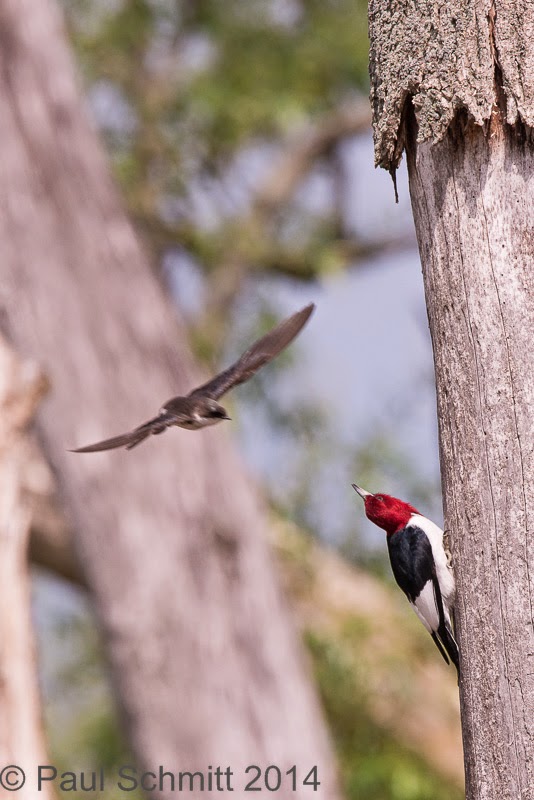
Now, these cavities are prized by a number of other birds seeking a nesting spot, so there can be conflicts.  I saw one such episode where the woodpecker was protecting the cavity from the much smaller Tree Swallow.


 In this case, the swallows quickly abandoned the plan.  Starlings have also been seen trying this with a more serious conflict resulting. 

One of my goals has been to capture the birds in flight at the nest. They are very fast when flying, but after many attempts I finally got one leaving the nest to the care of its partner.

 
I'll be continuing my attention at this nest and hope the pair is again successful in raising young this year.  

Paul