Tuesday, February 21, 2023

It's a Maine Thing

The Mid-Coast of Maine is a favorite place for me.  I've been long overdue to return, and last week I finally took five days there. In winter, it is far quieter - so much so that it can be difficult to find restaurants staying open.  I was one of eight photographers in a program offered by Hunt's Photo in Boston.

I arrived a day early for a more leisurely pace.  After a 5 hour drive, my stop was just over the border at Kittery.  Before dinner, I went over to the Nubble Lighthouse.  The wind was "brisk", but it did not discourage locals from enjoying the sunny day. I shot about 40 images to freeze the wave in the foreground.

Up early,  I hurried north to the iconic Portland Head Light.  It you look closely at the light keeper's building closer to the base of the tower, you can see three orange rectangles.  Those are where huge January waves  crested over the rocks and broke out windows. 


The waves were far more modest during my visit.

With all of us in our lodging in Wiscasset and introductions made, we visited South Bristol Harbor.  It is a small working harbor with little tourist activity. Central to the village is Osier's, which is a grocery,  food takeout, lobster pound and roadside gas pump. 


There is a lot to discover.  Buoys draped in a dead tree branch.

On the dock behind Osier's I found piles of fishing gear.


I can't tell you what this net is used for, but the form was attractive, so I had to share it.


The next day we had some dreary weather, so we explored some local museums.  There were some interesting discoveries.  Ropes in a shipbuilder's shop.

Antique car grills at Owls Head.


The next morning was cold but favorable at Pemaquid Point.  This is my favorite lighthouse of all.  Down here you can grasp the height of the promontory it occupies.  The sloping layers of rocks rise from the waves dramatically.  (The tide was rising, and shortly after this I had to retreat upward. )


Up at the lighthouse, there are, even on a cold and icy morning, some hearty people coming out for the view.


Every visit I have ever made to Pemaquid has been inspiring. Soon afterwards, we were at Deb's cafe for hot coffee and great food. It was worth departing at 5:15 am to be there for another beautiful dawn.

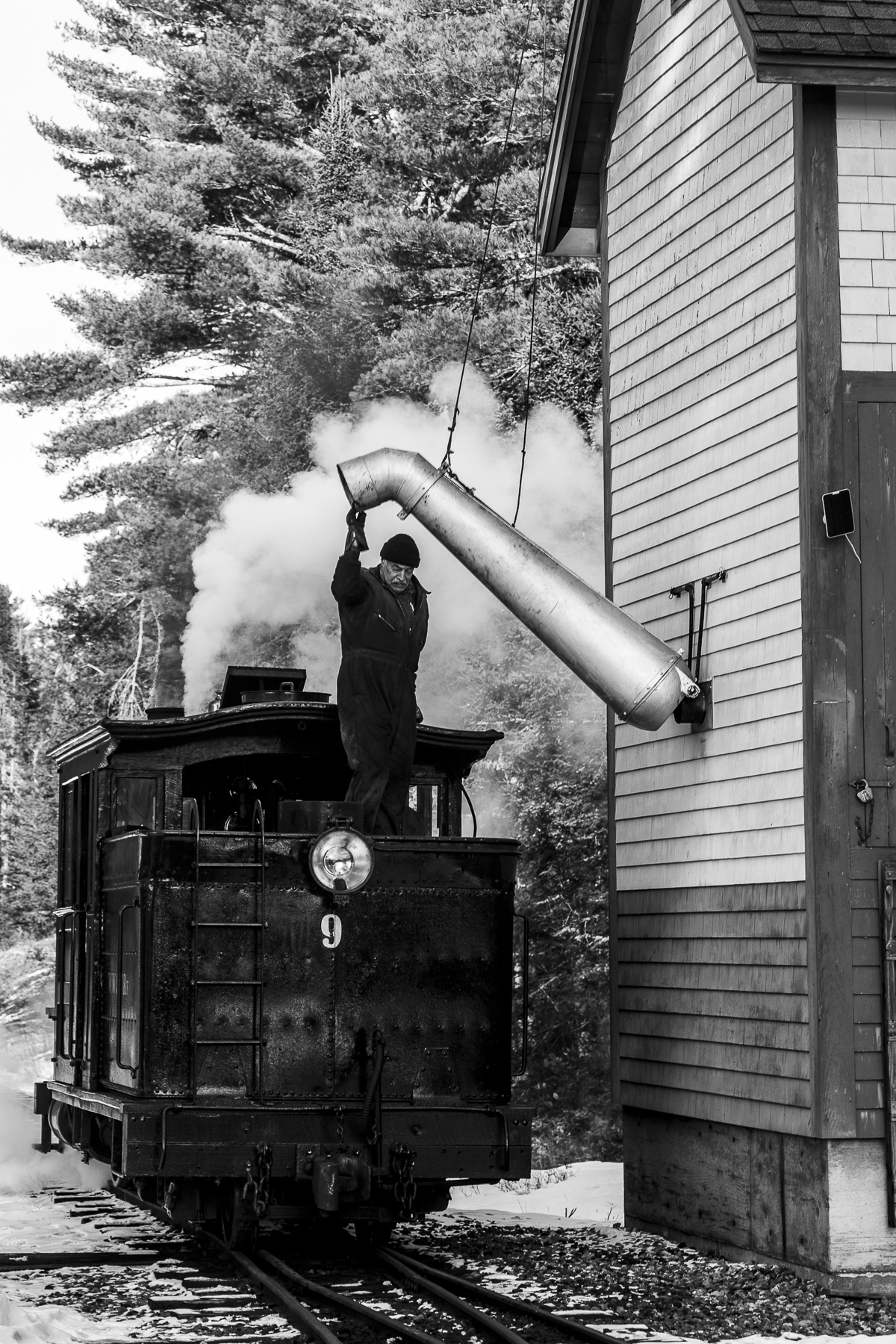
That afternoon, we made a big shift in subjects to a small narrow gauge railway near Wiscasset, the Wiscasset, Waterville & Farmington.  It's totally volunteer based and very busy even in February. Here are a few images:


Our final morning was at Friendship Harbor. Again, this is a working harbor with little tourist flavor.  It was another early start.

There was a very creative Christmas tree still on the one dock in mid-February. 

The sunrise cast a golden glow on one of the fish houses.

Nearby was another fish house with buoys that seemed best in monochrome to reflect on time.

Maine in winter is clearly not dreary, nor boring.  Just a little patience is called for when weather is in control.  Natives seem to thrive in winter. 

Well, this ran into more images than is my usual.  Hopefully it is sufficiently entertaining.

Paul Schmitt

Thursday, February 9, 2023

Frozen in Time

 Winter strips the landscape of a lot of noise.  The inner form of trees is simplified absent the leaves.  Waterfalls become clearer with the trees bare.  The precipices are covered with ice, and sometimes the flow of water is nearly stopped.  Early in my discovery of waterfall photography, I was directed to this hidden falls in Lansing (New York).  It was part of a family's backyard.

I even returned at night to make extremely long exposures and painted the ice with colored lights. 

The little falls had no name and likely was never seen in a postcard. Big falls are often seen on postcards and imitated by newbies.  I did that at Niagara Falls in 2013.  The falls are illuminated every evening.  Many capture just what was seen on the postcard.  There is also much more to see when exploring more closely.  

Seen below is a small portion of the American Falls that was created in the late morning when the sun created a rainbow.  Now, the sun moves pretty quickly across the sky so the rainbow is not static either.  Keeping the rainbow on that ice-capped rock keeps the photographer shooting, and quickly moving the tripod while not bumping into other people next to the railing.

This image of the American Falls was much more memorable in part, because it is not found on a postcard and will not be repeated exactly like this. 

Here in the Finger Lakes, the iconic falls is arguably Taughannock.  At 215 feet of straight drop, it is higher than Niagara and easily approached to the lower level, even more so in winter.  It's my favorite, especially when ice covered.  On this morning, there was a strong flow contributing to widespread ice well away from the drop.  It was also extremely cold; my fingers were nearly numb even with glove liners plus mittens.  (It was worth the walk up the gorge to hear and feel the giant in winter.)

There is, however, much more to portraying the mix of solid and liquid found in such a scene.  This is an ever-changing sculpture of  hard ice and liquid water.  This is an instant in time that will never be recreated. 


The photographer has the choice of shutter speed that creates an interpretation that can be faster or slower than how our brain processes time.  Seems fascinating to consider.

There are other winter scenes to explore. At the base of Ithaca Falls, there are ice formations found away from the falls.  They are the result of wind blowing the water spray, and also the rise and fall of the flows.  As the day warms, the flow increases and the ice creeps higher.   This image presents two levels - Ithaca Falls and the crooked willow on the edge.   That seems more interesting.

I think it wise to begin with a local favorite and conclude with an exotic favorite - Gibbon Falls in Yellowstone in early February 2020.  The river is not frozen because of thermal springs feeding the river.   One of the attractions for this location is the beautiful circular path presented to the viewer's eyes. 

A week later after making this image, we were all learning about a global pandemic and foregoing travel. So, that makes it a little more memorable.

I hope you find this enjoyable.

Paul Schmitt


Saturday, December 31, 2022

It's About Time

This discussion all began with a critique by a fellow photographer stating that his preference for showing moving water was with the camera "freezing" movement. He preferred that and suggested  long exposures were artificial.  So, he viewed the creamy texture seen below as not natural.


The exposure for the above image was slow, 0.8 seconds.  I liked this because it gives a feeling of gentle flowing water. It occurs to me that before the invention of the camera shutter, we had no idea of what any moving subject looked like.  Before that, we could not see crashing drops of water spilling over a water fall, or the wings of  the Goldfinch launching into flight seen below.  It was a blur.

Time itself is a human invention.  It was developed for navigators to determine longitude.  Then it was extended in the industrial revolution to economically quantify labor delivered, and later refined to coordinate railroad schedules across wide distances.  Moving pictures use the shutter to create a stack of still images which, when displayed sequentualy at 25 frames per second,  create an illusion of motion.  Again, that is not natural but a human artifice.
 
Our perception of time is also shaped by the speed that our brain processes what we see, clock speed.  If you are driving behind a truck and something falls off the truck and into your lane, it takes your brain about 250 milliseconds to send the orders to  your muscles to brake sharply.  That's 1/4 second.  That won't work for the Louisiana Waterthrush at right.  Survival demands increased speed to capture little water bugs.  So, our human perception of time is not universal.  Our clock speed is natural for us, but not for all creatures.  
 
Here's a big idea.  The shutter allows us to switch to a new perception of time.  It freezes a bird in flight on one side, and alternately revises how we interpret the sea swirling over a rocky coast or how we see a waterfall.  I want to explore how very long exposures present a different interpretation of time.  Below is a winter favorite of mine, Taughannock Falls in nearby Trumansburg, New York.  The gorge and waterfall were created over a span of about ten thousand years following the last ice age.   It is winter now, so ice is appropriate.


The view from the north wall is in two layers -  a warmly lit foreground that is crisply defined and the distant falls in cool blue light.  To me, stopping the water's movement is not what my eyes see.  The gorge walls are reasonably defined so the creamy water speaks for falling water.  

There's an easy hike from near Cayuga Lake up the gorge to near the big falls. 


On both sides of the falling water, there is a constantly evolving filigree of ice formed as varying winds paint patterns of ice.  This was a 1.6 second shutter.  My mind is wrapped in a slower clock speed.  I want to distill the scene even more. I really pushed the clock speed to 48 seconds.

What feelings does this create for you?   For me, I feel the cold, raw power of Taughannock.   

As one retreats back down the gorge, there is a final waterfall that is more complex than the big drop.  It offers some delightful forms to explore with slower shutters.  (I am keeping these images in a cold, blue light because that's usually what my cold hands are feeling like after two hours in the gorge.)

It's a different feeling to me, and the pathways my eye follows are more varied. 

Shifting my lens to the left, I discover another ice sculpture that would be missed at a fast shutter.


It is now five days past when I saw these frozen falls.  We have had three days of very warm, above freezing temperatures.  The ice is nearly gone, but I know the cold will return and create new ice forms.  I'll be back to find new ice sculpturess at a slower clock speed.

Paul Schmitt


Friday, November 18, 2022

Is it still just a phone? ... or a photographer's tool now?


I recently switched to an iPhone 13 Pro after five years with my iPhone 8.  I'm not a "first" innovator, and the newer iPhone 14 just did not fill any additional needs for me.  Honestly, the three lenses were the major reason.  While in a photo workshop in October, someone kindly allowed me to play with his iPhone 13.  I was sold. Now,  I am going to take you along on my discovery of the phone plus offer a few "hacks" which may liberate you to do even more with a phone camera. 

Mixed in will be images with each of the three lenses.  I hope to keep a good balance with some techie talk.  The experience has lightened the weight when I am exploring new locations looking for future  photography.   I can now move faster with a day pack devoted mostly to water, snacks and maybe battery pack. 

First, I want to highlight an app that offers many advantages over the standard Apple camera controls.  ProCamera was already on my iPhone 8, but I had drifted away from using it until now, when I found it was greatly enhanced.   This app offers high dynamic range (HDR) exposures for scenes with a wide brightness range.   Here's a beautiful sunset in late October.  It used the ultrawide lens.


Look at the detail seen in the shadows without the sun being washed out. ProCamera analyses the situation and usually takes 3 photo spaces to capture from the darkest to brightest areas.  (For ultra cases, it takes 5.)  It was done so quickly that I could handhold the phone. 

Let's look at what each of the three lenses covers at the overlook on Cowanesque Lake south of Corning. 


You've seen already the sunset using the ultra-wide lens.  Here is an image using the wide lens.

For the image above, I developed a trick using ProCamera in manual focus.  Photographers choose a small lens aperture so that the background is indistinct.  It keeps your eye on the stump in the foreground.  The iPhone 13 camera does not have an adjustable lens aperture.  However, ProCamera has manual focus plus a feature called focus peaking. Where it detects high contrast around sharply focused places, the screen puts a color highlight on the screen. In the image above, I used the manual focus feature in ProCamera to pull the focus closer to me until only the stump was flashing yellow.   That's one of many useful features it offers.

Next is an image using the tele lens.  In this case, I wanted the image to be sharp for foreground and distant.  Corning Incorporated's headquarters building shows sharpness from red fruit on the trees and right out to the iconic Little Joe Tower.

The versatility of three lenses is clearly seen in these examples.

The small size of a phone opens another window, the ability to place the camera very close to the ground.  This can create a perspective not easily seen (unless you like to lay your head on the bare ground or in a snow drift.)  Here's an example that used the wide lens.

When getting very low, one problem is precisely locating the lens vertically.  Tilted images just don't seem very pleasing.  Here's an example where I wanted to capture a reflection of a tree in a large water puddle on the abandoned farm road.


I did this by putting the phone in a holder attached to a small tripod.  The red grips of the Ulanzi ST-03 allow full visibility of the phone screen.  Cost $19.95 at Amazon; it adapts to Arca-style tripod mounts.  With my phone in a protective Otterbox, the Ulanzi is not directly squeezing the phone case. 

Here's another example of a setup using a tripod.  I began from the position seen at right and made a series of small moves until the foreground gate framed the decaying barn with the gate staying just below the lower edge of the barn.  It would be tough to do this handheld, and then to wait for the break in the clouds above roof remnants.


There is one more hack that I've developed.  The only lens filter I ever need is a circular polarizer.  I greatly value a CP filter.  It reduces glare on shiny surfaces whether they be on foliage or water, plus it gives a deeper blue on the sky. I've never seen a filter mount on any phone camera.  I've found  a fix for that.  It combines a SmallRig filter clip with a mating 52mm filter designed to fit the filter clip. See at right:

The details are:

  •  SmallRig 52mm Filter Clip from B&H Photo ($30)
  •  K&F Concept Magnetic 52mm Circular Polarizing   Filter Kit from Amazon ($56)

 Note that the richer blue sky is best done using manual settings in the ProCamera.

So,  when I am traveling light, in the woods or visiting family, I bring a very compact kit of accessories  including the Ulanzi holder, the SmallRig clip, magnetic filter and an ultra small tripod seen also at right.  Add a lens brush and I'm ready.

The first three items fit in a small zipper bag, and along with the small tripod, are easily included where ever I go. 

Yes, I have found this three lens phone to be a great tool.  I'll continue to use my professional cameras and lenses, but maybe I'll reduce my kit by one lens to reduce weight.

Please feel free to contact me if you have any question on ProCamera or the additional tools I've incorporated into my iPhone 13 Pro  kit.

I'll close with a favorite scene that is prepared using Ulanzi on a small tripod.

Paul Schmitt


Thursday, October 27, 2022

Autumn's Second Season

My engagement with the scenes of fall has been extended by a simple idea.  When the brilliant red maples shed their leaves, it is not over.  I move in to see more closely. On a recent Sunday, I walked along Corning's riverside trails and found unexpected inspiration.  Hidden in an alcove of Corning Incorporated's headquarters building were some hold-out colors reflected in the facade.


Continuing along the river, I found an unexpected wide landscape.  Substitute red sumac for the maple's reds.


Now, let's get a look at what I found on another day along an abandoned farm road.   Again, it's red sumac.

A bit farther along the road, I looked down and found this.  This time, no reds for a change.  Still works.

There doesn't need to be any catchy color, or even color at all, to speak of the second season of autumn.  The killing frost earlier this week removed all green from the delicate maidenhair ferns growing in a corner of my garden.


But, I have to complete my story with a magical jumble of leaves that I found. I could never have assembled such a screen deliberately.  The single feature that stopped me was the beads of water on the overturned leaf in the upper part of the frame.   I recall that this was just after a brief shower.

So, this is my piece on the delights of the second season of fall.  It extended my autumn.

All of these images used my recently acquired iPhone 13 Pro and the ProCamera app that extends controls greatly beyond the Apple offering.

Paul Schmitt