Showing posts with label wild geranium. Show all posts

Thursday, May 18, 2023

Mundy Wildflower Garden- Slowing Down to See

It's been twenty years since I discovered the Mundy Wildflower Garden on the Cornell campus. The rich array of spring blooms captured my imagination. Soon I was working on a project to upgrade the  images posted at the welcoming "Bloom Board."  A sense of urgency drove me as I worked to find artful compositions that spoke of the beauty.  No mug shots! I said.  Over five hundred quality images were put on file; but in retrospect, I needed to slow down in order to realize the emotions that I was feeling. 

The urgency is now controlled.  Honestly, every time I get low on the ground for an intimate view, well, my cranky knees also work to slow my pace.  There are only three subjects for this message.  In addition to appreciating their beauty, I hope there is some useful insight for even simple phone captures.

The first subject is a small pod of Wild Geraniums. This image is different from what I made twenty years ago in two respects.   First, I paid more attention to the colors in the scene and to the location of the supporting yellows especially.  Twenty years ago, the distant colors were not carefully placed above and below the blue-violet blooms. I could have done better years before.  Notice how the leaf at the bottom shows  the form clearly.

The second difference is in the camera technology now available. I was so close to these flowers that only a short distance is actually in sharp focus. The image is a stack of six images that walk from the nearest part of the Wild Geranium leaf to the last part that I wanted in focus. The camera is on a tripod and does not move for all six images.  For each shot, the scene displays red dots on all edges that are sharp. I merely walk the red dots from near to far on the flower, and stop. The software selects all sharp areas and fills in the rest with those blurry remaining pixels.  Amazing, and not even a dream in 2003.  

The next image is also a second group of Wild Geraniums but with a different intent.  There is a subtle hint that the plants thrive in the mixed light of woodlands.  That was my intent. The blooms are also more directly facing the viewer. 


This is actually a better offering for identification purposes.  It called for greater depth in sharp focus; there were 9 images in the stack.  Impossible twenty years ago.  Easy today.

These big white Trillium grandiflorum are my final subject.  Wait, did I say white?
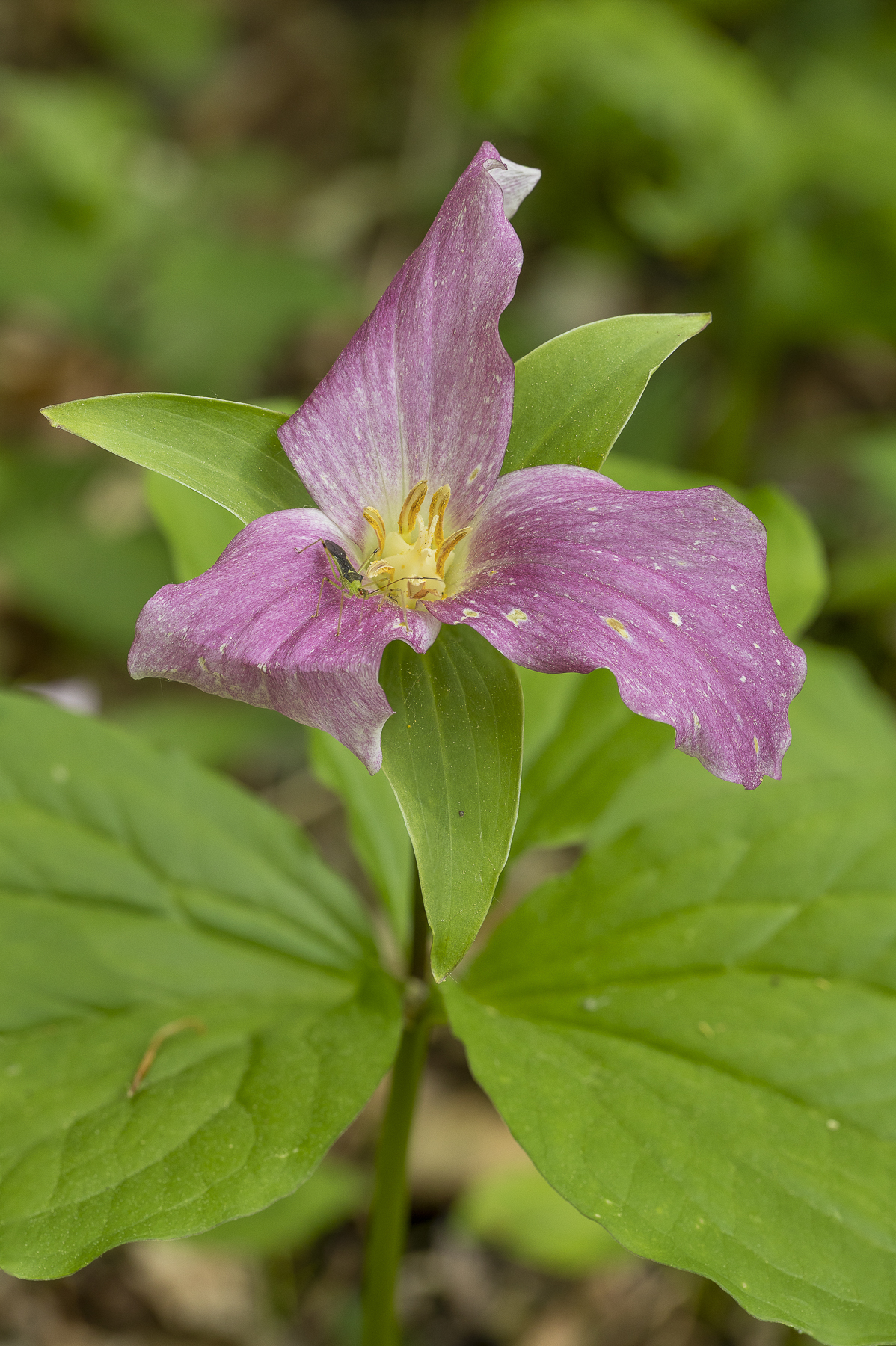
Yeah, this healthy trillium started out that way, and in its old age it is blushing pink. Still beautiful.  That's why I concentrated on it.  Richly green leaves, too.  It gets love from me because it is still vibrant.  Do you see anything unusual on the flower?  There's a critter sitting motionless even as I poked the one-eyed lens close to it. Let's get a closer view.


I wonder if it is waiting to snap up some visitor feeding on the rich amber pollen? 

I am not sure if I would have noticed this little bug in my earlier rush to photograph everything.

So, there you have it.  Three images in 2-1/2 hours with pauses to enjoy the orioles passing through Mundy.  

Going up to Ithaca, I also am slowing down with the idea to see any of the deer waiting to run across the Route 13 morning rush of commuters. That's another story that also teaches that the slower you go, the more you see.

It's spring.  Enjoy!

Paul


Wednesday, May 27, 2015

Blooming Wonderful

The Finger Lakes of New York are a bonanza for the nature lover. One of my favorite nature spots in spring is the Mundy Wildflower Garden along Fall Creek on the Cornell University campus. It is a rich, intensely managed natural area with an amazing array of native plants, and it is alive with birds, too.  I have been going there for twelve years and always come away richly rewarded.  To learn more, go to:   http://www.cornellplantations.org/our-gardens/botanical/mundy-wildflower

Today, I began there shortly after sunrise. I concentrated on the flowers though the birds were very active.  Later, I would join a work party removing invasives and planting more native plants. But first, I would have some play time. Entering the garden,  large beds of yellow surrounded the white flowers of the Great Solomon's Seal hanging gracefully beneath rich green leaves.  I've seen Ruby-thoated Hummingbirds hovering under these to gather nectar.

Near the entrance was White Baneberry, Actaea pachypoda, called Doll's Eyes because the china white berries have a purplish "pupil". The plant in Mundy was in such a charming alignment that a photo was mandatory. The leaves and flower head were in ideal arrangement.

Other delights awaited me in the garden.  Down the trail were the Great Solomon's Seal mixed in with Wild Geranium. Also called Spotted Cranesbill, Geranium maculatum is an easy plant to introduce into the home garden.  Both of these are hardy, though I've learned to keep the Solomon's Seal behind a fence to thwart the deer's hunger. Unlike so many of our introduced garden plants, they are ideally matched to our climate and low maintenance.

Next I came upon some False Solomon's Seal growing among the ferns. These sway in the slightest breeze, so I had to work fast before the sun stirred up the air.  However, unlike a bird, they cannot fly away just as I get ready to fire the shutter.


Not all plants are in peak bloom; the large White Trillium, Trillium grandiflorum, can also be attractive when the white flowers fade to red.  See below.


 Another deer resistance plant that is ideal for the home garden is the Wild Columbine. Watching a hummingbird feed on it is not to be missed.  In many cases, it has been shown that these native varieties have richer nectar than the exotic varieties that may be somewhat showier.  For me, a native plant that is better adapted to our locale means less care in the garden and a great ability to sustain itself over the years.

My saunter through Mundy Wildflower Garden led me to another late spring favorite, May Apple.  I have it in my home garden where its toxicity has proven its worth. Deer have never touched it.  It is not invasive and requires zero care.  Today I headed for a favorite place in Mundy where I discovered a harvestman spider in residence.


I made a final stop on my way to join the work party. I had found another Wild Geranium next to a contrasting tree.  The difference in the textures and colors attracted me.


 There was just so much eye candy to be found, that I found it hard to quit. The ephemeral nature of native plants means that a return next week will present a new set of blooms to enjoy. That is part of what keeps me coming back each year. Throughout the spring, there are both wildflower and bird walks in the Plantations that are expert-led.  They are listed in this link:
 http://www.ssreg.com/cornellplantations/classes/classes.asp?catID=4421

So, whether it is birds or flowers, the Mundy Wildflower Garden is a treasure for all nature lovers.  Discover it if you can.

Paul


Thursday, June 5, 2014

Blooming Highlights

The rush of migrating birds has ended, and it's time to catch up with the highlights of the spring wildflower blooms. I find myself pulled between the elusive birds and ephemeral blooms.  Here is the best of the spring blooms.

At the entrance to Cornell Plantation's Mundy Wildflower Garden, I found Celandine Poppies and Virginia Bluebells in wonderful colors.  I had to get very low on the ground to get this view.


Nearby was one of my favorites each year, May Apple. Another chance to lie on the ground.


The Trillium grandiflorum were a bit higher and less difficult to photograph.  They are always grand.


An easily overlooked wildflower is the Wild Geranium (Geranium maculatum).  Oddly, the garden geraniums we plant in our gardens are not members of the Geranium genum.   The Wild Geraniums are so prolific that the deer must not be eating them.  Hope it stays that way!


Now, all of these are fairly common, and while beautiful, they do not excite the passions like a wild orchid. These Pink Lady's Slippers were in a cluster of 185 plants that I visited for the first time this spring.


That is an extraordinary cluster of blooms.  I also like to portray the charming arrangements that the blooms sometime present.  This one is, for me, a portrait, .....perhaps of two sisters?


So, those are my highlights of spring.  In only a week or maybe two, the later blooming orchids will appear, and I'll get excited once again.  The one difference is that I will have to endure the mosquitoes that frequent the bogs and fens in June.

You can understand how I am torn between choosing blooms or birds on any given day.

Kind regards,

Paul

Friday, May 25, 2012

Birds and Blooms

True to my blog's name, today was birds and blooms, just in reverse order. Began the day at Cornell Plantation's Mundy Wildflower garden with another skilled photographer.  It's always enlightening to see how two photographers can stand next to one another and end up with widely different and equally interesting photos. It is an excellent way to increase your creativity.

The Wild Geraniums instantly got my interest.  Just love their color and simple form.


While the garden is devoted to native plants, it is virtually impossible to keep non-native plants out.  Think of how impossible it is to banish dandelions for your garden or lawn. 

So, the garden also has masses of lovely pink and purple Dame's Rocket. Now, this plant is widely called Phlox, but it is not.  Phlox has the same colors, but it has five petals.  This has four. I am sure the small bee on the flower doesn't care what the name is. End of botany lesson.

I have Dame's Rocket around my yard, and while I do pull it, I've accepted that it will not be defeated.  I accept it in small numbers because the colors are appreciated and it would be too much work to do otherwise. It is a truce.

And, as I continued in the garden, the Dame's Rocket provided a nice framing to some Cow Parsnip that just began to bloom. Cow Parsnip is a sort of coarse and ungainly plant. The bees love it.


Usually, Cow Parsnip grows in large, ungainly masses that make it difficult to photograph in such a way that a single plant's form is clearly seen. So, I liked this combination of Cow Parsnip and Dame's Rocket.

As I continued, I found another plant just beginning to bloom, and it is one of my favorites, Blue Flag.


By this time, I was growing hungry, my companion had to go, and the wind was making it nearly impossible to photograph flowers and get sharp images. Time to grab a Subway and eat while I observed a nearby  Redtail Hawk nest.  Arrived to find one adult perched nearby.  At first, it flew from a perch behind where I stand on the bridge and went to a perch directly above the nest, and then into the nest. The two chicks were dozing. It soon left the nest.


It returned to the perch behind me where I could see it was watching something in the wooded area.  It flew into the woods, but returned to the perch with no prey. It was likely a squirrel or chipmunk.


What happened next was pretty exciting as the bird launched from the tree and flew nearly directly overhead on its way to the nest.


After some time, one chick must have rung the dinner bell and the adult hawk responded.  She pulled a grey squirrel up from inside the nest and began to deliver bits of food.  The other chick in the back watched but did not join in, eventually going off to sleep.

I figured the action was over for awhile since sleep usually follows food. Time to head home and start the long process of downloading and editing. 

All in all, a pretty good day of birds and blooms.

Paul