Showing posts with label galapagos. Show all posts

Friday, October 23, 2015

Amazing Galapagos Birds

A single visit to Galapagos can never come close to seeing, much less photographing all of the exciting birds one sees. Here are a few that bring back good memories of our week.  One has to begin with the Blue-footed Boobies.  They just make me smile.  My one regret is never capturing one of these in the ferocious dive they make into the sea.  Could that justify another visit?


There is also the Nazca Booby that fishes farther out to sea.  It did not exhibit any courting, but its stately appearance was memorable.


Catching the birds in flight is a passion of mine. One day we landed on South Plaza Island, where we hiked to the top of a high cliff to watch the seabirds barrel in to land on their cliff-side nests. Amazing.

Two birds were particularly fun to track in an attempt to capture the moment.  The first was the Swallow-tailed Gull seen at left.  It is the only fully nocturnal gull, feeding on squid and other fishes that are active after dark.  Notice the rather hook shaped bill that may aid in grasping prey.

Another exceedingly beautiful bird seen at South Plaza was the Red-billed Tropicbird.  I'd seen it from the boat at a distance, and I approached the cliff with a determination to capture one of these in flight.  Seen below, the Tropicbird has a long trailing tail, plus a distinct face with brilliantly colored bill and dark eyebrows. 


They came roaring in from the sea with a strong tailwind. It was difficult to keep the bird in the viewfinder. But it only got more difficult as the bird did a U-turn into the wind and bounced about approaching the cliff face below.

I could have spent an entire day at this location and never lost interest, but that is not allowed and the rest of the party would have intervened.


One afternoon we landed about three hours before sunset with the objective to see an albatross rookery, but one should be open to surprises.  Early on the trail we saw the Galapagos Dove perched on some rocks. It's a beautiful bird.


Not far up the trail we saw a group from another boat intent on something, and it was truly special.  A Galapagos Hawk was feeding a single chick atop some rocks.


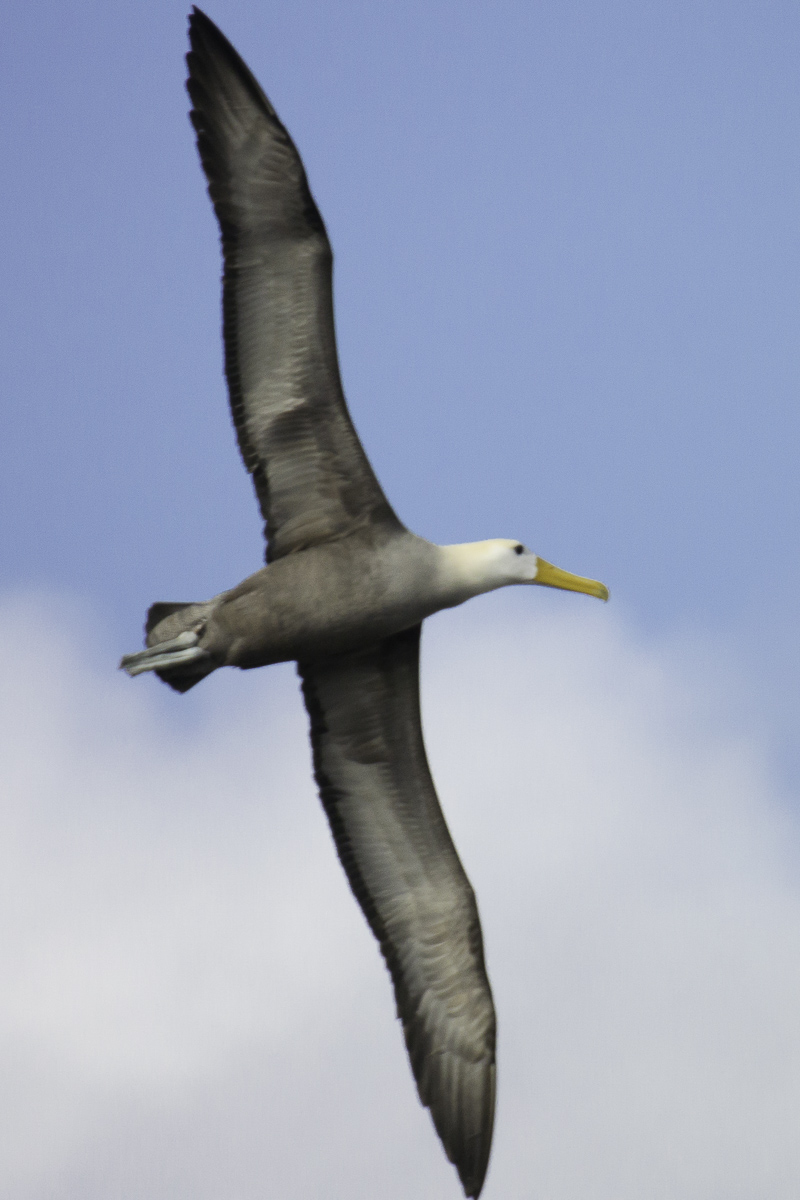
We continued on toward the rookery, where we hoped to find Waved Albatrosses.  Albatross are huge (7-1/2 ft. wingspan),  graceful seabirds that soar effortlessly over the ocean for most of their lives, only coming to land to breed. They are considered a vulnerable species, with Espanola being their primary breeding location worldwide.

Much like Blue-footed Boobies, the Waved Albatross couple performs several rituals, such a bill-circling and tapping, bill clacking, bowing and raising their neck to make a Whooing sound.  While this was not a huge rookery, we did see some pairs courting.  The bird's name derives from the wave-like pattern in the feathers around the neck.


Breeding, like is the case for the boobies, seemed to be in several stages simultaneously. There was one nest with a large chick watched over by a parent.  At other nests, a parent was sitting on an egg.


One morning we were up before sunrise to land as early as possible.  It proved to be worth the effort. Quietly approaching a brackish pond near our landing beach, we saw Pink Flamingos peacefully feeding near our opening.  Another boat came ashore an hour later and found the birds on the distant side of the pond.  Yes, the early start was best.


Flamingos are one of those birds that is always exciting to see.  Not likely to turn down a chance to see yet another one in a wild location.  So it was, that days later we landed for a walk on another island, and were surprised to see a few more that were unusually approachable.


I'll end this with two of the more elusive birds seen.  First is the Woodpecker Finch. It's small and not seen around the seaside, but rather, in our case, found up in the highlands of Santa Cruz while we were visiting a ranch that has many Giant Tortoises.  Did not expect this little bird - likely one of the more unusual of the Darwin finches.  Look at that bill!


The Storm Petrel is not uncommon in the Galapagos. Actually, it was unusual not to see them trailing the boat as we cruised to another location.  They are the smallest of seabirds. The birds are swallow-like as they dip and dive near the water's surface picking up planktonic life - crustaceans and small fish. The challenge for me was to capture that elusive and brief instant when they dip down to the claim their food. It was steady entertainment to watch them from the stern of the boat.

So, there you have my highlights of the amazing birds we saw in the Galapagos, and you have another reason to put this on your bucket list.


Paul


Wednesday, October 14, 2015

Galapagos: Discovering the Shore

Our floating hotel for our week in the islands was the Yolita II, a comfortable 110' yacht hosting 14 visitors, trip leader, birding guide,  naturalist, and a crew of 8.  It was a comfortable accommodation with an efficient, and always helpful, crew.

At the appointed time for each shore landing, we donned life vests and boarded the two zodiacs for our trip ashore - sometimes a wet landing and other times a questionably dry one. Tide and wave height can make the dry quite wet.

Often, the trip to our landing was in itself an event, as when we toured this bay with its distinct volcanic features.

Every day was characterized by intense equatorial sun.  Sunscreen and a good sun hat were perhaps as vital as a good (dry) camera.

On Espanola Island,  there was a skeleton of a Humpback Whale with one of the endemic Mockingbirds perched atop.  


The bird was not really being friendly. There is scant water on the island, so these birds were constantly trying to mooch water from people. Human visitors are not to alter the balance on the island; it was expressly forbidden to offer them water.

The Sally Lightfoot Crab is often seen in great numbers.  The name reflects the  speed with which they can move. Common from Florida to Chile, they eat algae plus whatever else can be found.


Any trip to the Galapagos calls for considering some of the thirteen species of Darwin finches. Their adaptions to the differing conditions among the islands have been a mainstay of evolutionary studies over the years. They are frequently seen near the beaches in the low shrubby growth.

At the left is a Small Ground Finch. (But it could be a "medium" GF. I'm no expert).

One of the more interesting birds we saw was  the Cactus Finch seen below. (There are both Large and Small Cactus Finch species.) They are thought to have evolved from ground finches to more effectively feed on the Prickly Pear Cactus, eating  insects in the flowers and the fruit itself.

The Galapagos visitor sees new animals that create a certain amazement, and some quite familiar ones.  So, it was with some surprise that I saw this bright yellow warbler, called a Mangrove Warbler.  Looks everything like what I see here in New York. It's a bit involved, but the New World warbler species Setophaga petechia has about 35 sub-species of which our American yellow warblers have six, and the Mangrove Warbler has twelve.  One difference is that the Mangrove Warbler comes very close to humans.

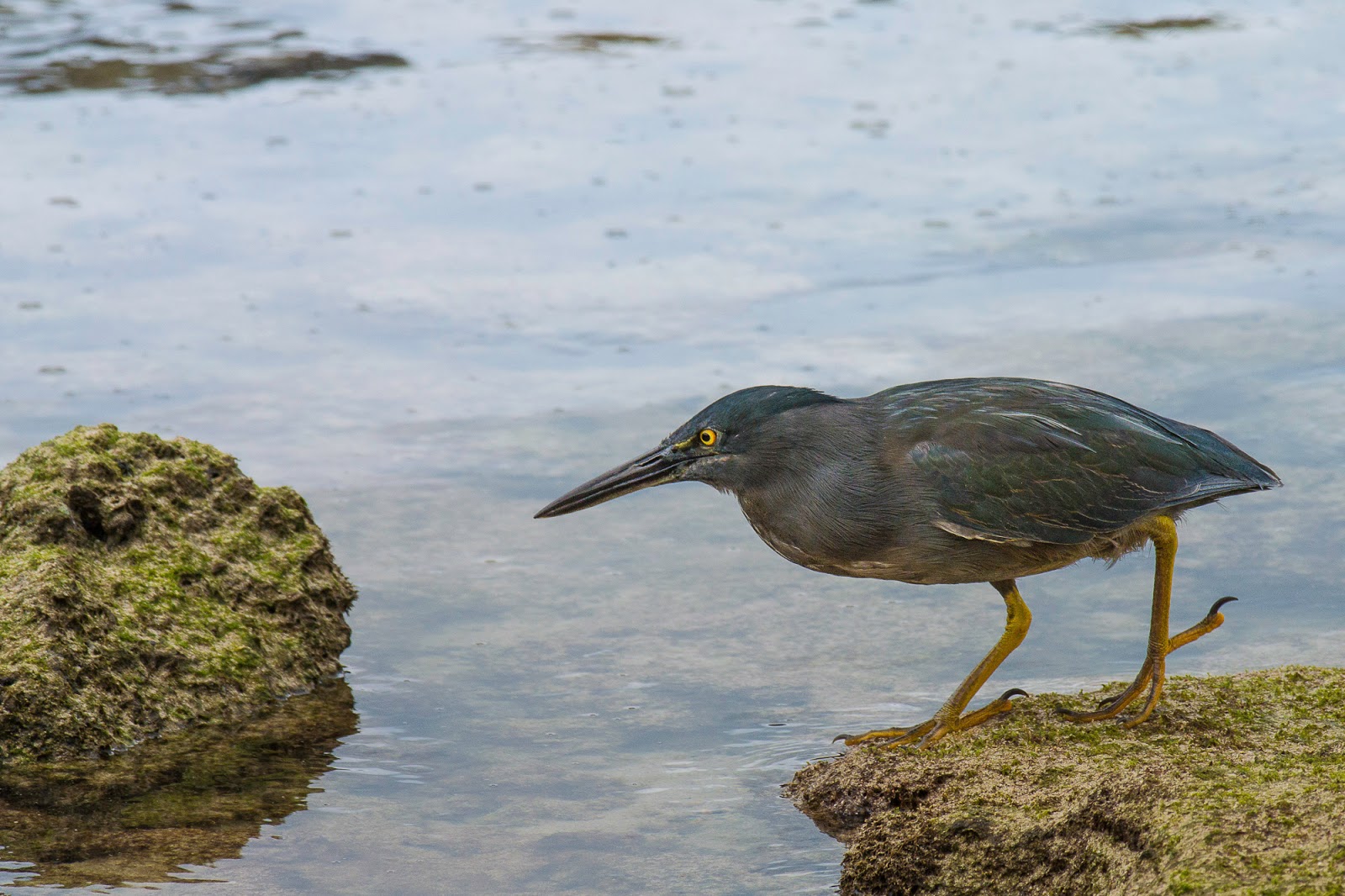
Another familiar bird was the Green Heron. The major difference observed was that in North America the Green Heron is very shy and hard to observe closely. The ones in  Galapagos seemed unperturbed by people, and provided interesting observation.


Contrast that with the fascination one feels when watching the Land Iguanas. The males are boldly colored, and rather like bulls looking to show their strength to other males.  The claws are impressive.


Marine Iguanas are often seen sunning to regain body warmth before returning to the cold ocean water to harvest seaweed.  They don't seem to have the personality of the land variety. They impressed me as being something from a prehistoric era, even more so than the Land Iguanas.


The reader can appreciate that on our tour of Galapagos, our group's observations were certainly more thorough than some.  A pause on the beach revealed the tracks of a Marine Iguana, as it emerged from the sea.

We were often on shore for three hours or better, wherein other boats making the same landing came ashore later and returned to the boat sooner, accounting for at most half of our time.  Many seemed to be in a race to complete a trail. This can perhaps be attributed to our deep interest in our surroundings, and to a birder's penchant for seeing the details.


As a result, we also took
pleasure in some typically overlooked details, like the Spotted-wing Glider at left and the Large Painted Locust at right.


Other groups also missed the small Lava Lizards, and in particular the orange cheeked males, that would appear when a person would slow down and allow them to become active. Truly, the less you move, the more you see.
There is a common misconception that all animals on the Galapagos are fearless of humans and, while this often seems true, there are examples where survival demands fear.  Again, slow and thorough observation revealed a Santa Fe Rice Rat.  They are wary and secretive.  This one ventured out from cover to chew on the edges of a Prickly Pear Cactus. It's really only about 2-1/2 inches long at the most.  Non-native species have decimated their numbers.  It was special to just see this animal.


So, this is my recap of what a Galapagos island landing might reveal on any given day.  The return to the Yolita II always included a large tray of freshly squeezed fruit juice and some freshly baked treat. After as much as three hours(or more) in the equatorial sun, this was a real boost.

In my next installment, I will get to some of the amazing birds that we saw.

Kind regards,

Paul


Wednesday, September 30, 2015

Galapagos Birds: Magnificent Frigatebirds

The first Magnificent Frigatebird appeared early on our first day on the boat, and they were nearly constant companions to our boat when it was cruising. They came very close.

The male's bright red neck pouch during breeding season is visible from quite a distance.


Our first landing took us to an island rookery where numerous Frigatebirds were concentrated on ill-formed nests in very low bushes.  During breeding season, the male is often seen with the pouch inflated to create a display of vitality. As nesting progresses, the neck pouch recedes as seen above.


Frigatebirds are an aggressive bird with a reputation for stealing food from any other bird, as it returns from the sea. Various sources call them pirate birds or condors of the sea. They seem to eat anything.  Their aggressive nature was also displayed towards neighboring nests, and it appeared to include unattached males seeking to displace other males from a nest. The male seen below landed near the couple on the nest and displayed what he likely considered a superior inflated pouch.  Note the colors on his neck hackles.


The intruder neither intimidated the male, nor evoked any visible interest from the female partner.    A stare-down developed.


A physical conflict soon developed. The female seemed impassive to the fight as it progressed.


The conflict continued beak-to-beak with no way of knowing which one was winning.


The fight ended with no apparent knock-out blow, as the intruder suddenly abandoned the fight. There was no victory celebration, and the female was as impassive as ever. Some degree of calm returned.

The breeding appears to be spread out over a span of time; we saw a mix of  courting pairs, small chicks and much larger chicks. The  female lays a single egg.  An adult guards the lone chick for the first weeks, but as it gains size both adults go to sea for food, and it is left alone to await a feeding visit. So it was that we came upon nests that had a single chick of pretty good size.  Many chicks were panting in the intense equatorial sun and alertly watching the sky, likely looking for an adult returning with food. The chick below is seen to be shedding its down for juvenile feathers.

As noted, the nest construction is sparse and unkempt.  There seems to be a shortage of building materials, and the low bushes have little to support a more elaborate construction. Nest malfunctions happen and chicks fall out, such as is probably the case below.  It is likely doomed, and the nesting pair will have to start over.


A visit to the Galapagos is done with the requirement that you do not to interfere with  nature's processes, and that you stay on the trails to minimize your impact.  This chick will not be returned to its nest, nor even approached. That hands-off policy is a key to keeping the islands true to their heritage. There appears to be no shortage of Frigatebirds.

Sunday, September 20, 2015

A Tale of the New and the Old- Blue-footed Boobies & Yellow Warblers

Saw an incredible variety of new birds during my recent trip to the Galapagos Islands. I'll begin with a short post featuring the most entertaining bird seen, the Blue-footed Booby.  At the time of the bird's naming the meaning of "booby" was essential a clown.  Actually, they are a graceful with a stately posture (most of the time).  


And, they are fast flying --like dive bombers-- projectiles that can slam into the water at any moment when they see prey.  In once place,we saw them in group formations exploding into the sea to catch fish.  But, the most endearing image is of a male prancing about in a high stepping display.  Isn't he handsome?  Well, he surely is to the females.


Let's go to a short video that captures the persona of this actor. (Probably best viewed a medium screen size or smaller..)


 So, on our first day we saw this entirely new bird and fell in love with it.  Almost at the same time, we saw an old friend from the Northeastern United States.  There among the salt bush and the mangroves was the same colorful Yellow Warbler, only they call it the Mangrove Warbler.  Still a lovely find.


Now, I am not a "counter" out to tally up a large number of species so I found both of these birds entertaining as I watched how they behave in this new found environment.  It is truly amazing how far some of these tiny birds can travel to find  islands 600 miles from the mainland.

Keep in touch.

Paul