Showing posts with label Smoky Mountains. Show all posts

Tuesday, December 17, 2019

Smoky Mountains in Early November

For a third year, I attended the Great Smoky Mountain Nature Photography Summit.  From sunrise to mid-morning, there are photo outings - mostly near the Townsend side of the park. (This is a quieter option than Gatlinburg and much closer to Cades Cove.)  The rest of the day is devoted to expert presentations by high-level professionals.  There are also opportunities to slip away for photo outings, including nighttime photo locations.

This year offered poor autumn colors because of a severe drought in the region.  For the most part, I looked for other subjects.  Here are a few images that I feel are appealing, beginning with sunrise from the Foothills Parkway.  The crepuscular rays of sunlight appeared after I had given up on seeing a good sunrise, so the scramble to retrieve my tripod and camera was amusing (to others).


The lesson from this is:     Never give up!   

I admit that I love saying "crepuscular".  Sounds so scientific.

On one morning I had no scheduled outing, so I was away very early and was the third car in line for the gate to be opened at Cades Cove at sunrise.  Wasting no time, I arrived at the trailhead for Abrams Falls and was underway on the 2-1/4 mile hike with only one pair of hikers ahead of me.  I kept whistling as I walked to be sure I did not surprise a bear.  It was great to reach the falls before others.

Can you imagine how high the creek was to put that log across the top of the ledge?

I finished my photography at 9:30 am as the hoard of visitors arrived.  Perfect timing.  The parking had swelled from two cars to over fifty.

One of my favorite locations is the Tipton homestead in the cove.

It took a few visits to get images without wandering people in the scene.  This view is from inside the grain storage shed.

The ground level of the barn has a bay to unload forage wagons under cover.  The perimeter overhang provided shelter for livestock. It's a beautiful reproduction of the original.  There is a small wagon under the barn's bay as seen below.


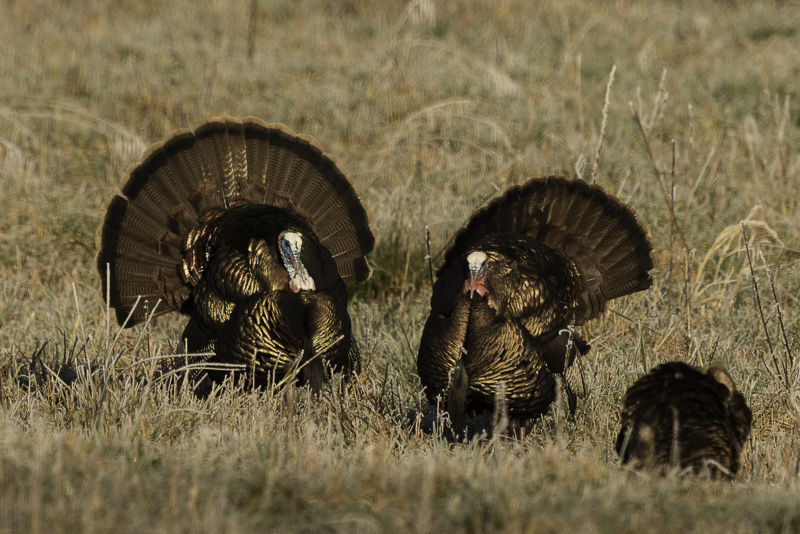
In the early hours at Cade's Cove, I saw deer, coyote and these bachelor turkeys. You can guess which is the dominate gobbler.

Likewise, in the early hours, it is possible to capture clean images without a dozen cars on the lane. 

As the park fills, it is best to look away from the road. These sulfur shelf mushrooms were 50 feet off the loop road.  They were of little interest to people who just wanted to see a bear.

This is one fungi species that I know, and yes, delicious sauteed in butter with sweet peas. 

Leaving the Cades Cove loop road for a higher view, one finds a nice view of the Cades Cove Methodist Church. It is on my list for a more colorful year in the future. 


And, a little farther from the cove there was a black bear with  two cubs.  I watched her (at a respectful distance)  through a screen of saplings as she foraged on acorns.  Her cubs explored nearby. The gentle wind clearly told her where I was, but caused no alarm.  This is the best I could obtain.

Nearby, I finally found some autumn color that excited.


There is one other way to escape the crowds. That involves getting up at 3:00 am and joining other photographers on the heights of the Foothill Parkway overlooking Townsend toward Cades Cove.  No traffic to be sure, just the valley in a cold morning fog.  Beautiful.

At 5:00 am, there is already commercial aviation coming past on the way from Europe to the Atlanta airport.  I had to watch for them, as this is a twenty second exposure.

Even in a poor year, autumn in the Smokies is beautiful. I really like Townsend, which is distant from the Gatlinburg carnival scene and closer to the real beauty of the park.  It has great restaurants, affordable lodging and a really good coffee house. There you have it.

Paul Schmitt


Monday, April 11, 2016

It's Good to Be Alpha- Wild Turkeys

Recently I had the good fortune to get close to a flock of Wild Turkeys while in the Smoky Mountains. The group consisted of two gobblers and a dozen hens. When the sun plays upon the males at the peak of their breeding coloration, the feathers glisten with colors of copper, gold, scarlet and violet. Add in the colors in the gobblers comb and waddle for a dazzling display meant to impress the hens.

Seeing their line of travel, I picked a position and waited for them to come to me. Luck  favored me, as they came right toward me. My second good fortune was to witness how two competing gobblers settled which was the dominate one.  I'd expected some form of conflict, but it was actually very civil.

The two gobblers displayed more to their rival than to the hens.  The hens were more interested in catching food in the grass.  It became apparent that the male on the right was not able to spread its tail feathers in as complete a fan.


It does take considerable strength to fan out all of the body feathers, plus the tail feathers. Number two was running low, it would seem.  Within minutes, he was more relaxed and could almost be confused with the smaller hens.  He still has the distinctive beard on his breast and colorful feathers, but seemed to be destined to wait for next year.


The alpha gobbler began to display to the hens, while number two went to the edge of the flock near two hens and commenced to feed.  Alpha circulated until he found a single hen settled down in the grasses and not feeding.  He certainly had the energy to continue making a big display.  She was clearly receptive. 


He circled her a few times, stepped upon her back, and then began to "knead" her for about three minutes.


Copulating was brief.  The gobbler quickly resumed displaying to the hens, as the flock continued its path passing me at about 45 feet.

I went back the  next morning and could find no turkeys whatsoever.  That reinforced my feelings of good fortune.

To paraphrase Mel Blanc, "It's good to be  King  Alpha."

Paul Schmitt


Thursday, April 12, 2012

Smoky Mountain Waterfalls

This April's trip to the Smoky Mountain area was rich in two of my photographic passions - wildflowers and waterfalls.  There was no time to address the third passion, birds, though we were constantly hearing warblers singing in the treetops.  This time, I will present the best of the waterfalls.

Our dear friends near Knoxville took us to the Bald River near Tellico Plains. In my research on the area, I had not been alerted to this location, and I wonder why.

Bald River Falls, Tellico Plains, Tennessee

Most interesting in this particular falls is the pool halfway down on the right side. Notice the large boulders resting in the pool. I'll surely return to this waterfalls on any future visit.  And, I'll be sure to again visit the little bakery in Tellico Plains for lunch. It is a must.

Little River Cascade

Arriving at the Smoky Mountain National Park on Tuesday, we drove the Little River Road as a roaring rainfall slowed traffic.  The nearly continuous progression of cascades and small waterfalls  set my first priority for the next day, mapping the best waterfalls.

A key to this area is locating both the nice drops and the safe parking areas.  I noted the key areas as we drove up to Cades Cove with mileages, and checked the weather to learn that the next morning would begin cloudy, perfect for waterfall photography. The next morning I began at a nice cascade about 2.5 miles below the Sinks.


Working upstream towards the Sinks, I found this nicely framed drop in the river. To me, this image is about the plants that frame the waterfall.

Streamside Flowers- Little River

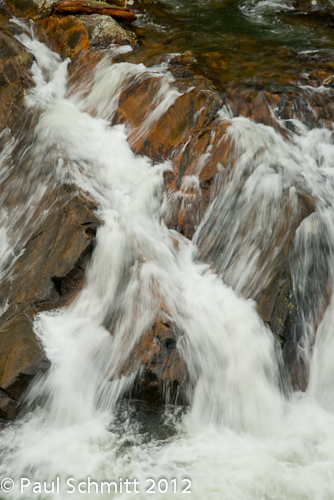
Now, to reveal why the Sinks is perhaps the most popular site on the Little River.  This falls has steeply inclined plates of richly color rocks, and is the largest drop on the river.

The Sinks on Little River

There are many different ways to look at the Sinks.  I also like this view.

Newly Leafed Trees at the Sinks


Our wildflower forays were usually around streams, and so we also discovered some nice hillside cascades coming down steep slopes. This was near the Elkmont campground on the upper reaches of the Little River. It was a rich wildflower area. The cascade was lined at places with Brook Lettuce that resisted my attempts to photograph; preferred not to take a bath because of the slippery rocks.  Next time I will take hip boots so I can move around more freely.

On a second cloudy day, I found the nice cascade seen below. It was along the Little River in a site  that required a little rock scrambling to see.  I only wished the Rhododendron was in bloom for this image to add more "pop" to the scene.

Large Cascade on Little River

On our final day in the park, we went east of Gatlinburg to the Porter Creek area. The Little Pigeon River is  a beautiful trout stream formed at the junction of the Porter Creek and the Ramsey Cascade.  The junction is an intriguing setting that proves to be very difficult to capture, largely due to the large trees along the river bank.  Rather than eliminate the one Y-shaped tree, I decided to use it as the inverted pattern of the two branches of the incoming Ramsey Cascade. The Ramsey Cascade splits around an island in the middle ground as the Porter Creek spills in from the right hand side. Another photographer told me "Someday I will get this right.  Someday."

Beginning of the Little Pigeon River


I cannot close without showing why the Porter Creek area was a favorite that will call me back on a future trip. It was very rich with wildflowers.  I found beds of  Hepatica acutiloba that covered areas the size of a queen size bed.  They were past bloom, so I must go again earlier in the season.  But, we also found this delicate little Pink Lady's-slipper.  Wild orchids and waterfalls are sure to excite me about future visits.

Best,

Paul Schmitt


Wednesday, April 11, 2012

Smoky Mountain Wildflowers

A first visit to the Smoky Mountains offers the opportunity to find and photograph native wildflowers not common to the northeastern United States. The trip was a success, and I'm sharing images of six native wildflowers that I found most interesting.

When  I scheduled the trip for the first week of April, I feared I could only find the earliest spring ephemerals.  But this has been an extremely mild winter and a very early spring, so the early ephemerals were mostly finished. As an example, instead of blooming Hepatica, I found its seed head and new array of  leaves that are formed only after blooming is complete.  This meant I'd be looking for the later blooming natives, and of course adding some waterfalls given the wet spring they were having.  I'll share the waterfall images in a later blog.

Showy Orchis

So, here is the first of six native plants that I found in bloom.  All are interesting to me, and hopefully to you. The Showy Orchis (Galearis spectabilis) seen at left  is in some ways similar to the much  larger Showy Lady's-Slipper (Cypripedium reginae). Standing only 5 to 10 inches high, it presents a cluster of blooms. It has two basal leaves and a leaf-like bract at the base of each flower.

 I found it in numerous locations within the Smoky Mountain National Park including the Roaring Fork Motor Nature Trail, the Porter Creek Trail, and several trails near Elkmont campground. It was also prolific in the Joyce Kilmer Memorial Forest just southeast of the park.

Crested Dwarf Iris

The second wildflower that I found interesting was the Crested Dwarf Iris (Iris critata).  Standing only 4 inches typically, I was sure to get muddy knees every time that I got down to photograph it.

Each sepal of the bloom has a yellow crest, and the leaves have a rich spring green.  We found this in many moist locations, sometimes in great clusters. This proved a difficulty in that I wanted a single plant isolated so its form was immediately recognized.

It is a very lovely plant that seems to fade rapidly. Probably the largest numbers were on the Porter Creek Trail in the park.

Foremost on my list of plants were two trillium that are unique to the area, Catesby's and Vasey's Trillium. Each is a nodding type where the bloom hangs down below the leaves. Neither is widespread.


Catesby's Trillium


I was successful in finding a very few Catesby's Trilliums (Trillium catesbaei) at a location near Cades Cove. This example has white petals, but I also found one with a light pink as the field guides suggest.  In any future visits, I will concentrate more on areas around the Joyce Kilmer Memorial Forest near Robbinsville, North Carolina. In this first visit, I mostly stayed on established trails so that I could cover more ground and learn the best areas.  I did see a few possible examples of the Vasey's Trillium, but I was uncertain of the identification and will not include those images.


Now to the fourth and arguably the most interesting flower, a relative of the Wild Ginger common from the northeast to the Smoky Mountains.

Little Brown Jugs

Little Brown Jugs (Hexastylis arifolia) is a Birthwort which stands about 4 to 6 inches tall. The waxy arrowhead shaped leaves are distinctive for identification. That is fortunate in that the reddish -- mauve?-- flowers on  nearly every plant I found  were hidden within the leaf litter. The only exceptions were with  a few on steep  hillsides. The flowers are reported to be pollinated by fungus gnats. Noting the small opening in the flower, it certainly must be a small creature.

A local book reported that the stems were used to make a tea used to treat whooping cough.What else did they have in that early era?


Now to a flowering plant that may not be unusual, but is charming.  We had talked with one of the visitor center ladies in Cades Cove, who volunteered that concerning wildflowers, "Joe knows". So we found Joe and he suggested some great places including a rock cut on the Laurel Creek Road coming out of Cades Cove. We found it.  It happened to be one of the few with a flat area to safely park in.

Wild Bleeding Hearts


 The nearly vertical rock face was dripping with water and a huge number of plants grew on the rock faces and small ledges. Stonecrop, trillium, violets and beautiful Wild Bleeding Hearts, (Dicentra eximia).  This plant was growing out of  a moss covered vertical wall which I have to assume remains damp all summer.

Squaw Root

Finally, a most unexpected plant was Squaw Root (Conopholis americana). The average height was about 6 inches. It is a parasitic plant that derives nutrition from  oak tree roots since it has no chlorophyll itself.  To me,  it looks like small ear of corn. Each protrusion from the stalk is a flower.  I often found large clusters of Squaw Root, as many as ten in a single group.

My main challenge in photographing this unusual plant was to find a fresh example as it appears to quickly turn brown.  Black bears are know to feed upon them although we saw no evidence of that.

Now, final comments on visiting the Smoky Mountain area. First, consider if your visit coincides with school breaks in spring; ours did and it made for more traffic.  Next, consider some alternatives in lodging location. The most popular town for lodging is Gatlinburg which is a huckster's dream and at times approaches gridlock. If a quieter  visit the north side of the national park, I suggest looking at Townsend.  It is closer to some prime areas such as Cades Cove and trails such as Chestnut Top, Lead Cove, and  Elkmont. Cades Cove can be excellent in early morning for wildlife too. Finally, recalling that I was very impressed with the Joyce Kilmer Memorial Forest, I also recommend looking for lodging in the southwest corner between Robbinsville and Tapoco where you are more likely to find only B&Bs. Keep in mind that US129 west of Tapoco is a twisting road that attracts large numbers of motorcycles.  Lodging near Tapoco might be a tad noisy at times. We often noted  the profuse number of Rhododendrons and wished we could also visit when they are in bloom.  Some of the waterfalls and cascading streams would be spectacular when they bloom.  I guess you can't have it all in one visit.

Paul Schmitt