Sunday, February 16, 2020

Discovering Yellowstone in Winter- Part Two


Beyond the wildlife in Yellowstone, there are the iconic locations that are transformed in winter.  Old Faithful Geyser becomes a solitary study in blue and white with no people in the scene. Our trip leader knew to take us behind the amphitheater-like semicircle of benches to face south into the sun.  The back lighting was dramatic, and no one else was present.  The foreground is textured with the outflow from the geyser.   It's lovely.

The eruption begins at a time that is plus or minus the posted time by maybe 10 minutes or more.  First there is a burp and a sputter.  Maybe there are several false starts over several minutes.  Then  the geyser comes to life with some commitment.


A key lesson about Old Faithful is to skip it on cloudy days.  It needs a blue sky to really shine.  Another lesson is to look around for overlooked scenes.  Walking 50 yards away from the view of Old Faithful, one finds a hot spring pouring out an amber stream into the Firehole River. It is blue  and gold.


Many (most?) visitors arriving at Old Faithful drive past an entrance to the Biscuit Basin.  It is a colorful basin with sapphire pools and steaming hot springs.


The vistas are dramatic, yet few visitors are there in winter.  All the better that we are alone.


The scenic variety of Yellowstone extends beyond the thermal features to places like Gibbon Falls.  The flow of water forms a backwards "S" from upper left to lower right, and in winter I particularly like the simple color set of red rock and touch of green.  In winter, the snow removes a lot of visual clutter.


Look at how beautiful and simple winter makes these landscapes.  One is an intimate setting.


Another captures the vastness of the Hayden Valley.


When you think of vastness, one has to include the Yellowstone Canyon in its many forms.


Forms that include the canyon walls.


The many shapes and colors of the thermal areas provide a balance with both grand views like this in Middle Geyser Basin.


And closer views that entertain.  There is a lot going on in this location with living colonies and hot spring mud. 

Other places have strange forms such as this hot spring above Mammoth, which seems to resemble the shape of South America upside down.


Some locations change on a daily basis such as these terraces at Mammoth Hot Springs.

Throughout the hot spring areas one sees trees claimed by the shifting thermal activity, standing like silent sentinels.  The land is alive with change as seen in Mammoth and all other thermally active areas.


We made a final stop at the Firehole Falls that I first saw thirty-two years ago.  It is so different in winter.  No crowds this time and a new-found beauty were there.  I saw this with new eyes ....


..  and I saw this for the first time on the rock walls of the canyon.


Traveling in Yellowstone with a group of highly skilled photographers, plus the expert teaching by John Gerlach, was a richly rewarding experience.  Across the group there was a quick eye for seeing and interpreting the scenes with no hesitation about what was significant.  Members quickly got set up and made their images so that next person could take their prime location.  The results shared on our last evening were full of memorable images that each told a story.  The absence of crowds made that possible.  I'd do this again.

I hope you both enjoy these images and also take away some useful ideas about seeing beauty as you travel.

Paul Schmitt

Monday, February 10, 2020

Discovering Yellowstone in Winter- Part One

Entering Yellowstone in winter is very different from the summer routine. There are no lines of private cars and tour buses. Sunrise is later, and often a gradual event under thick clouds.  The tour leader presents documents and park passes to the ranger and comes back with a large bag of candies from the ranger.  At 8 o'clock, we are ahead of the snowmobile groups as the snow coaches proceed along the Madison River.  Soon our focus is on spotting critters.

We hope to spot a rare bobcat or snowshoe hare.  We'll settle for the first group of bison near one of the pull-offs. But what we often get is a spectacular landscape of the Madison River valley and a distant volcanic ridge.  There will likely be some ripples on the river from a lone common goldeneye diving under the shiny blue surface for food.   It is beautiful, and quiet.  We all pile out of our three snow coaches to find the perfect spot for a landscape photo.


We quickly learn that when stepping away from the hard road surface of compacted snow, your feet will plunge in to deep snow, often up to your knees.  Walking to the river's edge is laborious. Coming back is harder.

Our aging Bombardier snow coaches prove to be ideal for our day's journey.   The tracks smooth out the undulations from the snowmobiles and the mammoth all-wheel trucks. 

Our coaches have two roof hatches that we can photograph from.  This proves invaluable when we stop for bison.  If they approach within 25 yards, everyone must be inside their vehicles, but unlike the trucks, we have hatches that allow us to continue photographing.  On our next stop, there were bison in along the Madison rooting through the snow for grasses.  They decided to climb the bank towards our coaches. Quick, into the coach.


There would be daily opportunities to photograph bison.  And there would be numerous times when our drivers would negotiate bison on the road. 


The bison herds in winter are chiefly cows and calves.  Bulls are seen singly. They are all pretty docile with the focus on survival, not mating.  Food is scarce and poor.


There are other critters to be seen along the rivers, like these trumpeter swans.  They exist only because market hunters were unaware of a small population in the remoteness of Yellowstone.


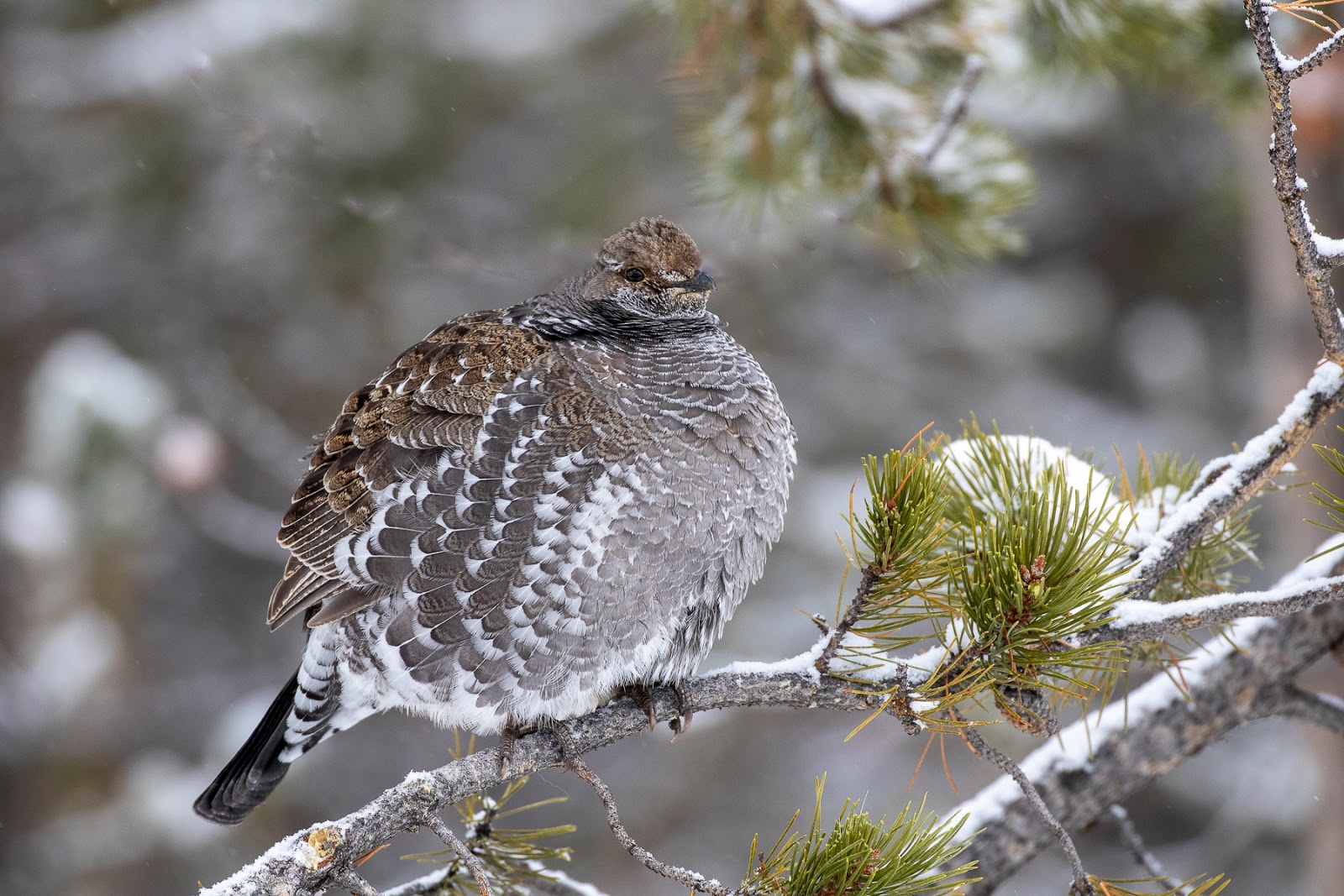
We rarely failed to stop at the Madison Junction for the facilities- clean, modern and offering a coffee and snack bar.  Every stop there also included looking for the dusky grouse that occupied the spruce trees along the entrance road.  Sometimes one was sitting in a snow bank.

But, as we motored, most eyes were looking for animals.  Our experienced drivers were always alert.  I  had a camera body with a long zoom lens ready. Sometimes the opportunity was too brief, and it was down to a quick popping up through the roof hatch. The first passenger ready gets the first shot. Such was the case for this bald eagle along the Gibbon River.

On another day, a bedded coyote was spotted some 200 yards across the Madison River.  We'd seen a pair there the day before.  Suddenly I saw the reddish coat of another coyote at the river edge only 50 yards away.   It was hunting a little side slough of the stream.  

Soon, everyone was out of the coaches and we watched the coyote meticulously patrol along the slough.  It focused its attention and pounced!

The evidence of critters in winter is sometimes slender.  We'd stopped along a river for landscapes.  This small spruce was growing on a glacial boulder in midstream. I was attracted to the tree's shadow  that led the eye to an even smaller seedling atop the boulder.

I became bored with the location while most others were still exploring the river.  I looked upstream where there was evidence of  nighttime visitors, possibly two kangaroo mice. 


There were other signs in the snow, too.  On the Yellowstone River near the falls were river otter tracks along the icy stream, but no otters.  There is another side to Yellowstone in the winter, the landscape.  There are icy waterfalls, thermal hot springs, geysers and wintery shapes on the mountain walls.  That will be in Discovering Yellowstone in Winter - Part Two.

Enjoy.

Paul Schmitt


Sunday, February 9, 2020

Grizzly and Wolf Discovery Center- West Yellowstone

I have long wished to see the snow-covered landscape of Yellowstone National Park.  In late January 2020, I began this long-anticipated trip a day early to avoid any weather related delays.  My  trip was led by John Gerlach, a long time resident of West Yellowstone (and an accomplished photo instructor).

Flying over the plains of Montana approaching the Bozeman airport, I was concerned by what I saw beneath me.  The only snow visible from 35,000 feet was hidden in the lee of small ridges.   Would Yellowstone be barren of snow?  I over-nighted in Bozeman and boarded the Karsch Stage's bus at 4:30 am for West Yellowstone.  As the bus approached the Big Sky ski resort for an inter-mediate stop, my fears were gone - maybe not deep snow, but enough to suggest that at the higher elevations, there would be deep snow.  Nothing to worry about; and, the forecast was for mild temperatures between 12 and 30 degrees.  Perfect.

Arriving in West Yellowstone at 08:00 am, the streets were snow-covered.  A hearty breakfast at Three Bear Hotel told me that John Gerlach had picked a great place for our group's lodging and food.

The Gerlach program did not begin until after dinner, but I had plans to fill the day. It was a short two block walk over to the Grizzly and Wolf Discovery Center in West Yellowstone.  My goal was to get some practice in action photography. I scouted in the morning, and returned after lunch with camera.

The center has multiple groups of grizzly and wolf.  For both species, they have large outdoor runs that are kept meticulously clean.  The outdoor run is prepared with treats and natural scents before a group of 2 or 3 animals is allowed out.  They enter stimulated to explore the area, and the local ravens are actively interacting with them, too, as they look for food scraps. 

Let's look at the grizzly first.  The keepers hide treats under some logs in the enclosure.


One of my first lessons was how difficult it is to see a bear's eyes.   There are nearly no whites to see, and they are very dark.   Another challenge is separating the bear's shape from the gang of ravens.  Patience.


Another lesson is using a wide open lens aperture to keep the background indistinct. The bear enclosure had limited angles where the fencing is unseen. It was still very useful practice.

The wolf enclosure was also fruitful, with the wolf's fleetness offering challenging but rewarding photography. The eyes are easily seen, and capture your attention.  This wolf was prone to bursts of running, that often were free of any elements of the fencing.


Most of the wolves were towards a blackish color, and this one particularly attracted me.


On my first day at the center, it often snowed.  In the bursts of snow, it became impossible to lock focus on the eyes of a running wolf.  The camera always locked on a large snow flake closer to the camera.  On the last day of the Gerlach program, we returned to the Grizzly and Wolf Discovery Center, giving me another opportunity with moments free of snow.


There were other attractions in the discovery center.  The Great Horned Owl pair were attractive, but the enclosure always ruined the photo with fencing.  There was an indoor space with River Otters and a fish pool.  I'd  wondered if the fish were to feed the otters. No, I was told; that would have made for some wild viewing.


As it was, I did get a short clip of a lone River Otter while using my mobile phone.  I'd hope to see the otters on the Yellowstone River later in the week.  Had to settle for seeing their tracks in the snow.


One last goal on my trip was getting a good image of one of the Ravens.  It's hard to get the dark eyes and tones of their feathers.  On the last day, back at the Grizzly and Wolf Discovery Center,  I closed my visit out with checking off the Raven from my photo list.


I will soon provide coverage on my five days in the winter wonderland of Yellowstone Park.  You will see that the park has a different personality in winter. Snow and ice create a new landscape.  A vastly smaller number of visitors present cleaner landscapes.  The bison are plentiful and present many interesting portraits.  The winter light is less harsh than summer.  I loved it and only want to experience it again.

Paul Schmitt

Tuesday, December 17, 2019

Smoky Mountains in Early November

For a third year, I attended the Great Smoky Mountain Nature Photography Summit.  From sunrise to mid-morning, there are photo outings - mostly near the Townsend side of the park. (This is a quieter option than Gatlinburg and much closer to Cades Cove.)  The rest of the day is devoted to expert presentations by high-level professionals.  There are also opportunities to slip away for photo outings, including nighttime photo locations.

This year offered poor autumn colors because of a severe drought in the region.  For the most part, I looked for other subjects.  Here are a few images that I feel are appealing, beginning with sunrise from the Foothills Parkway.  The crepuscular rays of sunlight appeared after I had given up on seeing a good sunrise, so the scramble to retrieve my tripod and camera was amusing (to others).


The lesson from this is:     Never give up!   

I admit that I love saying "crepuscular".  Sounds so scientific.

On one morning I had no scheduled outing, so I was away very early and was the third car in line for the gate to be opened at Cades Cove at sunrise.  Wasting no time, I arrived at the trailhead for Abrams Falls and was underway on the 2-1/4 mile hike with only one pair of hikers ahead of me.  I kept whistling as I walked to be sure I did not surprise a bear.  It was great to reach the falls before others.

Can you imagine how high the creek was to put that log across the top of the ledge?

I finished my photography at 9:30 am as the hoard of visitors arrived.  Perfect timing.  The parking had swelled from two cars to over fifty.

One of my favorite locations is the Tipton homestead in the cove.

It took a few visits to get images without wandering people in the scene.  This view is from inside the grain storage shed.

The ground level of the barn has a bay to unload forage wagons under cover.  The perimeter overhang provided shelter for livestock. It's a beautiful reproduction of the original.  There is a small wagon under the barn's bay as seen below.


In the early hours at Cade's Cove, I saw deer, coyote and these bachelor turkeys. You can guess which is the dominate gobbler.

Likewise, in the early hours, it is possible to capture clean images without a dozen cars on the lane. 

As the park fills, it is best to look away from the road. These sulfur shelf mushrooms were 50 feet off the loop road.  They were of little interest to people who just wanted to see a bear.

This is one fungi species that I know, and yes, delicious sauteed in butter with sweet peas. 

Leaving the Cades Cove loop road for a higher view, one finds a nice view of the Cades Cove Methodist Church. It is on my list for a more colorful year in the future. 


And, a little farther from the cove there was a black bear with  two cubs.  I watched her (at a respectful distance)  through a screen of saplings as she foraged on acorns.  Her cubs explored nearby. The gentle wind clearly told her where I was, but caused no alarm.  This is the best I could obtain.

Nearby, I finally found some autumn color that excited.


There is one other way to escape the crowds. That involves getting up at 3:00 am and joining other photographers on the heights of the Foothill Parkway overlooking Townsend toward Cades Cove.  No traffic to be sure, just the valley in a cold morning fog.  Beautiful.

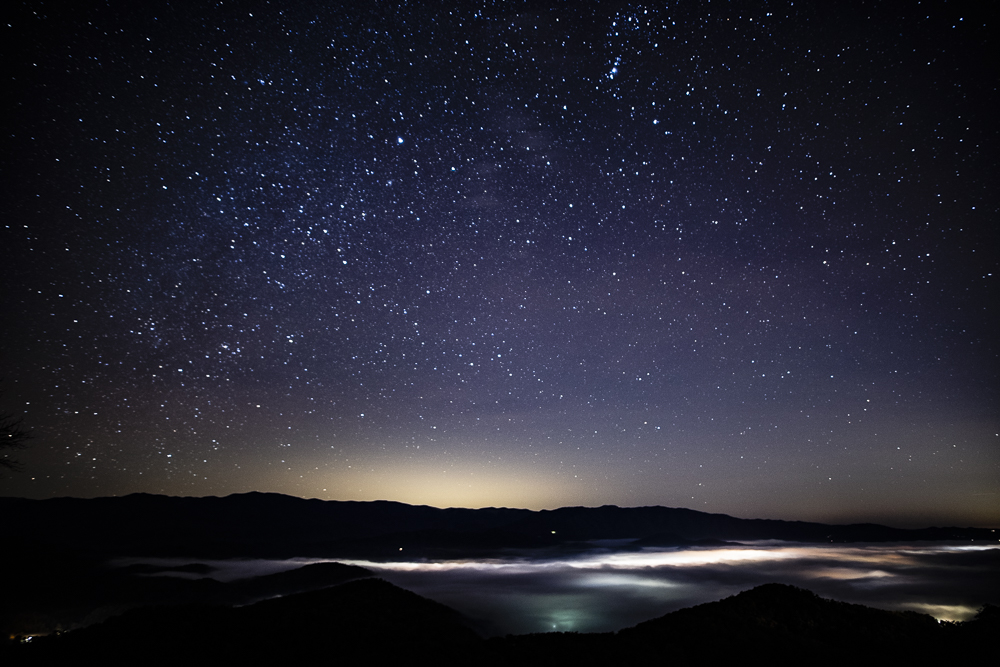
At 5:00 am, there is already commercial aviation coming past on the way from Europe to the Atlanta airport.  I had to watch for them, as this is a twenty second exposure.

Even in a poor year, autumn in the Smokies is beautiful. I really like Townsend, which is distant from the Gatlinburg carnival scene and closer to the real beauty of the park.  It has great restaurants, affordable lodging and a really good coffee house. There you have it.

Paul Schmitt


Monday, October 14, 2019

Double Allium- A Sculpture in Metal and Glass

This is the first time I have devoted a post to just one photo.  It took months to make it. This one photo was the result of a visualization that combined a beautiful metal and a glass sculpture with autumn colors.  It is found in the entry to the Cornell Arboretum's Nevin Welcome Center.

As I viewed the work of Jenny Pickford, a British metal sculptor, I merged the sculpture with the arrival of autumn colors on the Cornell campus.  In the background were maple trees that promised to present some rich reds or oranges.  Some research suggested that in early October, the sun position would bathe the scene with nice side lighting.  The uncontrolled factor was weather.  I needed a day with a lingering sunrise after the sun cleared the trees to the east. It all came together on Friday, October 11 at 8:43 am.


 If the weather had not co-operated,  I guess you'd be waiting until 2020 for the photo.

Paul Schmitt

Saturday, July 27, 2019

Visual Impressions- Cornell Arboretum's Herb Garden

In summer, the Cornell Arboretum offers among the richest array of blooms in the Finger Lakes.  And, in the height of summer, the Herb Garden adjacent to the Nevin Visitor Center is a sure winner.  On two recent visits, I did some portraiture of some beautiful flowering plants.  Join me for a little explore.

Before I even reached the Herb Garden, the bioswale captured my interest. There is a new installation by Jenny Pickford.  I am looking forward to exploring the many ways this presents itself through the seasons and in different lighting.  Visualize it with red maple trees in autumn.

Double Allium


Behind the sculpture in the bioswale, I found some of richest Purple Cone Flowers I can recall ever seeing. 

Purple Cone Flowers


Understandably, I needed to remind myself that the light was excellent, and that I had to get to the Herb Garden while the sun stayed low.  What did I find? 

First on my route was dew-laden Borage.  It has s a tiny blue flower, and offers a pleasant fragrance to boot.

Borage


Sharing the raised flower bed with the Borage were some Corn Poppies which often have a white band on the rim of each petal.


Red and Blue Companions


While the Borage has its share of  bees, the Corn Poppies much offer a richer harvest for the bees. 

Feasting on a Corn Poppy


There are also larger Opium Poppies in the Herb Garden.  The bees find them equally attractive.

Opium Poppy in Among the Lilies


For my friends on the staff at the Cornell Arboretum, thank you for your dedication and creativity.  The same goes to the volunteers who add so much help.  For my fellow photographers in the Finger Lakes, don't pass this up.  It is one of the few arboretums that is open for photography in the beautiful early morning light.  For the rest of my friends, now you know one more reason I love living here.

Paul Schmitt

Monday, July 22, 2019

A Golden Delight- American Goldfinch

It's now the end of July and the male American Goldfinches are flashing their brilliant yellow form as they fly over weedy roadsides, overgrown fields and woodland edges.  I love it. They swirl through the sky with a bobbing up and down flight pattern.  Hardly any females are to be seen.


The Goldfinches have finally begun to nest.  They're a seed eater, and wait until their food supply is peaking to start nesting. July is the time, and the females are sitting tight on the nest. In the last week, I have only seen one female.  

The male is now responsible for harvesting seeds and taking them back to feed the female.  She'll stay firm on the nest to protect their four to six eggs from rain and excess heat, or a marauding chipmunk. 

Right now, their preferred seeds seem to be Spotted Knapweed.  It's the dark dried seed head the bird is perching on.  (The purple blooms are likely Crown Vetch and of no interest to foraging Goldfinches.)   It is really easy to watch them.  I find a remote country road with Knapweed close to the roadway and safely park on the side near their preferred plants.  Sit still for a while and soon their piping song announces their presence. This male Goldfinch has landed on a single stalk with a mature seed head.

The male forages through to find the best heads, and begins a two-step process.  First, he'll open the head to find a good seed.


Then he'll strip away the outer chaff to reach the heart of the seed.  Their beak is very dexterous in peeling away the chaff.


The males waste no time with a seed head that is not perfect, and will quickly move to sample another plant.

You've got to be quick to keep up with their movements.  When their crop is full, they're off to feed their female.  Right now, they can quickly find enough seeds and the feeding is not continuous.  Once the eggs are hatched, the males are feeding their partner plus up to a half dozen small chicks. Feeding will pickup with the females initially staying on the nest, and then as the demand of the growing chicks increases, I will see females joining in the harvesting of the seed. 

Overall, it will be about four weeks from the start of incubation until the nesting is complete and large flocks of Goldfinches will then appear.  It's truly a whirlwind from start to finish.  By autumn all the adults will have molted, and there will be no brilliant yellow finches to be found until next spring.

Paul Schmitt