Thursday, March 7, 2013

CM Ducks?

The old joke has one southern gent saying "C M Ducks", to which his friend argues "M R Knot".  The first counters "S M are,  C M Wangs".  Well, I just love the splendid variety of plumage that our ducks display in breeding season.  So, their most colorful appearances are seen now and it is time to get active with the camera.  I just got back from the Chesapeake Bay region where I worked on adding to my duck images. I think you'll enjoy these few examples.

I've wanted to get close to Canvasback Ducks without any success for some time, and that all changed at my first stop where the ducks were very close. The eyes capture my attention.


I've photographed the American Wigeon before, but I am always discovering new ways to love this dainty little duck.  Note the beautiful feather details along the back and the neck patterning.


Another duck that is in some ways similar to the Canvasback is the Redhead.  Beautiful plumage, brilliant eyes and a distinctive blue and black bill.


None of the above ducks were plentiful, but the Lesser Scaup was almost as commonplace as the Mallard is in all places.  The difficulty was in finding a single example that was alone, but this one  finally came looking at me.  Again I love the eyes.


All of the above were photographed while out in a strong wind at freezing temperatures, but I was lost in the moment and only realized my hands were very cold after an hour.  It was worth the discomfort.  The cold finally won the day, and we headed for out night's lodging.

A day later, I was shooting from a car and had some protection from the cold except for my left  hand that was outside the window.  The skittish ducks are more comfortable around a vehicle, and this allowed me to get my very first images of a long wished for subject- a male Hooded Merganser displaying to a female.


There is more to the story about Hooded Mergansers, but I will save that for a later post.

Last year, I finally got good images of the stylish Pintail Duck, but I still wanted more. On the last evening as the sun set, this pair came screeching in to a protective marsh area.


I'll  share more photos as I have time.

Regards,

Paul


Wednesday, February 27, 2013

Winter's Bucket List

This is not about that ominous "bucket list".  I intend to keep going for a long time, but each winter I do make a sort of "seasonal bucket list" made up of those objectives that always get ignored in warmer seasons.  So my list includes a few books, exploring some new photo techniques and planning my photo travel for the coming year.  This still leaves some time for a few photo outings when the weather allows.

So, in between reading Charles Dickens and Richard Dawkins, I've been exploring some creative applications in my smartphone. The first iPhone app I've looked at is Laminar.  Had it for nearly a year, and had not been able to understand it until a new version was introduced.

The base photo was taken with the front facing iPhone 4 camera and sent to MobilMonet --another pretty neat iPhone app-- where I modified it so the background is monochromatic.

Next I slipped out to my frozen yard and snapped a photo of some dormant grass.  This grass image was put in Laminar as a base layer and the portrait was set on top with a bit of transparency. Seems to capture my thinking about the pause in the plant world.

 Our home has a sun room which is a nice sanctuary on winter days; I can sit there and watch the weather in between pages of a good book.  Right now, one of Pam's orchids has come into bloom bringing real cheer to each winter day. I am just fascinated by orchids.  They are so sensuous in both form and color.  How could I not photograph this? And then, how could I help but explore how to create a greater interpretation? 


Two layers processed on iPhone4.  Lower layer is monochromatic close up.  Upper layer is reduced in opacity to reveal the lower layer.  Laminar app.  Photogene app used to optimize each basic image.

There have been nice days to get out. Recently, we drove up to Sodus Bay on Lake Ontario.  The lighthouse out on the jetty showed the result of high winds and extreme cold in the form of heavy ice.

Initial image from iPhone4, edited in Lightroom4.  As good as the iPhone apps are, they cannot match the result in Lightroom4. And, should the reader get extremely impressed with the smartphone photo capability, here is what my Nikon DSLR gave me at the same location.

The color sensitivity and zoom lens just allowed greater flexibility in matching what the viewer actually saw.  Both nice images, but the iPhone has fewer options for composing the scene.

There is one very nice capability with the iPhone plus versatile apps, and that is exploring strongly interpretive images that step away from traditional "reality". (If there really is such a thing as reality.) So, the creative mind can run wild combining textures and colors.  This is a layering of two wildly dissimilar images - dried winter grasses and thin ice forms. 


So, this is my final post of February.  The bucket list is pretty much completed, and I am ready to burst out with images of birds and blooms. 

Paul Schmitt


Tuesday, January 29, 2013

Falling for Ice

What's to be done when the winter turns bitter cold and the river is filling with ice?  I could get caught up on my reading, or home repairs, or just hibernate.  What could get the creative photographer in me to venture out and face the elements?  Why, it's the magical ice sculptures that appear where ever there is falling water.  I've fallen in love with ice falls and don't mind the cold hands or heavy insulated shoes.

Less than an hour from home is the tallest single-drop falls in the eastern United States- Taughannock Falls.  It's a 215 feet drop. It is one of the few waterfalls that can be safely approached in winter.  This is how my iPhone4 recorded a cold morning below the falls.


(Technical note:  iPhone 4, Pro HDR app, tripod with Joby tripod adapter)

I have also been fascinated with the tones that are revealed when converting the images to monochrome (black and white) images. The above scene depicts those cold but sunny winter days with a blue sky contrasted by the shaded gorge in subtle colors including green, or all things.  Going to monochome creates a different response if the blue is filtered to darken it.


Now it looks cold and stormy.  I've explored this scene in some detail with my Nikon D800, and find some images are more effective with a slight bit of color.


I feel a chill when I look at this image of a small part of the falls. My mind fills with a replay of  the subtle hiss of the falls. At the same time, some of the scenes in monochrome have a pure feeling like this one. 


I think the monochrome above captures  the contrast of the hard, immoveable ice against a streaming ribbon of falling water flashing into a mist of ice crystals.


One inner voice says to me that winter is the one time of the year when monochrome works consistently, so just forget the color until spring comes along. Another voice says no, you've got color, use it. Maybe you, the viewer, can help me?  Your initial reaction is something I cannot capture myself after looking at these so much. Obviously, I cannot keep showing two versions of the same photo.  That becomes boring.


At left is a color rendering of the falls with the light blue and green tones that are found naturally.  I like the sense of cold that it conveys.  I've set the white on the clean show in the upper left corner.


At the right is the same photo processed into monochrome. I like it also. I see more of the forms in the ice and the falling water.  The stream of water seems to have more power. 

There is my conflict. Which to show?  I've looked at these so much that I cannot capture the initial response of a first time viewer.  Which works best for you?  ... or is it a matter of which works best for different scenes?  I welcome any comments on how you first react to these. They will be sincerely appreciated.


Now, I am also experimenting with another way to look at falling water and ice.  At another little waterfall after dark, I illuminated the totally frozen drop with a blue gel filter on a flashlight.  What could make the scene seem any colder than blue light? It was, in fact, brutally cold on my first trial of this method. A little bit of moonlight came in to make it easier to see what I was doing.


This scene can be rendered in black and white, but it does not have the same cold feeling to me. In grey tones, it seems more about forms than about cold.

I'll be back at this lovely little falls when there is a little more flowing water to see what more can be discovered.

Yes, I've fallen in love with ice's elegant forms and its ability to convey a beautiful side of winter.

Paul Schmitt


Wednesday, January 9, 2013

Going South for the Winter

It is January. The snow is a hard, crusty boilerplate.  Some houses in the neighborhood have been abandoned temporarily for a few months of living down south.  Similarly, many birds have left us for Central America or even farther south. I am staying here for the most part and hoping winter will be short.  It is all a matter of perspective, as this writer suggests.

To shorten winter, borrow some money due in spring.

                          W. J. Vogel
 
But, following that plan could result in losing some friends.  Better to tough it out. Winter is also a time of solitude, so I'll catch up on reading and other quiet passions.

For these winter months, the woods seem deserted of the springtime song of courting birds and our bird feeders are seeing waves of birds hungrily seeking suet and oil-rich sunflower seeds. These are the hardy ones, or so I presume.  Maybe they are just intent to get the best nesting spot when spring comes?  Somehow, they have evolved to find shelter and food in a time of want. I treasure these few birds. Winter is no time for the weak, whether man or bird.

Foremost among these hardy ones is the Tufted Titmouse, ever shy even in winter.  It waits in a nearby bush for a moment when the feeder is nearly empty, grabs a seed and again takes refuge in the bush to crack open the sunflower seed.  I've tried to get them to take seed from my hand, and they just cannot bring themselves to land even when the feeder is empty.
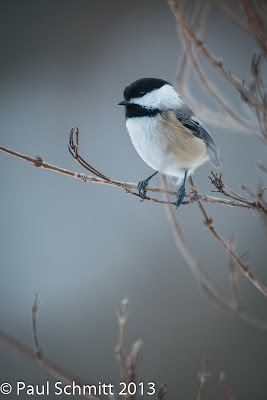

Another of my favorite visitors is the Black-capped Chickadee. They have none of the shyness of the Tufted Titmouse. While tending a feeder today, it only took them a few minutes to begin feeding out of my hand. They are so light that I felt no sense of weight when one landed.  They are precocious, but also discriminating.  Once in my palm, they pick through the seeds to find the plumpest one.  Didn't you always pick the best apple from the bowl?

Perhaps the Chickadee gives an insight into why some birds remain in winter.  They cannot store up fat and that is a requirement for long distance migration.  So, they stay out of necessity and even have to feed on the foulest day to survive.  None of this implies anything about my neighbors who go south each winter.  Really!


I must also add a third winter hold-out that brings joy to us every time that we see it.  The Northern Cardinal shares the shyness of the Tufted Titmouse, and the reason seems pretty obvious. Even on a gray day, the male's color is rich and lustrous. They are an easily seen target for a hungry hawk.  When I get up at first light, they are always on the feeder at the hour when the brilliant red is hard to see.  The same goes for the evening when they are always last  to leave. When he comes in at midday, he grabs a seed and retreats into the nearby bush, again for safety.

So, these are three of the reliable winter guests at our bird feeder.  All are entertaining, and if not rare, are still savored each January. But, sometimes we also get migrants from even farther north. In 2012, we had a rare influx of Snowy Owls from the high arctic. That caused great excitement  to all who were able to see one of these beautiful big owls. Only a few Snowy Owls were seen in our region and people traveled for hours just to see one.

In 2013, another unusual bird has decided it is "Going South for the Winter".  In years when the spruce or beech seed crop fails, the Common Redpoll abandons the boreal forest of northern Canada and comes south to visit us.  Yes, we are living in this bird's "South".  My reference says it commonly survives to -65° F.  That's real winter.

At first sight, a flock of Redpolls looks like a group of House Finches or common Sparrows.  In fact, it is often in a mixed flock with House Sparrows, Goldfinches and maybe a few Pine Siskins.  Where we were content with one Snowy Owl last winter, our group of Redpolls has swelled on some days to over fifty.  We love to watch them. The brilliant red cap on its head and the light red blush on the male's streaked breast are lovely.

They perch in a wonderful array of attitudes, and never stay in place for long.  Getting them in the camera viewfinder and in sharp focus is a frustrating string of failures with only a few successes.


They can be comical as they skip across the snow, scattering snow crystals.


They are a social bird, and often interact in ways left to human conjecture.


This little red capped bird reminds me that winter has many levels.  The Common Redpoll, like the Snowy Owl, makes me admire how animals somehow survive. They do it in a far simpler (but more desperate) way than we can imagine.  Our hard winter is another's average. Going south for the winter now means something new to me.

Accept winter for the joy that spring will bring. It is the season of perseverance.

Paul Schmitt


Tuesday, December 25, 2012

Seeing Winter

Up until today, our winter had not delivered any covering of snow, and the iconic images are just not found on my walks.  Can you still feel the winter without snow?  Well, I think it is easier with a cold blue sky such as I found at Hog Hole on Cayuga Lake last week.

On that day, the blue sky was very transient and I soon was left with the grey sky.  Thankfully, the clouds had some features to them, and I could move to a black and white image that also conveyed a coldness.  What is missing is the feeling of the cold wind coming off Cayuga Lake.


I resisted the temptation to put a bluish cast to the scene. It seems cold already. (This is an iPhone photo, converted to b&w in Lightroom 4. )

A few days later, we had a lot of rain, a freezing night and then some sleet in the morning.  A hike at the nearby Steegee Hill Preserve found another cold image.  Those little white spots are balls of sleet. I can hear them hitting the frozen leaves, making a sound that is unique. It just sounds cold.


Most of the trails are on old logging roads with deep ruts from the heavy log skidder.  The ruts were   filled with water.  Overnight, the pools of water were covered with a thin sheet of ice.  As the rainwater seeped into the ground, a thin filagrie of ice was left, delicately suspended above the damp leaves. 

Today, heavy snow is being forecast to be on its way.  It will be easier to capture the feeling of winter, but perhaps I've found more creativity while facing less iconic weather.  I just wish I did not have to drive thru a snowstorm tomorrow.  Hopefully, I'll still have snow when I get back home.

Paul


Wednesday, December 19, 2012

A Few Views of the Winter Solstice


As I walked through the now barren herb garden at Cornell Plantations last week, the statue of the Yarb Woman seemed perfect for how I feel at the winter solstice.


The Yarb Woman looks over her sleeping garden cleared of all the remnants of cone flower, aster and thyme. Her patina of red and blue seems the only color remaining.

The daylight is brief and the night long. Most days are damp and chilly. Our personal energy seems at a low point.

So, what is this winter solstice revealing to us at what feels like a low point?  We know the sun will return and start a renewal of life.  It seems a time to be optimistic in the face of long nights,  to remember  how we complain about the hottest days and to recall  how the heat can sap our energy.

Beyond the cold, the darkness and the lifeless fields, we know that life is still good.  It is really extraordinary.  The buds lie asleep on the beech and the azalea alike, and their time will come to our delight. Be patient.


This time is also a challenge to a photographer in love with the colorful blooms and the birds of summer. I have to find wonder in the subtleties of the season if I am to photograph.  This blog is my attempt to match the feeling of the solstice to the feelings in the photos.  (All photos taken with Canon G9 or iPhone4s.)

One morning, I took a walk around a nearby pond. The teasels remained for the gold finches to pick apart for seed. To match the feeling, I reduced the color to just a  hint, for the sun only added  a hint of warmth to the day.  That matches how the gold finches' color is also reduced to only a suggestion of their bright yellow breeding colors.

During my walk, the sun made an effort to warm the day, and some color did erupt for my camera's pleasure.  Note the lone green pine tree reflected in the pond beyond the ice.  It is our knowing perseverance.  How welcome is that little bit of green.


Yet, the predominate color is a dull red found in these dead stalks and a cold blue from the sky.  And, I realize it too is the color of the deer in winter. Not the warm honey red of summer, but a darker and more somber hue that makes it easy to walk past and not see the animal standing there.

I realize that I long for the first real snowfall this year to replace the ground's dull browns and to gracefully dress the brown weed stalks.  The last two days' rain would have been more uplifting as snow.  I grew up in the south were snow was the exception, and I did not get to really appreciate its gift to raising the spirits until I came to the New York's Finger Lakes. 


So, today, as I walked my neighborhood, the stark outline of barren oak trees made me pull out my iPhone and record how I felt on a rainy December day when there should have been snow.

I guess I am in a winter solstice sort of funk, and need some snow to brighten up the landscapes and give me reason to pull out the snowshoes for a brisk hike.   Or, maybe I need  to dance around a bonfire?

Paul


Tuesday, November 13, 2012

Bald Eagles Aplenty

Each November, the approaching winter brings about a concentration of Bald Eagles to locations where there is easy fishing. This only lasts three or four weeks for the adults.

I just returned from a three day trip to one such place with good results.  There were easily two hundred Bald Eagles with a mix of adult pairs and juveniles; all were waiting for the hydroelectric units to roar into action and dispense a buffet of stunned fish.  I soon saw that  some were skilled at snatching fish from the river, and some were, well,  not so good. The latter were typically inexperienced juveniles who are now without parents to catch fish for them.  This was a great opportunity to build my skill at tracking the fast moving birds and timing the shutter release for the critical events.  It was basically batting practice for birds-in-flight (BIF photography).  Great fun too.

My first object was to capture the aerobatics of the eagles as they circle overhead.  Not so easy with the narrow field of view of a telephoto lens.  You have to get the lens onto a fast moving bird, lock focus and keep on the bird as it sweeps across the river.


When an eagle spots a fish, it can easily turn quickly and dive down for a closer look.  I love the way that they can throw their legs out and drop the tail to swing around.  Leaves me envious.


Once down to the right elevation, the eagle usually makes a shallow glide to the target and, at the last moment, throw its talons out to snatch the prey.


Those talons present quite a formidable array, and only a few points need to make contact.


I believe this catch was a small Walleye Pike.

The power turbines are usually active at sunrise when electrical usage jumps up.  Having roosted overnight, the birds are hungry.  The early morning activity is pretty intense and the low light a challenge for photography.  But the birds can be beautiful in the soft, warm light.


I think the graceful curves of the wing feathers are especially interesting as they  flex in the moving air.  This is only visible because the camera can freeze the motion.

Now, there is a lesson about survival in the natural world that we should recognize.  There is little room for social graces and politeness when an animal must eat or die. Robbery is a common event among eagles. Here are two juveniles in such a duel.  The trailing bird can fly faster and maneuver more nimbly than the bird with the fish. It easily overtakes the other bird.


Look closely at the first bird's tail. It is a fish's tail, not his.  He's already begun to voice his anger.  It is simply easier to steal a fish than to catch it.  So, juveniles especially attempt this on other juveniles or adults alike.  I saw a particularly good example among two adult eagles.  The attacker is on the left.


As is often the case, the attacker did not get the fish.  You can see it dropping to the river.  The victim voices his anger at the attacker on the left.


You may rightly wonder who got the fish?  Neither.  It sank.  The victim immediately flew off, and the attacker searched without luck.

So, how can an eagle ever get to eat its catch with so many robbers about?  I saw one example that may shed a light on the question.  This bird has a relatively small catfish.  He flew into a densely branched Beech Tree so that any attacker would be limited in approaching.


You can also see that the eagle was pretty vigilant, keeping an eye to the sky.

There is one other aspect of this to address.  With two hundred or more eagles eating several fish a day, who cleans up after all of this?  Eagles don't exactly clean the plate.  Nature has a pretty efficient system for this.  Here it is.


This is a Black Vulture.  A cousin of the Turkey Vulture, it has a taste for fish rather than rodents. So this relatively unusual bird finds it way into a small area around the hydro plant; it is found nowhere else in the area. There are  a comparable number of BVs waiting to dispose of the leftovers from the large number of eagles.  Now,  I know what you are thinking, but what would your life be like if no one took your garbage away?  They are actually very graceful flyers too.  I just would not recommend standing under one of their roost trees.

I'll post my most exciting images later after I have had time to edit all of my photos.

Paul